Dedicated Offshore Development Team
In This Article
- Business growth often creates a difficult technology challenge.
- What Is a Dedicated Offshore Development Team?
- Why Businesses Choose Dedicated Offshore Teams
- Dedicated Team vs Staff Augmentation vs Project Outsourcing
- Staff Augmentation
- Project Outsourcing
- Dedicated Offshore Development Team
- Dedicated Offshore Teams From Murmu Software Infotech
- AI Applications and Automation
- Enterprise CMS and Headless Platforms
- Custom Software, MVP and SaaS Development
- Mobile, QA and DevOps
- How We Build Your Offshore Team
- 1. Discovery and Team Planning
- 2. Role and Skill Definition
- 3. Developer Selection
- 4. Process Integration
- 5. Delivery Governance
- 6. Flexible Scaling
- Security, Confidentiality and Intellectual Property
- How to Evaluate an Offshore Development Partner
- Start Small and Scale With Confidence
- Build Your Long-Term Engineering Advantage
- Ready to Build Your Offshore Development Team?
Build a Scalable Engineering Extension Without Hiring Overhead
Business growth often creates a difficult technology challenge.
Your product roadmap is expanding. Client projects are increasing. AI, cloud, mobile, CMS, integration and security requirements are becoming more complex. However, hiring every specialist internally can take months and increase permanent operating costs.
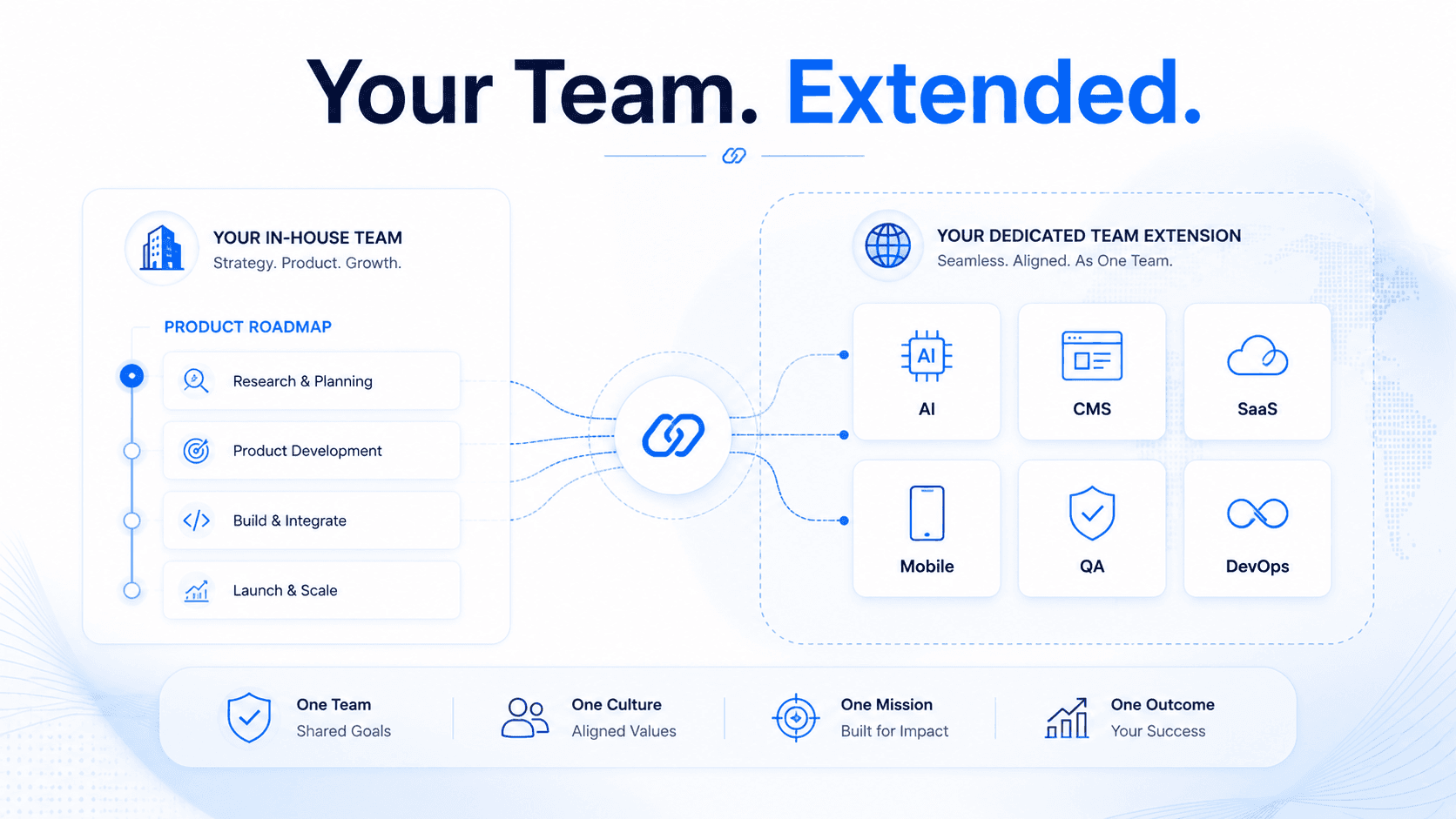
A dedicated offshore development team gives startups, enterprises and digital agencies a practical alternative: a stable group of engineers who work exclusively on your projects while an experienced technology partner manages recruitment, infrastructure, payroll, continuity and team support.
Murmu Software Infotech helps organizations build dedicated offshore teams for AI applications, enterprise CMS, custom software, SaaS platforms, mobile apps, CRM, ERP, integrations, QA and DevOps.
The objective is not simply to provide remote developers. It is to create a reliable engineering extension aligned with your business goals, technical standards and delivery roadmap.
What Is a Dedicated Offshore Development Team?
A dedicated offshore team is a group of software professionals based in another country who work exclusively or primarily for one client.
Unlike project outsourcing, where a vendor controls most delivery decisions, the dedicated-team model gives the client greater control over priorities, workflows, tools and day-to-day execution. The offshore partner typically handles recruitment, HR, payroll, infrastructure and retention while the client directs the product roadmap and evaluates performance.
A dedicated team may include:
- Solution architect or technical lead
- Business analyst or product coordinator
- Frontend and backend developers
- Mobile application developers
- AI and data engineers
- Enterprise CMS specialists
- QA and automation engineers
- DevOps and cloud engineers
- UI/UX designers
The team structure should reflect the product stage, technology stack, delivery risks and expected growth—not a fixed staffing template.
Build Your Dedicated Offshore Team and Scale Delivery Faster
Why Businesses Choose Dedicated Offshore Teams
The strongest benefit is flexibility.
Organizations can add specialized talent when demand increases, scale the team as the roadmap evolves and avoid the disruption of repeatedly hiring and releasing permanent employees. Offshore teams can also provide access to engineering capabilities that are difficult to recruit locally, including AI, cloud, cybersecurity, enterprise CMS, data engineering and DevOps.
A properly structured offshore team can help businesses:
- Accelerate product and feature delivery
- Reduce recruitment and onboarding delays
- Access specialized engineering expertise
- Control long-term development costs
- Improve delivery continuity
- Strengthen QA and documentation
- Extend productive development hours
- Keep internal leadership focused on strategy and customers
The model is particularly useful when development is continuous rather than limited to a single fixed-scope project.
Dedicated Team vs Staff Augmentation vs Project Outsourcing
These models are related but not identical.
Staff Augmentation
Individual developers temporarily join an existing team to address short-term capacity or skill gaps. The client normally manages each resource directly.
Project Outsourcing
A vendor receives a defined project and is responsible for delivering agreed outcomes. The vendor usually controls the team and execution process.
Dedicated Offshore Development Team
A stable, integrated team works on the client’s long-term roadmap. The client maintains strategic and operational control while the offshore partner manages staffing, administration and continuity.
Choose a dedicated team when you need long-term product knowledge, predictable availability and an engineering unit that becomes part of your operating model.
Dedicated Offshore Teams From Murmu Software Infotech
As a trusted software technology partner, Murmu Software Infotech builds teams around the client’s actual business and technical requirements.
AI Applications and Automation
Our AI solutions development capabilities include:
- AI agents and assistants
- MCP servers and connected tools
- Retrieval-augmented generation systems
- Enterprise AI search
- Custom chatbots
- Workflow automation
- OpenAI, Claude and Gemini integrations
- AI-powered web and mobile applications
A dedicated AI team can include Python or backend engineers, frontend developers, data specialists, QA and cloud support.
Enterprise CMS and Headless Platforms
We support Sitecore CMS, SitecoreAI, XM Cloud, Umbraco, Optimizely, Sanity, Strapi, Contentful and Next.js-based headless experiences.
Our enterprise healthcare migration to Sitecore XM Cloud and Next.js demonstrates experience with complex content platforms, reusable frontend components, integrations and AI-powered search.
Custom Software, MVP and SaaS Development
Dedicated teams can build and maintain:
- Custom business applications
- SaaS platforms
- MVP and AI MVP products
- Enterprise portals
- Workflow systems
- Dashboards and analytics
- CRM and ERP applications
- Marketplace platforms
- API-connected ecosystems
Our DOC247 telemedicine platform case study reflects experience contributing to scalable healthcare workflows, mobile experiences and video-consultation capabilities.
Mobile, QA and DevOps
Teams can also include React Native or Flutter developers, automation QA engineers, cloud specialists and DevOps professionals responsible for CI/CD, infrastructure, deployment and monitoring.
Successful dedicated teams usually combine development with QA, delivery oversight and operational support rather than relying only on software developers.
How We Build Your Offshore Team
1. Discovery and Team Planning
We begin with your business objectives, product roadmap, architecture, delivery timeline and required technologies.
2. Role and Skill Definition
We define the appropriate team structure, seniority, responsibilities, communication model and time-zone overlap.
3. Developer Selection
Relevant candidates are screened for technical expertise, problem-solving ability, communication and project compatibility. You can review and approve resources before onboarding.
4. Process Integration
The team joins your preferred tools and workflows, including Jira, Azure DevOps, GitHub, Slack, Microsoft Teams and CI/CD systems.
5. Delivery Governance
Regular stand-ups, sprint reviews, code reviews, documentation, QA reports and delivery metrics provide visibility and accountability.
6. Flexible Scaling
The team can expand with additional developers, QA, DevOps, AI or CMS specialists as priorities change.
A structured onboarding process should cover documentation, repositories, coding standards, communication routines, access controls and shared working hours.
Security, Confidentiality and Intellectual Property
Before engaging an offshore team, businesses should clearly define:
- NDA and confidentiality requirements
- Source-code and intellectual-property ownership
- Repository and environment access
- Data protection responsibilities
- Device and identity controls
- Secure development practices
- Client non-solicitation terms
- Exit and knowledge-transfer procedures
An NDA alone may not establish complete IP ownership. Contracts should explicitly document how intellectual property transfers from each engineer through the offshore provider to the client.
For agencies, MSI can also operate as a White Label Software Development Partner for Agencies and Enterprises, delivering under the agency’s brand while protecting its client relationships.
Extend Engineering Capacity Without Increasing Permanent Hiring Overhead
How to Evaluate an Offshore Development Partner
Do not select a provider solely on hourly rates.
Evaluate:
- Relevant technical and industry experience
- Candidate screening and replacement process
- Communication and time-zone alignment
- Architecture, QA and DevOps capability
- Security and IP-protection terms
- Team scalability and retention
- Project visibility and reporting
- Client references and case studies
- Post-launch support capability
- Alignment with your company culture
Strong offshore partnerships depend on communication, cultural compatibility, security, transparent pricing and long-term team integration.
Start Small and Scale With Confidence
You do not need to begin with a large engineering department.
Start with:
- One dedicated developer
- A small cross-functional product team
- A technical discovery sprint
- A defined MVP module
- A CMS migration assessment
- An AI proof of concept
Qualified partners can also review our white-label and development partnership offers for lower-risk ways to evaluate communication, engineering quality and delivery performance.
Build Your Long-Term Engineering Advantage
A dedicated offshore development team should not feel like an external vendor working at a distance.
It should operate as an extension of your organization—aligned with your roadmap, culture, tools, standards and measurable outcomes.
Murmu Software Infotech combines AI, enterprise CMS, custom software, SaaS, mobile, CRM, ERP, QA and DevOps capabilities to help organizations build and scale reliable offshore engineering teams.
Your roadmap. Your control. Our dedicated engineering expertise.
Ready to Build Your Offshore Development Team?
Discuss your required skills, team structure, timeline and delivery goals with Murmu Software Infotech.
Schedule a Team Planning Call
Frequently Asked Questions
What is a dedicated offshore development team?
A dedicated offshore development team is a stable group of software professionals based in another country who work exclusively or primarily on one client's products and projects. The team follows the client's roadmap, tools, coding standards and delivery process.
Who should hire a dedicated offshore development team?
The model is suitable for startups, SaaS companies, digital agencies, enterprises and product organizations that need long-term engineering capacity, specialized skills or faster scaling without permanently hiring every role internally.
What roles can MSI provide in a dedicated offshore team?
MSI can provide solution architects, technical leads, business analysts, frontend developers, backend developers, mobile engineers, AI specialists, enterprise CMS developers, QA engineers, DevOps professionals and project coordinators.
How is a dedicated team different from staff augmentation?
Staff augmentation usually adds individual resources to fill short-term gaps. A dedicated team is a stable cross-functional unit built around a long-term roadmap, shared delivery goals and continuous product knowledge.
How is a dedicated team different from project outsourcing?
Project outsourcing focuses on delivering a defined scope managed largely by the vendor. In a dedicated-team model, the client has greater control over priorities, processes, technical direction and day-to-day execution.
Can MSI provide offshore AI developers?
Yes. MSI can provide AI engineers for AI agents, MCP servers, RAG applications, custom chatbots, intelligent search, workflow automation and integrations with OpenAI, Claude, Gemini, APIs and enterprise data.
Can MSI provide enterprise CMS developers?
Yes. MSI provides developers for Sitecore CMS, SitecoreAI, XM Cloud, Umbraco, Optimizely, Sanity, Strapi, Contentful and headless CMS implementations using Next.js, React, GraphQL and APIs.
Can the offshore team use our tools and processes?
Yes. The team can work through the client's Jira, Azure DevOps, GitHub, Slack, Microsoft Teams, repositories, CI/CD pipelines, sprint process, coding standards and reporting model.
Can a dedicated offshore team scale over time?
Yes. An engagement can begin with one developer or a small product squad and expand with additional engineering, QA, DevOps, AI, CMS or technical leadership roles as the roadmap changes.
How does MSI protect confidentiality and intellectual property?
Engagements can include NDA, explicit intellectual-property ownership, secure repository access, role-based permissions, device and identity controls, client non-solicitation terms and documented knowledge-transfer procedures.
Can agencies use MSI as a white-label offshore team?
Yes. MSI can work confidentially behind an agency's brand while the agency retains its client relationship, commercial ownership, communication structure and strategic control.
Does MSI provide ongoing support after development?
Yes. MSI provides QA, DevOps, deployment support, bug fixing, enhancements, performance optimization, maintenance, AMC and long-term modernization services.