White Label Development
White-Label Software Development Partner for US Agencies
PPrem M.6 Min Read

A promising client asks your agency for more than your current delivery team can handle.
Maybe it is a SaaS platform instead of a marketing website. An AI application instead of a campaign. A customer portal, mobile app, enterprise CMS implementation, CRM integration or complex custom software project.
You have two choices:
Say no—or find the engineering capacity to deliver it confidently.
That is where a white-label software development partner for US agencies becomes valuable.
But agency owners understandably hesitate.
Will the development company contact our client directly? Who owns the code? Will quality damage our reputation? How do we protect margins? What happens when our pipeline slows? Can an offshore team communicate effectively with US stakeholders?
A serious white-label partnership should answer those questions before asking your agency to commit.

Expand agency capacity with a trusted white-label engineering team while protecting client ownership, margins, communication, and delivery quality.
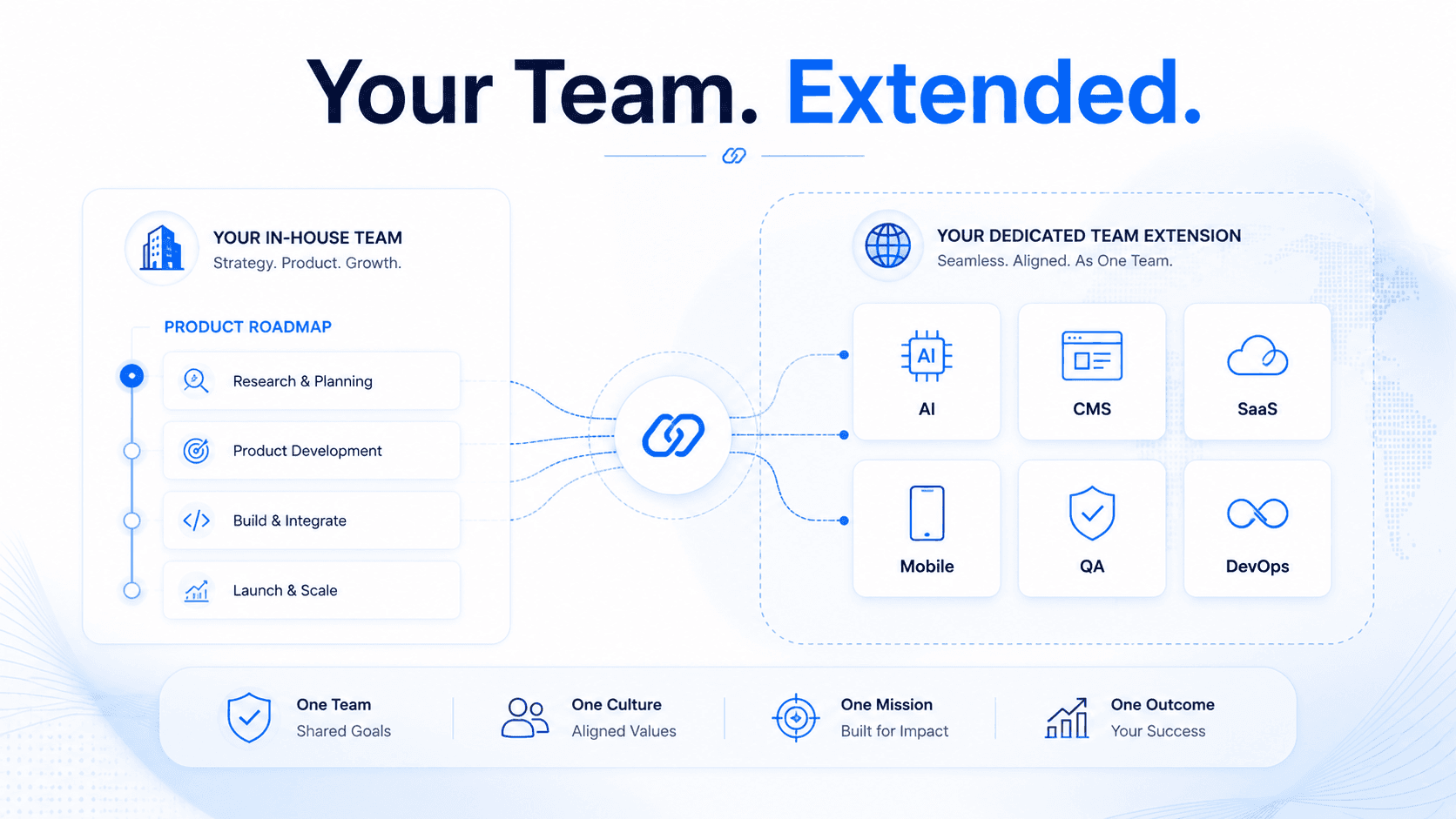
A white-label development partner works as the engineering team behind your agency.
Your agency retains:
The development partner provides the technical execution required to deliver the project.
From the end client's perspective, the software is delivered by your agency.
Infomaze describes the model similarly: the agency remains the face of the engagement while the engineering company works behind the scenes. Tretanz likewise emphasizes delivery under the agency's brand while preserving the original client relationship.
This lets design, branding, marketing, SEO and digital agencies expand into software engineering without immediately building every capability internally.
Explore our broader White-Label Software Development Partnership model for agencies and enterprises.
The biggest advantage is not simply cheaper development.
It is variable engineering capacity.
Suppose your agency wins three development-heavy projects this quarter.
Hiring multiple full-time engineers means recruiting before you know whether the same volume will exist six months later.
A white-label model allows you to increase development capacity when projects are won and reduce it when demand changes.
Bytes Technolab emphasizes this ability to expand and contract development capacity according to project demand, while Acquaint positions white-label teams as a way to overcome hiring delays and inconsistent freelance capacity without increasing permanent overhead.
That can help an agency pursue larger opportunities without carrying a permanently oversized technical team.
This is often the most important question.
The safest arrangement is one where client-contact rules are established contractually before development starts.
Your agreement should define:
Who communicates with the client, when technical engineers may join calls, which brand is used, and whether direct solicitation is prohibited.
Some partners remain completely invisible. Others can attend technical calls as members of the agency's extended team when requested.
Infomaze explicitly says it stays behind the scenes unless the agency requests direct involvement, while Bytes Technolab says client relationships remain with the agency and deliverables carry the agency brand.
At Murmu Software Infotech, the current white-label model is similarly positioned around complete brand ownership, with code, documentation and deliverables provided under the partner agency's brand.
Never leave this ambiguous.
Before the first sprint, establish ownership of:
A mature white-label agreement should also cover confidentiality, repository access and handling of sensitive client information.
Bytes Technolab explicitly combines NDA protection with full IP ownership for its agency clients, while Abbacus recommends NDAs, restricted access, secure communication and managed source repositories as part of white-label partner evaluation.
Trust should be written into the operating model—not left to verbal assurances.
Margin is not created merely by finding the lowest hourly developer.
A low-cost team that causes missed deadlines, rework or client escalations can destroy profitability.
The stronger calculation is:
Client price − complete delivery cost − agency management overhead − project risk = real margin.
A capable partner helps reduce the hidden costs associated with recruitment, bench time, specialist hiring and coordinating multiple freelancers.
White-label development can also let agencies sell services beyond their internal expertise.
For example, a marketing or design agency could expand into:
Agencies needing modern frontend capacity can also explore our White-Label React & Next.js Development Partnership.
The right model depends on how predictable your pipeline is.
| Model | Best For |
|---|---|
| Project-Based | One defined client project |
| Dedicated Developer | Consistent work requiring one specialist |
| Dedicated Team | Multiple projects or ongoing development |
| Team Extension | Adding specialists to an existing agency team |
| Retainer / Reserved Capacity | Recurring monthly client work |
| Specialist White-Label Partner | CMS, AI, mobile or enterprise technology requirements |
Abbacus distinguishes full-service delivery, specialist teams, staff augmentation and hybrid models, while Infomaze separates project delivery, dedicated teams and staff augmentation according to the amount of ownership the agency wants to retain.
For enterprise CMS agencies specifically, our White-Label Sitecore & XM Cloud Development Partner model supports specialist delivery without forcing agencies to maintain permanent Sitecore capacity.
Offshore development fails when communication is treated casually.
A professional partnership should establish:
Kwiqwork, for example, advertises daily overlap with US/EU teams and delivery inside clients' existing Slack, Jira and GitHub environments. Abbacus similarly identifies communication structure and transparent escalation as central to successful white-label relationships.
The objective is not to pretend the teams are in the same location.
It is to make collaboration predictable enough that location stops mattering.
One of the simplest ways to reduce white-label risk is to start smaller.
Tretanz recommends a bounded pilot before moving into retainers or pods. Kwiqwork similarly offers a pilot-first model rather than requiring an immediate long-term commitment.
Your first engagement could be:
One landing platform. One integration. One MVP module. One sprint. One dedicated engineer.
Evaluate:
Communication → technical judgment → code quality → QA → documentation → delivery reliability.
Then expand.
A white-label partner should earn more of your pipeline rather than demanding it upfront.
Ask prospective partners:
Will you sign appropriate confidentiality agreements?
Who owns the source code?
Will you contact our clients without permission?
Can our technical team interview your developers?
Can you work inside our project-management and Git workflow?
How do you handle QA?
What happens if a developer becomes unavailable?
Can capacity increase when we win a major account?
Can we reduce capacity when demand falls?
Who owns production support after launch?
Technical depth matters too.
Abbacus recommends evaluating architecture, APIs, cloud expertise, database design, security and scalability rather than relying only on portfolio screenshots.
That distinction becomes especially important when your agency begins selling software that is more complex than standard website development.
The strategic value of white-label development is simple.
Your agency should not have to turn down a profitable client because the required engineering capability is not currently on payroll.
Murmu Software Infotech provides white-label engineering across custom software, SaaS, .NET, Node.js, React, Next.js, mobile apps, enterprise CMS, CRM, ERP, AI solutions, integrations and ongoing development support. Its current partnership model includes dedicated developers, scalable engineering teams and project-based delivery designed to operate under the agency's brand.
For agencies specifically expanding offshore delivery capacity for North American clients, see our Offshore Software Development Partner for USA & UK Agencies.
The right white-label software development partner should help your agency:
Win larger projects. Protect client ownership. Preserve margins. Add technical capability. Scale without permanent hiring.
Do not start with a large commitment.
Start with one requirement. Validate the partnership. Then scale based on delivery.
Bring the opportunity, client relationship and strategy.
Let an experienced engineering team provide the technical capacity behind the scenes.
A white-label software development partner provides engineering services behind a US agency's brand. The agency retains its client relationship, commercial ownership and strategic direction while the development partner handles agreed technical delivery.
The agency wins and manages the client while the white-label partner provides developers, QA, DevOps or complete technical delivery. Work can be performed inside the agency's existing Git, project management and communication workflows.
Client-contact rules should be defined before the engagement begins. A true white-label model can keep the engineering provider behind the scenes or allow developers to join technical calls only when the agency authorizes it.
Source-code and intellectual-property ownership should be explicitly defined in the contract. Agencies should confirm ownership of code, documentation, designs, APIs, repositories and project deliverables before development starts.
It can improve margins by allowing agencies to add engineering capacity when projects are won without permanently carrying recruitment, payroll and bench costs. Actual profitability depends on client pricing, delivery cost, management overhead and project efficiency.
Services can include custom software, SaaS platforms, React and Next.js development, .NET and Node.js applications, mobile apps, AI integrations, enterprise CMS, APIs, CRM and ERP integrations, QA, DevOps and ongoing support.
Yes. US agencies can work with India-based white-label engineering teams using scheduled US-hour overlap, shared project tools and asynchronous development while retaining their own branding and client ownership.
Project-based delivery suits defined client projects, dedicated developers suit recurring specialist work, dedicated teams suit ongoing pipelines, and reserved-capacity or retainer models can support predictable monthly development demand.
Evaluate relevant technical experience, communication, code quality, QA, DevOps, confidentiality, IP ownership, resource continuity, scalability, client-contact rules and the ability to integrate into your existing workflow.
Start with a controlled project, module, sprint or developer engagement. Evaluate communication, technical judgment, code quality, documentation and delivery reliability before assigning larger client projects or expanding the team.