Development / CMS
Sitecore Development Services for Enterprises: Complete 2026 Guide
PPrem Murmu5 Min Read
Enterprise digital experience is evolving rapidly. Businesses today are expected to deliver fast, personalized, omnichannel experiences while maintaining scalability, security, and operational efficiency.
For many organizations, traditional content management systems are no longer enough.
This is where Sitecore development services become a strategic investment.
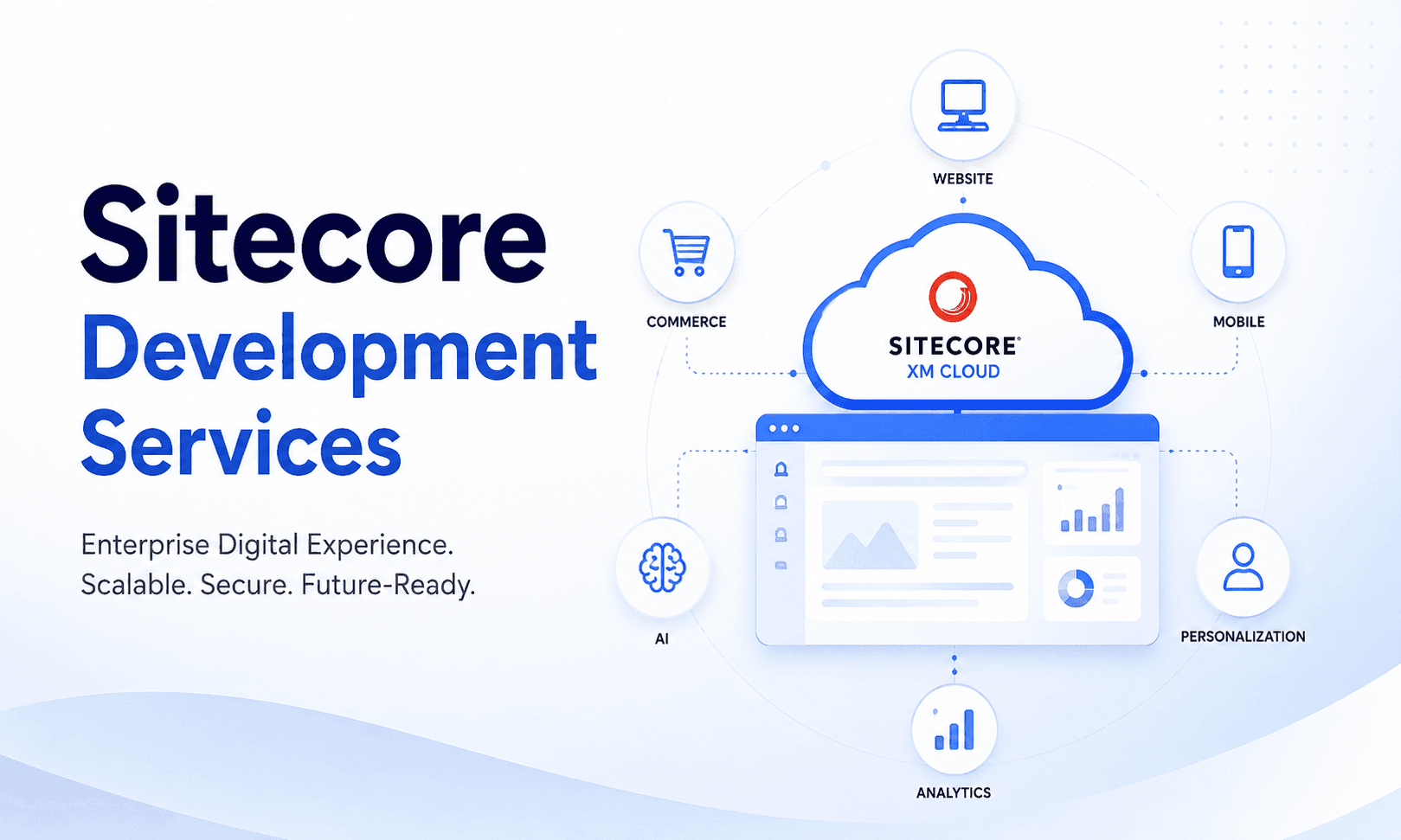
From enterprise content management and personalization to AI-driven customer experiences and headless architecture, Sitecore has become one of the leading digital experience platforms (DXP) for global enterprises. Modern organizations are increasingly adopting XM Cloud, headless CMS architecture, and AI-powered workflows to remain competitive in 2026.
However, implementing Sitecore successfully requires more than technology—it requires the right strategy, architecture, and implementation partner.
This guide explores how enterprises are leveraging Sitecore CMS development services, the challenges they face, and how the right Sitecore development company can help drive growth, scalability, and measurable business outcomes.
Many enterprises invest heavily in digital transformation but continue facing operational and performance bottlenecks.
Common challenges include:

Transform your digital ecosystem with Sitecore, XM Cloud, headless architecture, AI personalization, enterprise integrations, and scalable experiences built for growth.
Legacy CMS platforms often require expensive hosting, maintenance, upgrades, and infrastructure management. Organizations struggle to optimize operational costs while scaling digital experiences globally.
Enterprise websites with complex architectures frequently experience slower load times, poor Core Web Vitals, and inconsistent user experiences.
This directly impacts:
Many businesses still operate on older Sitecore XP environments. Upgrading or migrating to XM Cloud requires careful planning, content restructuring, and modern headless implementation strategies.
Without expertise, projects become risky, expensive, and delayed.
Modern customers interact across multiple touchpoints:
Traditional CMS systems often fail to deliver seamless omnichannel experiences.
Advanced Sitecore implementations require expertise in:
Finding experienced professionals internally is difficult and expensive.
Digital experience is no longer just a marketing initiative—it directly impacts business growth.
Organizations with faster, scalable, personalized platforms gain significant competitive advantages.
Customers expect:
Businesses that fail to deliver lose engagement and conversions.
Modern cloud-native architectures like XM Cloud help enterprises:
Marketing and digital teams need agility.
Modern Sitecore CMS development solutions enable:
Sitecore’s evolving AI capabilities help organizations deliver:
This significantly improves engagement and retention.
Modern enterprises are increasingly shifting toward composable and headless digital experience platforms.
Sitecore is not just a CMS.
It is a complete enterprise digital experience platform that combines:
XM Cloud is Sitecore’s SaaS-native, cloud-based CMS platform.
Benefits include:
Organizations migrating to XM Cloud often reduce long-term maintenance costs while improving agility.
Headless architecture separates frontend and backend systems.
This enables businesses to:
Technologies commonly used include:
AI is becoming central to enterprise content operations.
Modern Sitecore implementations increasingly leverage:
This helps enterprises scale content operations efficiently.
Choosing the right CMS architecture is critical for long-term scalability.
| Capability | Traditional CMS | Modern Sitecore Stack |
|---|---|---|
| Scalability | Limited | Enterprise-grade |
| Omnichannel Delivery | Weak | Strong |
| Personalization | Basic | Advanced AI-driven |
| Performance | Moderate | High-speed headless |
Traditional systems often struggle with:
Modern Sitecore solutions solve these limitations with cloud-native, composable architecture.
Successful enterprise implementations require specialized services.
Implement scalable, cloud-native digital platforms using modern SaaS architecture.
Migrate legacy Sitecore XP environments to XM Cloud while minimizing downtime and risk.
Build fast, scalable frontend experiences using:
Connect Sitecore with:
Improve:
Continuous monitoring, optimization, security updates, and scalability improvements are essential for enterprise stability.
Technology alone does not guarantee success.
Choosing the right Sitecore development company significantly impacts project outcomes.
A reliable implementation partner helps organizations:
Modern implementations require deep knowledge of cloud-native architecture and headless CMS.
Large-scale implementations require structured processes, scalability planning, and enterprise-grade execution.
AI-powered digital experience is becoming a major competitive advantage.
Enterprises often need:
The best partners provide both technical execution and strategic guidance.
At Murmu Software Infotech, we help enterprises modernize their digital experience ecosystem with scalable Sitecore solutions.
Our expertise includes:
In 2026, enterprise digital experience success depends on:
Businesses relying on outdated CMS systems will struggle to compete.
Modern Sitecore development services help enterprises deliver faster experiences, reduce operational complexity, and create scalable digital ecosystems that support long-term growth.
The organizations that succeed will not simply adopt new technology—they will implement the right architecture with the right strategic partner.
Planning a Sitecore upgrade, XM Cloud migration, or enterprise digital transformation initiative?
✔ Architecture assessment
✔ XM Cloud migration roadmap
✔ Performance optimization insights
✔ Cost reduction opportunities
✔ AI & personalization recommendations
Connect with our Sitecore experts today and build a scalable digital experience platform for the future.
Enterprise Sitecore development services include Sitecore implementation, XM Cloud development, headless architecture, migration, integrations, personalization, performance optimization, support, and ongoing platform modernization.
Enterprises use Sitecore development services to build scalable digital experiences, improve website performance, support omnichannel delivery, integrate business systems, and modernize legacy CMS architecture.
Sitecore XM Cloud is Sitecore's cloud-based headless CMS platform for managing and delivering digital experiences with SaaS-based operations, composable architecture, and modern developer workflows.
Current Sitecore documentation states that XM Cloud is now SitecoreAI in the evolving platform terminology. Existing implementations, documentation, code examples, and search queries may still use the XM Cloud name.
| Restricted |
| Highly composable |
| Infrastructure Management | High | Reduced with XM Cloud |
| AI Integration | Minimal | Extensive |
| Future Readiness | Limited | Cloud-native |
Modern Sitecore headless development commonly uses Next.js, React, GraphQL, JavaScript or TypeScript SDKs, APIs, and Experience Edge for scalable frontend and content delivery.
Yes. Enterprises can migrate from legacy Sitecore environments to modern cloud-based architectures, but the process requires assessment, content migration, architecture planning, frontend modernization, integration review, and testing.
Sitecore can be integrated with CRM systems, ERP platforms, commerce platforms, marketing automation tools, analytics systems, search platforms, APIs, and other enterprise business applications.
Headless Sitecore separates the content backend from the frontend, giving enterprises greater flexibility, faster frontend development, reusable content delivery, omnichannel capabilities, and modern architecture options.
Enterprises should evaluate Sitecore expertise, XM Cloud or SitecoreAI experience, headless development capability, migration experience, integration expertise, enterprise delivery processes, support models, and strategic consulting.
Yes. Ongoing Sitecore support can include performance monitoring, security updates, bug fixes, integration maintenance, deployment improvements, scalability planning, and continuous platform optimization.