How an AI Manufacturing Cost Calculator Helps Manufacturers Quote Faster, Protect Margins, and Win More Business
In This Article
- Why Manufacturing Cost Estimation Software Matters
- How AI Manufacturing Cost Calculator Software Changes RFQ Workflow
- AI Product Costing Software Can Accelerate RFQ Quotations
- Turn Costing Into a Commercial Advantage
- Manufacturing Margin Analysis Before Sending a Quote
- BOM Costing Software and Should-Cost Analysis
- Manufacturing Quotation Software Should Connect With Existing Systems
- AI Manufacturing Costing Case Study: From Spreadsheet to Intelligence
- Cost and Timeline Factors for AI Costing Software
- Turn Manufacturing Costing Into Revenue Capability
- Ready to Modernize Your Manufacturing Costing?
- Frequently Asked Questions
- What is an AI manufacturing cost calculator?
- How can AI product costing software speed up quotations?
- Can manufacturing costing software replace Excel?
- What is RFQ quotation automation?
- Can manufacturing costing software perform scenario analysis?
- What is should-cost analysis in manufacturing?
Discover how AI manufacturing cost calculator software speeds up RFQs, standardizes product costing, protects margins and improves quotation capacity.
A customer sends an RFQ today. How long does it take your organisation to understand the requirement, calculate the true manufacturing cost and send a commercially viable quotation?
For many manufacturers the problem is not the costing formula itself but everything required before that number can be trusted
Material rates may sit in one spreadsheet, BOM data comes from engineering, machine and labour costs come from production, procurement provides supplier prices, finance defines overheads, sales waits for the final margin and quotation.
The result is often:
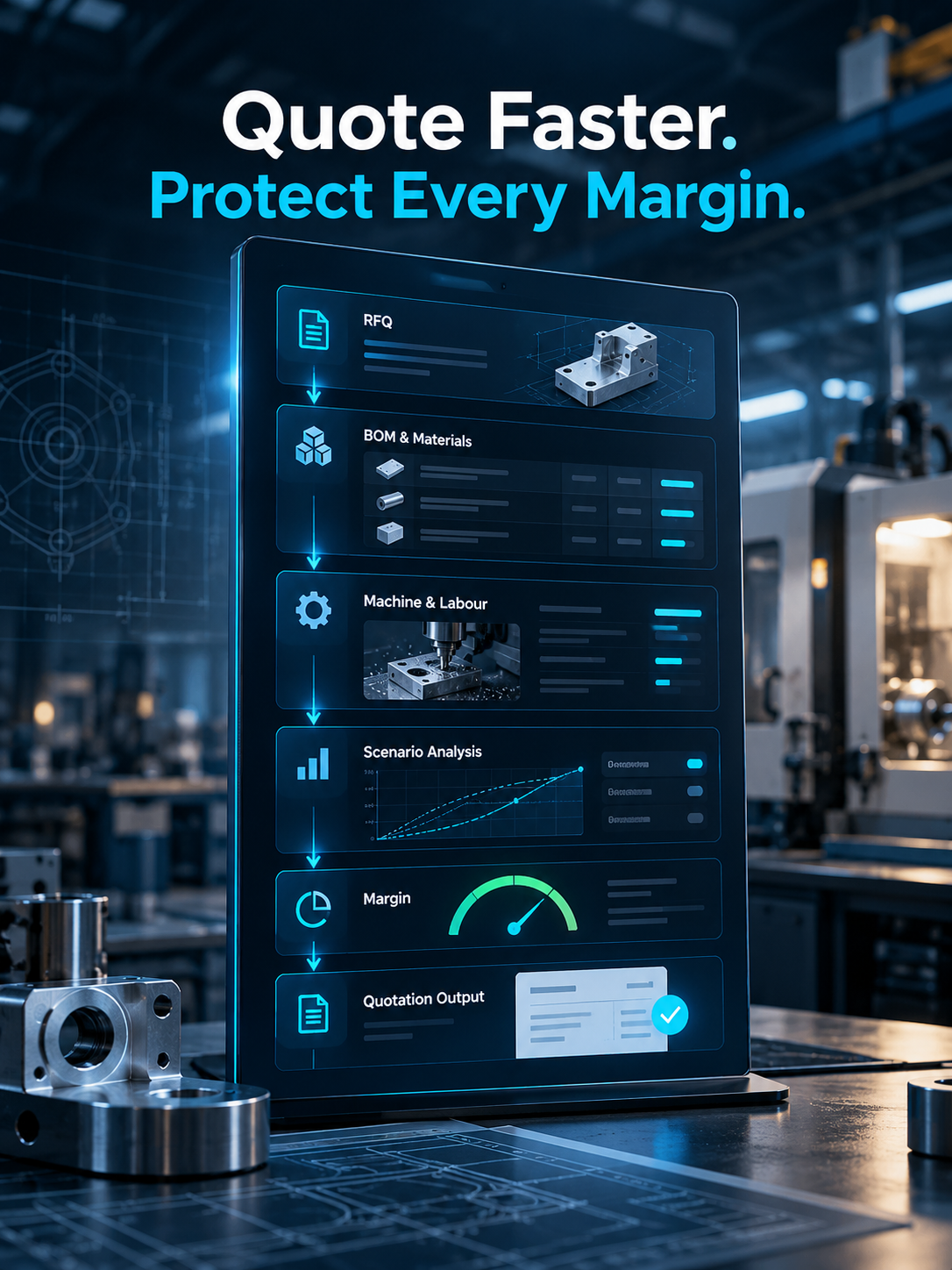
RFQ → Engineering → BOM → Material → Machine & Labour → Overhead → Margin → Quotation
Each manual handoff can slow the commercial response.
Why Manufacturing Cost Estimation Software Matters
Spreadsheet-based costing can work when quotation volumes and product complexity are limited.
As operations grow, however, teams may maintain different formulas, assumptions, material rates and historical files. Rebuilding estimates repeatedly also creates dependency on experienced employees who know where previous costing information is stored.
A structured manufacturing cost estimation software platform can centralize cost masters and calculation rules covering:
- BOM and raw materials
- scrap and wastage
- machine time
- labour
- manufacturing processes
- tooling and subcontracting
- quality inspection
- factory overhead
- packaging and logistics
- services and installation
- markup and gross-margin rules
The objective is not simply to replace Excel. It is to create a repeatable commercial costing process.
Quote Faster. Protect Every Margin.
Turn RFQs into accurate cost estimates, scenario comparisons and profitable quotations with AI-assisted manufacturing costing built around your workflow.
How AI Manufacturing Cost Calculator Software Changes RFQ Workflow
The strongest architecture unites artificial intelligence assistance and constrained financial computations.
A working example of such a chain might be:
RFQ / Requirement → AI Requirement Analysis → BOM + Processes → Deterministic Cost Engine → Cost Breakdown → Scenario Analysis → Margin → Quotation
Within this system, AI-powered interpretation of RFQs, extraction of requirements, identification of potential missing elements of costs, historical comparisons, and drivers explanation are performed.
Meanwhile, AI is excluded from governing total costs – they are determined by underlying mathematical algorithms, rates, and business rules.
Such a solution satisfies manufacturers’ needs in prescriptive, non-obscure quotation generation while still delivering the benefits of artificial intelligence.
MSI’s AI Manufacturing Cost Calculator is the embodiment of this architectural approach.
AI Product Costing Software Can Accelerate RFQ Quotations
The impact of time saved on costing has a direct effect on quotation capacity
At the start of every new RFQ when the estimator starts with a blank spreadsheet, considerable time may be spent identifying material prices, similar past jobs, machine rates and manufacturing assumptions.
Instead, AI product costing software can recall approved masters and historical estimates.
For a recurring or similar product, the team could recover an earlier estimate, amend quantities or material rates, apply current process costs and recompute the commercial position.
This changes the business equation:
Faster Costing → Faster Quotations → More RFQs Processed → More Opportunities Pursued
The benefit is not a guaranteed win rate. It is the ability to respond to more viable opportunities without proportionally increasing manual costing effort.
Quote Faster With AI-Powered Manufacturing Costing and Margin Control
Turn Costing Into a Commercial Advantage
Move from scattered spreadsheets to one intelligent workflow for manufacturing cost estimation, scenarios, margins and quotations.
Book a Manufacturing Costing Demo
Manufacturing Margin Analysis Before Sending a Quote
Fast quotations are useful only when the economics are understood.
Consider three questions:
What happens if SS316 increases by 8%?
What selling price maintains an 18% gross margin?
What happens when volume changes from 5,000 to 10,000 units?
A scenario engine can recalculate those variables without changing the original estimate.
This allows procurement to compare supplier assumptions, production teams to evaluate process alternatives, finance to understand margin effects and sales to know how far a negotiation can move before profitability falls below an approved threshold.
That makes manufacturing margin analysis part of the quotation workflow rather than an after-the-fact finance exercise.
BOM Costing Software and Should-Cost Analysis
A useful product cost calculator for manufacturing should also explain why the product costs what it does.
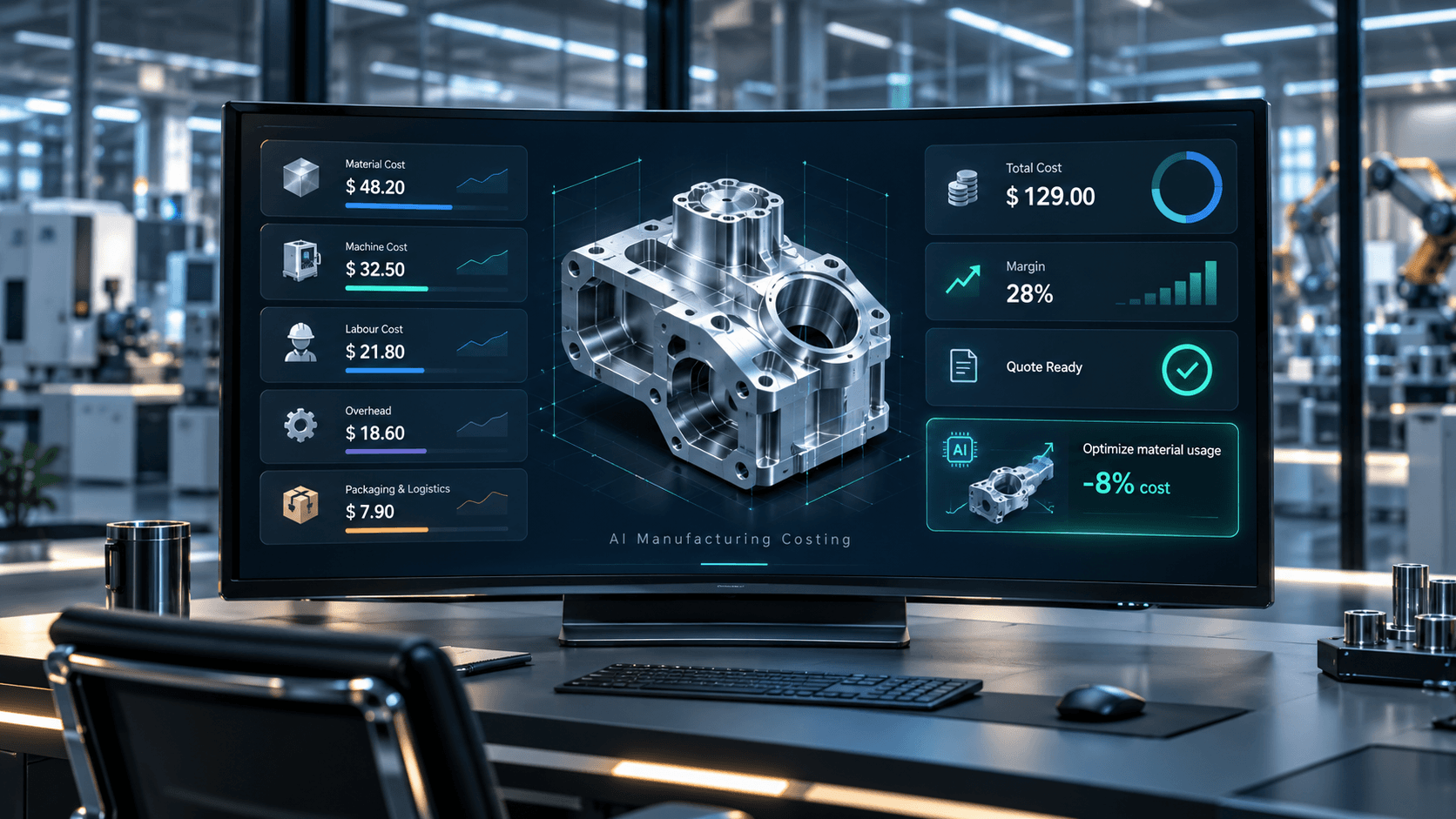
Teams should be able to see material, labour, machine, process, overhead, packaging and logistics contributions separately.
This supports questions such as:
- Which material drives the largest share of product cost?
- Which process is most expensive?
- How does this estimate compare with the last quotation?
- Would another supplier materially change total cost?
- How does a larger production quantity affect unit economics?
Over time, historical costing data can support should-cost analysis manufacturing, sourcing discussions and broader manufacturing cost optimization.
Manufacturing Quotation Software Should Connect With Existing Systems
Costing should not become another isolated application.
Where appropriate, manufacturing quotation software can connect with ERP, procurement, CRM, supplier, production and inventory systems.
That allows approved information such as materials, BOMs, supplier rates, customers or previous estimates to flow into the costing process instead of being manually re-entered.
Manufacturers planning a wider digital operations platform can also explore MSI's Manufacturing ERP and Production Software for production, inventory, procurement and factory workflow integration.
AI Manufacturing Costing Case Study: From Spreadsheet to Intelligence
The AI Product & Service Cost Calculator manufacturing case study shows how a centralized platform can structure product and service costing around materials, machines, labour, manufacturing processes, overheads, packaging and logistics.
The workflow includes AI-assisted requirement understanding, deterministic financial calculations, margin analysis, scenario modelling and historical estimate reuse.
The larger lesson is important:
AI for manufacturing companies creates more value when it improves the complete commercial workflow not when it is simply added beside an existing spreadsheet.
Cost and Timeline Factors for AI Costing Software
There is no universal implementation cost for manufacturing costing software.
Project scope depends on the number of costing components, manufacturing rules, user roles, workflows, integrations, dashboards, historical data, quotation templates, security requirements and AI features.
A focused product-costing MVP will be different from an enterprise platform connected to ERP, CRM, procurement and production systems.
The best starting point is therefore workflow discovery: document how RFQs arrive, how costs are calculated, where delays happen, which formulas must remain controlled and which activities AI can safely assist.
Turn Manufacturing Costing Into Revenue Capability
Costing is no longer only an engineering or finance activity.
It affects how quickly sales responds, how confidently management approves pricing, how procurement evaluates alternatives and how effectively the business protects margin.
The target workflow is straightforward:
Quote Faster → Understand True Cost → Simulate Changes → Protect Margin → Submit More Quotations → Improve Win Potential
An AI manufacturing cost calculator can bring those stages into one controlled workflow helping manufacturers make quicker commercial decisions while preserving the discipline required for accurate costing.
Ready to Modernize Your Manufacturing Costing?
See how your team can move from RFQ requirements to cost estimation, scenario analysis, margin calculation and quotation through one connected workflow.
Book a Manufacturing Costing Demo
Transform RFQ Costing Into Faster, More Profitable Quotations
Frequently Asked Questions
What is an AI manufacturing cost calculator?
An AI manufacturing cost calculator helps structure product or service estimates using materials, BOMs, machine time, labour, processes, overheads, packaging and logistics. AI can assist with requirement interpretation and analysis while controlled formulas calculate financial totals.
How can AI product costing software speed up quotations?
It can reduce repetitive work by interpreting RFQs, centralizing costing masters, reusing previous estimates and bringing cost calculations, scenarios and quotation preparation into one workflow.
Can manufacturing costing software replace Excel?
It can significantly reduce dependency on disconnected spreadsheets by centralizing rates, rules, historical estimates and calculations. Excel can still be used for ad-hoc analysis where appropriate.
What is RFQ quotation automation?
RFQ quotation automation connects customer requirements with costing inputs, business rules, margin calculations, approvals and quotation preparation so fewer manual handoffs are required.
Can manufacturing costing software perform scenario analysis?
Yes. Teams can model changes in materials, quantities, supplier rates, labour costs, discounts or target margins and compare them against the original estimate before finalizing a quotation.
What is should-cost analysis in manufacturing?
Should-cost analysis estimates what a component or product should reasonably cost by examining its materials, production processes, machine usage, labour, overhead and other underlying cost drivers.
Frequently Asked Questions
What is an AI manufacturing cost calculator?
An AI manufacturing cost calculator helps manufacturers estimate product or service costs by combining material, BOM, machine, labour, process, overhead, packaging, logistics and other cost inputs. AI can assist with requirement understanding, historical comparison and analysis, while governed calculation logic produces consistent cost estimates.
How does AI product costing software help manufacturers quote faster?
AI product costing software reduces time spent collecting data, checking spreadsheets and coordinating across engineering, procurement, production, costing and sales. It can help move an RFQ from requirement analysis to cost breakdown, margin calculation and quotation through a connected workflow.
Can manufacturing cost estimation software replace spreadsheets?
Manufacturing cost estimation software can reduce dependency on disconnected costing spreadsheets by centralizing approved material rates, machine costs, labour rates, overhead rules, BOM structures, historical estimates and margin logic. Spreadsheets may still be used for analysis, but they no longer need to be the primary costing system.
What costs should a manufacturing product cost calculator include?
A manufacturing product cost calculator can include raw materials, BOM components, scrap and wastage, machine time, labour, manufacturing processes, tooling, subcontracting, overhead, packaging, freight, logistics and target margin. The exact cost model should reflect the manufacturer's operations.
How can AI costing software help protect manufacturing margins?
AI-assisted costing improves margin visibility by showing the relationship between underlying cost drivers, selling price and target gross margin. Teams can test changes in material prices, quantities, suppliers, processes or production volumes before approving a quotation.
What is RFQ quotation automation in manufacturing?
RFQ quotation automation connects customer requirements with costing inputs, pricing rules, margin calculations, approvals and quotation preparation. It reduces manual coordination and can help manufacturers respond to more RFQs in less time while maintaining pricing discipline.
Can AI manufacturing costing software perform scenario analysis?
Yes. A manufacturing costing platform can model scenarios such as material price increases, different production volumes, alternative suppliers, process changes or target margins. Teams can compare the financial impact before deciding the final selling price.
How does BOM costing software calculate manufacturing cost?
BOM costing software calculates the cost of materials and components in a bill of materials and can combine them with labour, machine, process, overhead, wastage, packaging and logistics costs. This creates a more complete view of the expected manufacturing cost.
What is should-cost analysis in manufacturing?
Should-cost analysis estimates what a product or component should reasonably cost based on materials, manufacturing processes, labour, machine time, overhead and other cost drivers. It can support sourcing decisions, supplier negotiations, cost optimization and pricing analysis.
Who can benefit from an AI Product and Service Cost Calculator?
Manufacturing sales, costing, engineering, procurement, production, finance and management teams can benefit. It is especially useful for companies handling frequent RFQs, complex BOMs, changing material prices, custom products or margin-sensitive quotations.