Sitecore SEO Services: AEO, GEO, Technical SEO and Performance

In This Article
- Make Sitecore Visible Everywhere
- Why Sitecore SEO Requires Technical Expertise
- SEO vs AEO vs GEO vs Performance
- Technical Sitecore SEO
- Sitecore AEO: Build Answer-First Content
- Sitecore GEO: Build AI-Ready Content
- Sitecore Performance and Core Web Vitals
- Sitecore SEO Pricing and Engagement Models
- SEO Audit
- Hourly SEO + Engineering Support
- Dedicated Technical Resource
- Managed SEO and Support
- Related Sitecore Services
- Turn Sitecore Into a Search Growth Platform
- Ready to Improve Sitecore Visibility?
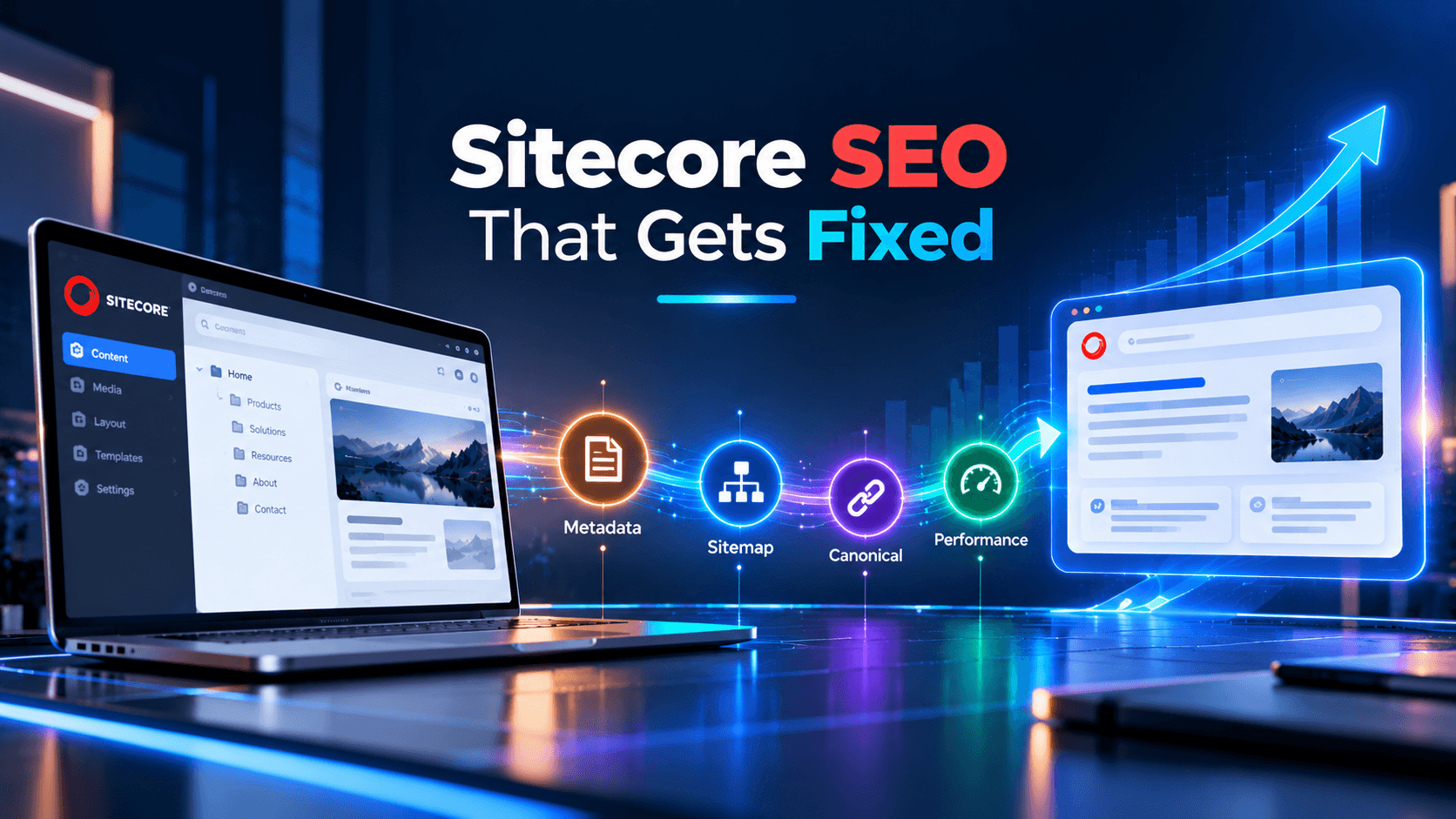
Sitecore SEO services improve how enterprise websites are crawled, understood, ranked and discovered across Google, Bing and AI-powered platforms. A complete program combines technical SEO, Answer Engine Optimization (AEO), Generative Engine Optimization (GEO), structured data, content architecture, Core Web Vitals, Next.js performance, multilingual SEO and ongoing search visibility monitoring.
For Sitecore enterprises, SEO should not be treated as metadata added after development. Search visibility depends on CMS architecture, rendering, content structure, internal linking, performance and how clearly important information can be extracted by both search engines and AI systems.
Murmu Software Infotech provides Sitecore SEO Services for Sitecore XP, XM, SXA, SitecoreAI, XM Cloud and headless implementations.
Make Sitecore Visible Everywhere
Improve technical search performance, answer visibility and AI discoverability through a connected Sitecore SEO, AEO, GEO and performance strategy.

Build a Search-Ready Sitecore Platform
Strengthen technical SEO, AEO, GEO, performance, structured content, and AI discoverability with Sitecore architecture built for scalable enterprise digital experiences.
Why Sitecore SEO Requires Technical Expertise
Enterprise Sitecore platforms commonly contain multiple websites, languages, markets, components, integrations and personalized experiences.
That complexity can create:
- Duplicate or inconsistent URLs
- Missing canonical tags
- Redirect chains
- Weak metadata governance
- Poor internal linking
- JavaScript rendering problems
- Slow components
- Oversized frontend bundles
- Incorrect multilingual configuration
- Thin or duplicated content
- Unstructured answers and FAQs
A strong Sitecore SEO strategy therefore needs both marketing and engineering expertise.
When SEO improvements require component, template or platform changes, Sitecore CMS Development Services can support the technical implementation.
SEO vs AEO vs GEO vs Performance
| Area | Main Goal | Typical Sitecore Work |
|---|---|---|
| SEO | Improve organic discovery | Crawlability, metadata, URLs, sitemaps, internal links |
| AEO | Make answers easier to extract | Questions, direct answers, FAQs, semantic headings |
| GEO | Improve AI understanding and citation readiness | Entities, key facts, sources, expert evidence, structured content |
| Performance | Improve speed and usability | Core Web Vitals, caching, images, APIs, JavaScript |
These disciplines should work together.
SEO builds discoverability. AEO improves answer extraction. GEO strengthens machine understanding and citation readiness. Performance supports usability and crawl efficiency.
None replaces the others.
Technical Sitecore SEO
Technical SEO should be built into reusable Sitecore templates and components rather than managed manually page by page.
Important controls include:
- Editable titles and meta descriptions
- Canonical URLs
- Robots directives
- XML sitemaps
- Redirect management
- Correct status codes
- Structured data
- Breadcrumbs
- Crawlable internal links
- Image alt text
- Hreflang and multilingual configuration
- Open Graph and social metadata
- Accessible semantic HTML
For XM Cloud and headless implementations, important content should also remain accessible through crawlable rendered HTML.
Organizations modernizing frontend architecture can combine SEO work with Sitecore XM Cloud Development Services.
Sitecore AEO: Build Answer-First Content
AEO asks a simple question:
Can a search or answer engine quickly identify the correct response on this page?
An answer-ready Sitecore page should use:
Question → Direct Answer → Explanation → Evidence → Next Action
Useful structured fields can include:
- AI summary
- Key facts
- Common questions
- Direct answers
- Primary entity
- Author and reviewer
- Sources
- Service area
- Last reviewed date
These fields can support visible page content, structured data, internal search and APIs without duplicating the editorial workflow.
Sitecore GEO: Build AI-Ready Content
GEO focuses on helping generative systems understand what an organization does, what a page is about and why the information should be trusted.
Effective GEO is not about creating artificial AI keywords.
It relies on:
- Clear entities
- Factual summaries
- Original expertise
- Relevant case studies
- Strong internal relationships
- Consistent business information
- Sources and evidence
- Expert authorship
- Freshness signals
- Accessible HTML
- Structured content
Structured data can improve machine understanding, but it does not guarantee rankings or AI citations.
Sitecore Performance and Core Web Vitals
Sitecore SEO and performance should be optimized together.
Common areas include:
- Largest Contentful Paint
- Interaction to Next Paint
- Cumulative Layout Shift
- Server response time
- Next.js bundle size
- API latency
- Image payloads
- CDN delivery
- Cache effectiveness
- Third-party scripts
A technically optimized page can still underperform when frontend delivery is slow.
Sitecore SEO Pricing and Engagement Models
Pricing depends on website size, Sitecore architecture, number of markets, technical issues and whether engineering changes are required.
SEO Audit
Best for identifying crawl, indexing, performance, content and AI-readiness gaps before implementation.
Pricing: Scope-based fixed assessment.
Hourly SEO + Engineering Support
Useful for technical fixes, schema, redirects, templates, performance and implementation work.
Published Sitecore support ranges are approximately $15–$30/hour, depending on responsibility and expertise.
Dedicated Technical Resource
For ongoing Sitecore development and SEO implementation, specialists can range around $20–$40/hour or from $2,500/month.
Businesses needing continuous implementation capacity can Hire Sitecore Developers.
Managed SEO and Support
Suitable for enterprises requiring continuous technical SEO, performance, publishing support, enhancements and optimization.
Broader managed Sitecore support programs can start around $25,000/year, depending on SLA and scope.
For ongoing production optimization, explore Sitecore Development Support.
Related Sitecore Services
- Sitecore SEO Services - Technical SEO, AEO, GEO and performance optimization.
- Sitecore CMS Development Services - Platform development, integrations and technical implementation.
- Sitecore XM Cloud Development Services - Headless modernization and Next.js development.
- Sitecore Development Support - Continuous maintenance and optimization.
- Hire Sitecore Developers - Dedicated engineering capacity for implementation.
Turn Sitecore Into a Search Growth Platform
Enterprise Sitecore SEO should improve more than rankings.
The objective is to make your content technically accessible, fast for users, understandable to answer engines and structured clearly enough for modern AI discovery.
Murmu Software Infotech combines Sitecore engineering with technical SEO, AEO, GEO, structured content, Next.js performance and continuous optimization.
Ready to Improve Sitecore Visibility?
Start with a technical and AI-search assessment covering crawlability, performance, content structure, structured data, answer readiness and implementation gaps.
Request Your Sitecore SEO Audit →
Frequently Asked Questions
What are Sitecore SEO services?
Sitecore SEO services combine technical SEO, structured data, content architecture, performance optimization, AEO, GEO, multilingual SEO, internal linking and ongoing search visibility improvements.
What is AEO for Sitecore websites?
Answer Engine Optimization structures Sitecore content around clear questions, concise answers, semantic headings, visible FAQs and structured information that search and AI systems can extract more easily.
What is GEO for Sitecore?
Generative Engine Optimization improves how clearly AI systems understand and potentially reference Sitecore content through strong entities, factual summaries, expert evidence, structured content, sources and contextual relationships.
Does GEO replace traditional Sitecore SEO?
No. GEO complements SEO. Crawlability, indexing, content quality, metadata, internal linking, structured data, authority and performance remain fundamental to both traditional and AI-powered discovery.
How much do Sitecore SEO services cost?
Pricing depends on platform complexity and scope. Published Sitecore support rates can range around $15–$30 per hour, while dedicated technical resources may range around $20–$40 per hour.
How can Sitecore technical SEO be improved?
Technical improvements can include canonical URLs, sitemaps, robots directives, redirects, schema markup, metadata, hreflang, status codes, crawlable navigation, semantic HTML and performance optimization.
How does Sitecore performance affect SEO?
Slow rendering, oversized JavaScript, poor caching, API latency, unoptimized images and third-party scripts can reduce usability and Core Web Vitals, making performance an important part of technical SEO.
How do you optimize XM Cloud and Next.js for SEO?
Optimization can include crawlable rendering, metadata, canonicals, schema, sitemaps, redirects, internal links, image optimization, caching, server response improvements and efficient JavaScript delivery.
Can Sitecore content be optimized for AI search?
Yes. Sitecore can structure summaries, key facts, direct answers, entities, authors, sources, FAQs and review dates so content is clearer for search engines and generative AI systems.
How should enterprises measure Sitecore SEO and GEO?
Measure organic impressions, clicks, rankings, crawl health, Core Web Vitals and conversions alongside answer visibility, cited pages, AI brand mentions, referral traffic and content coverage.