Development / CMS
Sitecore Content SDK v2.0 Released: Next.js 16, Agent Skills, Events, Tracking, Personalization & More
SSaurav Kumar5 Min Read
The digital experience landscape is evolving rapidly, and organizations are under constant pressure to deliver faster, smarter, and more personalized content across channels. To meet these demands, Sitecore has officially released Content SDK v2.0, a major upgrade that pushes headless development into a new era.
This release is not just an incremental update—it introduces Next.js 16 support, agent-based capabilities, enhanced event tracking, improved personalization, and AI-ready features. Together, these updates signal a strong shift toward composable, intelligent, and developer-friendly digital experience platforms.
In this blog, we’ll break down everything you need to know about Content SDK v2.0, what’s new, and why it matters for developers and organizations alike.
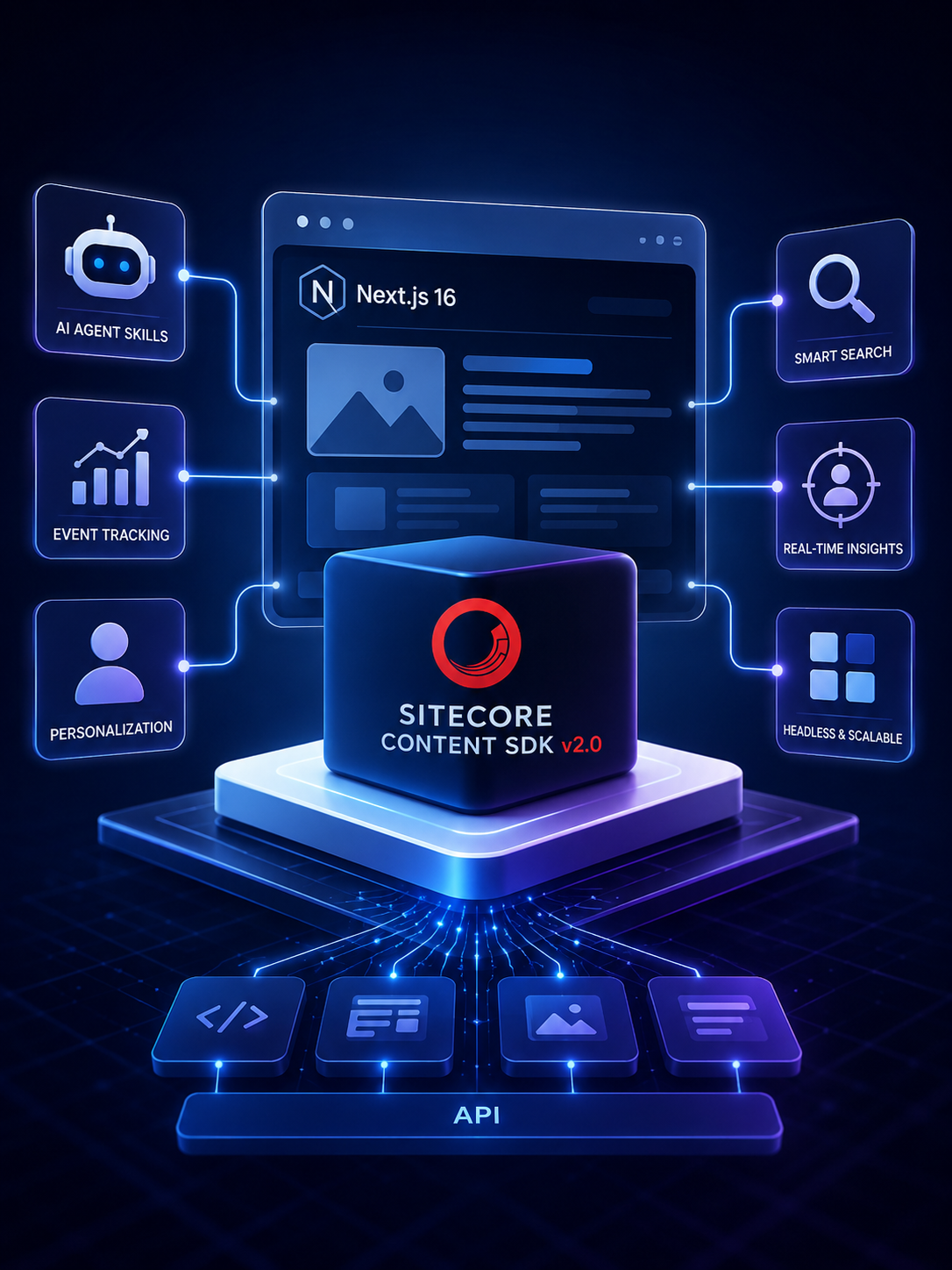
Unlock Next.js 16, AI agent skills, personalization, tracking, and scalable headless Sitecore development.
Sitecore Content SDK is a modern development toolkit designed for building headless applications with Sitecore XM Cloud. It enables developers to fetch, manage, and render content using APIs while leveraging modern frontend frameworks.
With version 2.0, the SDK becomes more powerful, flexible, and aligned with current development trends such as AI integration, edge delivery, andcomposable architecture .
Let’s explore the major features introduced in this release.
One of the most anticipated updates is support for Next.js 16, ensuring compatibility with the latest advancements in the React ecosystem.
Why it matters:
Developers can now take full advantage of:
This ensures that Sitecore applications remain future-proof and aligned with modern frontend standards.
Content SDK v2.0 introduces agent skills, a step toward AI-driven development.
What are agent skills?
Agent skills allow applications to:
Use cases:
This feature aligns with the broader industry trend of embedding AI directly into the development lifecycle.
Event handling has been significantly improved in version 2.0.
Key improvements:
Benefits:
This allows developers to create more dynamic and interactive user experiences.
Tracking is at the heart of personalization and analytics, and Content SDK v2.0 enhances this significantly.
New capabilities:
Why it matters:
Personalization has always been a core strength of Sitecore, and v2.0 takes it further.
Enhancements include:
Example scenarios:
One of the biggest themes of this release is AI readiness.
Content SDK v2.0 is designed to:
This ensures that applications built today can easily adopt future AI innovations.
Developers will notice immediate improvements in usability and productivity.
Key DX improvements:
This lowers the barrier to entry and accelerates development cycles.
Content SDK v2.0 fits seamlessly into a composable architecture:
This architecture ensures:
| Feature | v1.x | v2.x |
|---|---|---|
| Next.js Support | Limited | Next.js 16 |
| AI Capabilities | Minimal | Advanced |
| Event Handling | Basic | Enhanced |
| Tracking | Standard |
Content SDK v2.0 represents a major leap forward in how developers build with Sitecore XM Cloud. It’s not just about incremental improvements—it fundamentally reshapes the development experience by combining modern frontend capabilities with AI-driven workflows and a more modular architecture.
One of the biggest highlights is the introduction of agent support and AI skills, which brings automation directly into the development lifecycle. With structured files like AGENTS.md and Skills.md, along with predefined skill directories, developers can define how AI tools behave, what they can do, and where they should stop. This creates a controlled and scalable way to integrate AI into real-world applications rather than treating it as an external add-on.
The release also significantly improves analytics and personalization capabilities. By consolidating features into dedicated packages such as analytics-core, events, and personalize, the SDK simplifies tracking and user interaction handling. The new initContentSdk function further reduces setup complexity, allowing teams to get started faster with fewer configuration hurdles.
Search functionality has also been elevated with the introduction of a dedicated search package. Developers can now implement type-safe, scalable search experiences using built-in services that support pagination, sorting, and even request cancellation. Combined with new React hooks like useSearch and useInfiniteSearch, building advanced search interfaces becomes much more intuitive.
Beyond features, the upgrade to Next.js 16 and Node.js 24 ensures that applications are aligned with the latest performance and scalability standards. At the same time, architectural improvements—such as decoupling core modules—make the SDK more flexible and easier to maintain over time.
There are also important modernization changes, including the shift from older patterns like higher-order components to React hooks, improved configuration handling, and more predictable localization behavior. While these changes may require some migration effort, they ultimately result in cleaner, faster, and more maintainable applications.
In essence, Content SDK v2.0 is not just an upgrade—it’s a transition toward a smarter, more modular, and AI-enabled development ecosystem that prepares teams for the future of digital experience delivery.
Content SDK v2.0 is a significant step forward for several reasons:
1. Future-Proof Development
By supporting modern frameworks and AI capabilities, it ensures long-term relevance.
2. Faster Time-to-Market
Simplified workflows and improved DX reduce development time.
3. Better User Experiences
Enhanced personalization and tracking lead to more engaging digital experiences.
4. Alignment with Industry Trends
The SDK embraces:
To start using Content SDK v2.0:
The release of Sitecore Content SDK v2.0 marks a major milestone in headless and composable development. With support for Next.js 16, agent skills, enhanced events and tracking, and improved personalization, it empowers developers to build smarter, faster, and more scalable applications.
Sitecore Content SDK v2.0 is a modern development toolkit for building headless Sitecore applications, adding Next.js 16 and Node.js 24 support, Agent Skills, analytics, events, personalization, type-safe search, and a more modular architecture.
Content SDK v2.0 introduces Next.js 16 and Node.js 24 support, AI Agent Skills, consolidated analytics and events packages, personalization capabilities, a dedicated type-safe search package, custom Edge hostnames, and architectural improvements.
Yes. Sitecore Content SDK v2.0 upgrades its Next.js integration to Next.js 16, enabling applications to use the newer Next.js framework capabilities while requiring related migration changes such as replacing middleware.ts with proxy.ts.
| Advanced |
| Personization | Good | Improved |
| Developer Experience | Good | Exellent |
Agent Skills provide structured guidance and capability definitions for AI coding tools and agents. Content SDK v2.0 includes AGENTS.md and Skills.md patterns plus .agents/skills directories to help AI tools understand capabilities, rules, and stop conditions.
Yes. Content SDK v2.0 integrates event functionality through dedicated events and analytics packages, enabling applications to implement event tracking and connect user interactions with Sitecore analytics capabilities.
Yes. Content SDK v2.0 incorporates personalization functionality into the Content SDK architecture, allowing developers to configure personalization alongside analytics and event capabilities using the updated initialization approach.
Content SDK v2.0 introduces a dedicated @sitecore-content-sdk/search package with a type-safe SearchService supporting capabilities such as pagination, sorting, and request cancellation, plus React hooks including useSearch and useInfiniteSearch.
Upgrading requires updating Sitecore Content SDK packages to 2.0, upgrading to Next.js 16 and Node.js 24, replacing applicable Cloud SDK integrations with the new analytics-core, events, and personalize packages, and completing the required React and configuration changes.
Major changes include decoupling the content package from core, upgrading to Next.js 16, renaming middleware.ts to proxy.ts, updating image configuration, adopting the SitecoreProvider and modern hooks, and changing redirect and locale behavior.
Content SDK v2.0 provides a more modular foundation for Sitecore XM Cloud development with modern Next.js support, AI-assisted development, integrated analytics, events, personalization, type-safe search, and improved developer workflows.