Sanity vs. Competitors (Headless Maturity): Why Enterprise Leaders Are Rethinking CMS Strategy in 2026
In This Article
- Introduction: The Shift from “Headless” to “Mature Headless”
- What Does “Headless Maturity” Actually Mean?
- Sanity’s Differentiator: The Content Operating System Approach
- Schema as Code: Aligning CMS with Business Workflows
- Why this matters for business leaders:
- Real-Time Collaboration: A Game-Changer for Enterprise Teams
- Key benefits:
- Performance & Scale: Built for High-Velocity Content
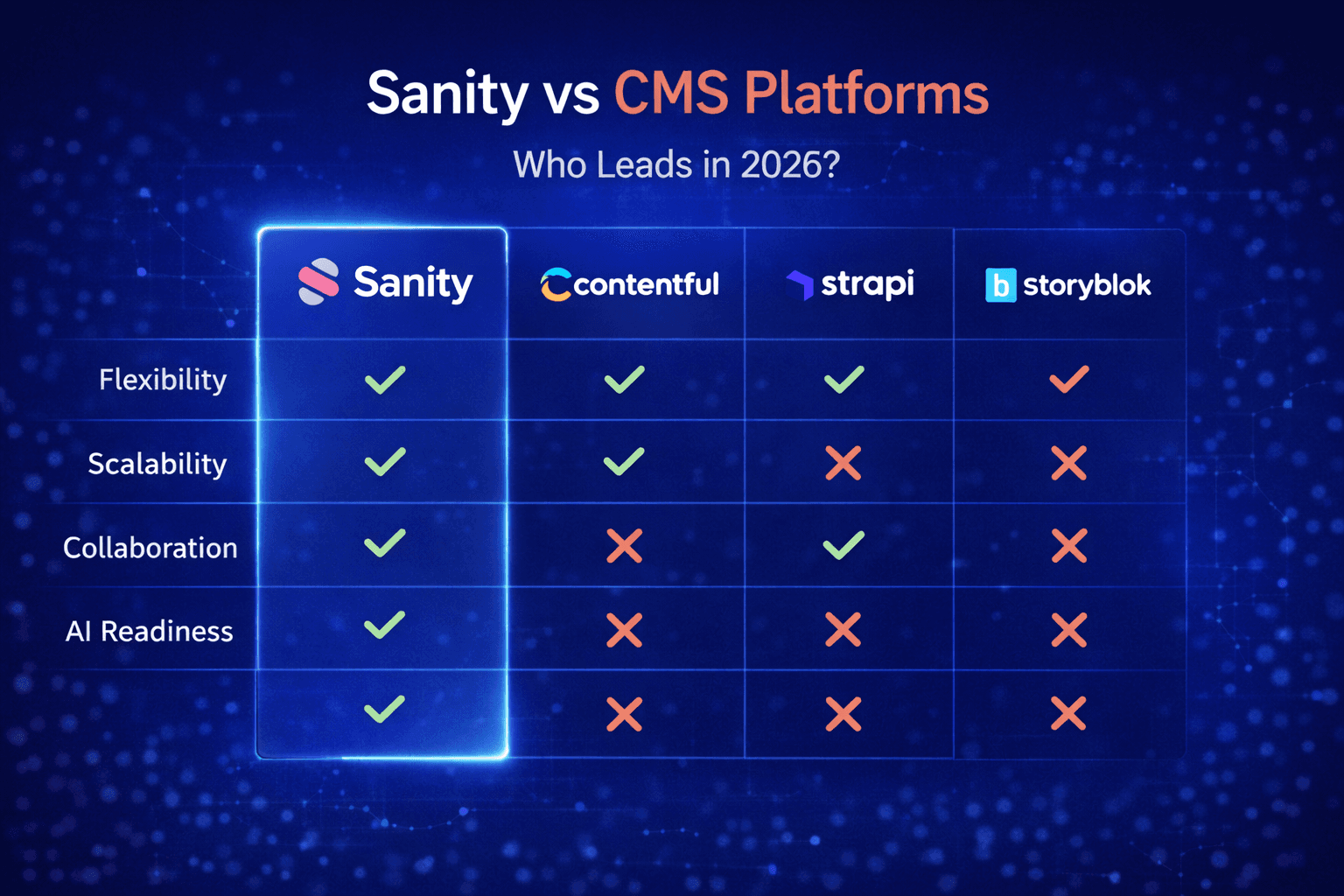
- Sanity vs Competitors: Strategic Comparison
- 1. Sanity vs Contentful
- 2. Sanity vs Storyblok
- 3. Sanity vs Strapi
- Why Headless Maturity Matters for CXOs
- Key business impacts:
- 1. Faster Time-to-Market
- 2. Operational Efficiency
- 3. Scalability
- 4. AI Readiness
- The AI Factor: Future-Proofing Your CMS
- Final Thoughts: Beyond CMS Selection
Introduction: The Shift from “Headless” to “Mature Headless”
Over the past few years, the headless CMS market has exploded. What started as a technical shift—decoupling frontend and backend—has now evolved into something far more strategic.
Today, enterprises are no longer asking:
“Which CMS is headless?”
Instead, they are asking:
“Which CMS is mature enough to support our business operations at scale?”
This is where the conversation around Sanity vs. Competitors (Headless Maturity) becomes critical.
Sanity is increasingly being recognized not just as a headless CMS, but as a Content Operating System—a platform designed to align content workflows with business logic, collaboration, and AI readiness.
What Does “Headless Maturity” Actually Mean?
Headless maturity goes beyond API-first architecture.
A truly mature platform must deliver:
- Operational flexibility (adapts to business workflows)
- Collaboration at scale (teams working together in real time)
- Governance & control (compliance, versioning, auditability)
- Performance under load (high-volume content operations)
- Future readiness (AI integration, automation, scalability)
Most CMS platforms achieve 1–2 of these.
Very few achieve all.
Sanity’s Differentiator: The Content Operating System Approach
Sanity’s biggest strategic advantage is its positioning as a Content Operating System (COS).
This means:
→ Content is treated as structured, reusable data
→ Workflows are customizable
→ Teams collaborate in real-time
→ AI can operate on structured content
This is fundamentally different from traditional CMS platforms that are still page-centric.
Schema as Code: Aligning CMS with Business Workflows
Scale Content, Teams & AI—All on One Unified Platform
One of Sanity’s strongest maturity signals is its “Schema as Code” philosophy.
Instead of rigid templates, organizations define content models as structured schemas.
Why this matters for business leaders:
- Content models mirror actual business processes
- Changes can be version-controlled and safely deployed
- Teams gain consistency across regions and products
- Governance becomes easier and more scalable
In simple terms:
➜ Your CMS adapts to your business—not the other way around.
Real-Time Collaboration: A Game-Changer for Enterprise Teams
Sanity offers a Google Docs-like editing experience, allowing multiple users to work on content simultaneously.
Key benefits:
- No version conflicts
- Faster approvals
- Transparent workflows
- Improved team productivity
Compared to more rigid platforms like Contentful, where workflows can feel linear and restrictive, Sanity enables parallel collaboration.
For enterprises with distributed teams, this is a major operational advantage.
Performance & Scale: Built for High-Velocity Content
As organizations scale, content volume increases exponentially.
Sanity stands out in:
- Handling large document sizes
- Supporting high-frequency updates
- Offering flexible rate limits
In contrast, platforms like Contentful often introduce constraints at scale, especially for enterprises managing multiple brands or global content operations.
This makes Sanity particularly attractive for:
- Media companies
- E-commerce platforms
- Multi-region enterprises
Sanity vs Competitors: Strategic Comparison
1. Sanity vs Contentful
Contentful Strengths:
- Enterprise adoption
- Stable infrastructure
- Strong ecosystem
Sanity Advantage:
- More flexible content modeling
- Real-time collaboration
- Fewer content restrictions
- Better adaptability to workflows
➜ Verdict: Contentful is structured for stability, while Sanity is structured for flexibility and innovation.
2. Sanity vs Storyblok
Storyblok Strengths:
- Visual editor
- Marketer-friendly interface
Sanity Advantage:
- Deeper customization
- Stronger content structure
- Better suited for complex workflows
➜ Verdict: Storyblok is great for quick visual editing, while Sanity excels in enterprise-grade content operations.
3. Sanity vs Strapi
Strapi Strengths:
- Open-source flexibility
- Full control over hosting
Sanity Advantage:
- Managed infrastructure
- Built-in collaboration
- Faster time-to-market
- AI-ready architecture
➜ Verdict: Strapi is infrastructure-focused, while Sanity is operations-focused.
Why Headless Maturity Matters for CXOs
Choosing a CMS is no longer just a technical decision—it is a business transformation decision.
Key business impacts:
1. Faster Time-to-Market
Launch campaigns and products quickly with flexible workflows.
2. Operational Efficiency
Reduce manual bottlenecks and streamline collaboration.
3. Scalability
Support multiple regions, brands, and teams seamlessly.
4. AI Readiness
Prepare your content for automation and intelligent systems.
The AI Factor: Future-Proofing Your CMS
Sanity is uniquely positioned for AI-driven content operations.
Because content is structured:
- AI can understand context
- Automation becomes reliable
- Content can be reused intelligently
This aligns with the broader trend of AI-powered content ecosystems.
Final Thoughts: Beyond CMS Selection
The real question is not:
“Which CMS is better?”
The real question is:
➜ “Which CMS aligns with how our business operates today—and how it will evolve tomorrow?”
The answer increasingly points toward mature, flexible, AI-ready platforms like Sanity.
- Explore our Sanity CMS Consulting Services
- Discover our AI Integration Solutions
Ready to move beyond traditional CMS limitations?
Let us help you implement a Sanity-powered content operating system that scales with your business, improves collaboration, and prepares you for AI-driven growth.
Contact us today for a strategic consultation.
Frequently Asked Questions
What is Sanity vs. Competitors (Headless Maturity): Why Enterprise Leaders Are Rethinking CMS Strategy in 2026?
Compare Sanity vs Contentful, Storyblok, and Strapi. Discover why Sanity leads in headless CMS maturity, scalability, and AI-ready architecture.