Development / MVP Application Development
MVP Development Cost and Scope
PPrem M.7 Min Read
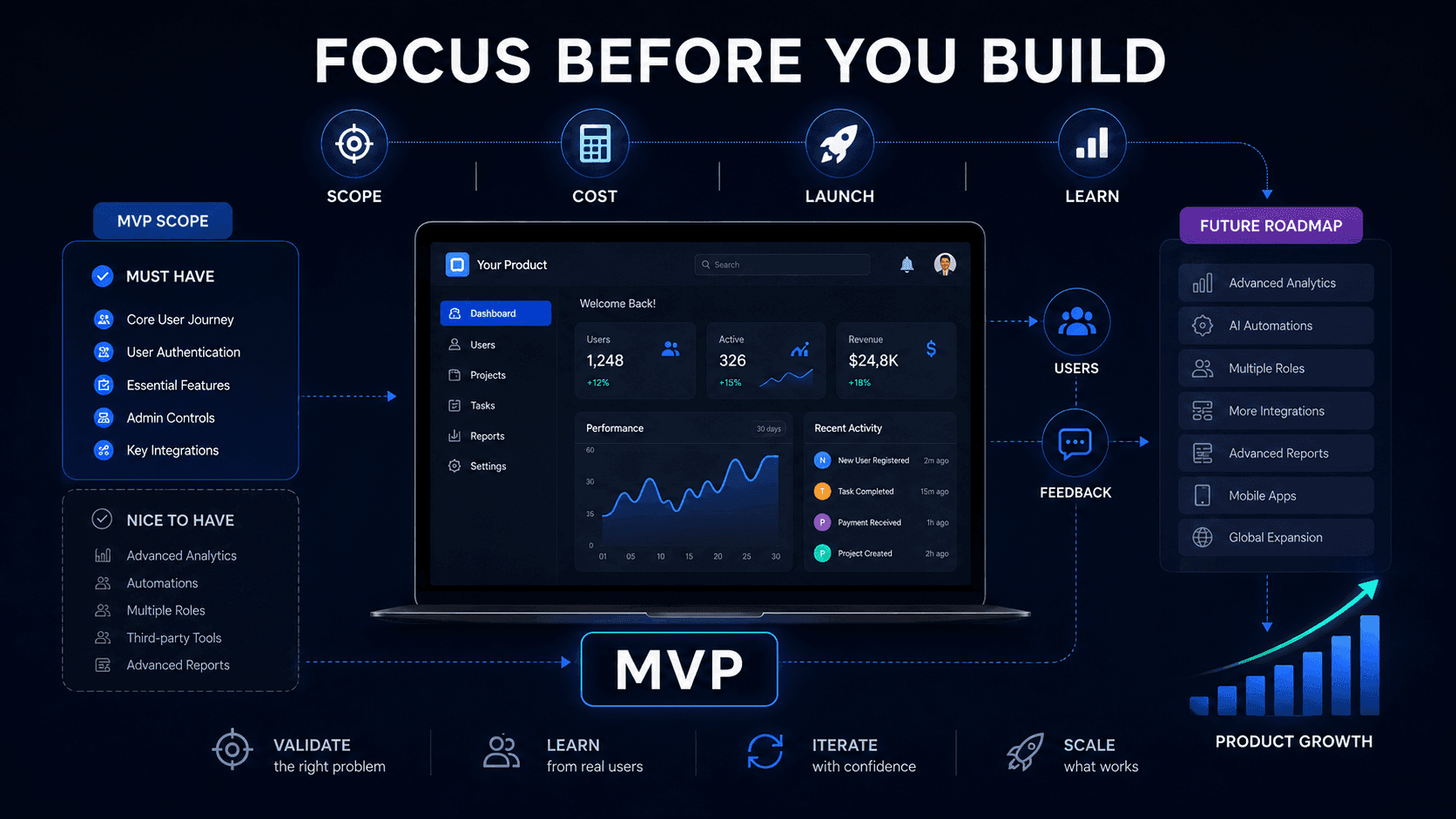
An MVP should not be a smaller version of every feature in your long-term product roadmap.
It should be the smallest dependable product capable of proving whether the business model deserves further investment.
Many founders make one of two expensive mistakes. They either build too much before speaking to real users, or they launch something so incomplete that it cannot test customer behaviour, willingness to pay or operational feasibility.
A strong MVP sits between those extremes. It solves one meaningful problem for one clearly defined user through one complete journey.
That focus determines both MVP development cost and the quality of the validation founders receive.
Before selecting technology or requesting quotations, define what the MVP must prove.
Examples include:
Your first product should collect evidence about the riskiest assumption.
An MVP designed to test demand may need a different scope from one designed to test pricing, retention, workflow efficiency or technical feasibility. Competitor research consistently shows that product complexity and feature depth—not the developer’s hourly rate alone—are among the biggest influences on MVP cost.

Build one valuable user journey, avoid unnecessary features, control development costs, validate demand, and create a stronger foundation for growth.
A web application MVP should let the target user complete one valuable task from beginning to end.
For example:
Register → create a project → complete the main task → review the outcome
Other possible journeys include:
Search → book → pay → receive confirmation
Upload data → process information → review insights → export results
Create product → receive order → manage fulfilment → update status
A complete journey produces meaningful behavioural data. Several disconnected features usually do not.
Industry guidance recommends ruthlessly separating must-have functionality from features that can wait. Some development guides suggest limiting an MVP to approximately three to five essential capabilities, although the correct number ultimately depends on the workflow being validated.
A focused MVP commonly needs the following foundations.
Most SaaS MVP development projects require registration, login, password recovery and appropriate access control.
However, the first release may only require two roles, such as user and administrator. Complex organisational hierarchies, granular permissions and departmental approvals should only be included when they are central to the business hypothesis.
This is the functionality that makes the product valuable.
For a booking platform, it could be availability and appointment management. For a billing product, it may be invoice creation, payment recording and reporting. For an AI product, it could be one dependable workflow that transforms user input into a useful, reviewable result.
A customer-facing product cannot operate effectively if the internal team cannot manage it.
The first administration panel may need to support users, content, submissions, transactions, product settings or support requests. It does not need the sophistication of a mature enterprise dashboard, but it should prevent the founder from depending on developers for routine operational changes.
Payments, email, SMS, video, maps, identity verification, CRM and accounting integrations can quickly increase development and testing effort.
Include an integration when the product cannot validate its core workflow without it. Everything else can be mocked, handled manually or postponed.
For AI MVPs, cost is affected by more than model access. Data readiness, integrations, output review, logging, risk controls and fallback behaviour can materially change the scope.
An MVP must be measurable.
Founders should be able to evaluate onboarding completion, core workflow usage, conversion, abandonment, repeat activity and payment behaviour. Analytics turn a software release into a validation tool.
The first release rarely needs every planned dashboard, subscription tier, integration, user type or automation.
Common causes of overbuilding include:
For many B2B and SaaS products, a responsive web-first MVP can be the most practical launch route because it works across browsers and avoids separate app-store release processes. Mobile development becomes essential when device capabilities or mobile usage are central to the product experience.
The final budget depends on what must be designed, engineered, tested and operated.
The largest cost drivers normally include:
Scope: More workflows, roles and edge cases require more engineering and QA.
Platform: A web application MVP usually has a different cost structure from separate native Android and iOS applications.
UI and UX: A clean functional interface costs less than a highly customised design system with animation and complex interactions.
Backend architecture: Databases, APIs, multi-tenancy, permissions, background processing and reporting increase complexity.
Integrations: Payments, communication tools, enterprise systems and third-party APIs add development and testing requirements.
Security and compliance: Healthcare, financial and other regulated products may need stronger data controls, auditability and compliance planning.
AI capabilities: Data pipelines, model behaviour, human review, guardrails and usage costs must be considered when AI is part of the core value.
Launch and support: Cloud infrastructure, monitoring, bug fixes, security patches and post-launch iteration should be budgeted separately from the initial build.
Across the reviewed competitor guides, published MVP estimates vary significantly because a simple web product, multi-tenant SaaS platform, regulated healthcare application and AI-native system are fundamentally different projects.
Under Murmu Software Infotech’s current Limited Digital Product Launch Offer 2026:
These are starting prices for clearly defined scopes rather than fixed quotations for every product. The offer is available until 6 August 2026.
A web MVP may focus on one transactional or operational workflow. A SaaS MVP generally adds recurring access, subscriptions, organisation accounts, usage controls, data separation and account administration. An AI MVP may require additional work around data, model selection, output quality, monitoring and human review.
No-code tools can be suitable for landing pages, prototypes, internal workflows and products based on standard data operations.
Custom development is usually more appropriate when the core value depends on specialised business logic, secure integrations, multi-tenant architecture, performance, AI workflows or full ownership of the codebase.
The decision should be based on what the MVP must validate—not on whether a specific technology is currently popular.
Founders who need a production-ready foundation can explore our custom MVP software development services and review relevant work within the MVP application development portfolio.
Offshore MVP development can give founders access to product strategy, UI/UX, frontend engineering, backend development, QA and cloud skills without building a complete internal team.
However, the lowest quotation is not automatically the lowest-risk option.
Evaluate whether the startup development partner:
A strong partner helps reduce scope before development—not after the budget has already been spent.
Our AI-powered stock research platform case study demonstrates how a complex product idea can be structured around defined research, analysis and decision-support workflows instead of an unfocused list of AI features.
The purpose of the MVP is not to impress users with feature volume.
It is to prove that the problem matters, the workflow creates value and customers are willing to adopt the solution.
Start with one audience. Build one complete journey. Measure the outcome. Use real evidence to decide what comes next.
The strongest MVP is not the product that contains the most features. It is the product that gives the founder the clearest business answer.
Request an MVP Scope Review to identify the core workflow, must-have features, technical architecture, realistic development cost and post-launch roadmap.
Explore current packages, portfolios and project showcases:
View the Limited Digital Product Launch Offer 2026
Email: contactus@murmusoftwareinfotech.com
An MVP, or Minimum Viable Product, is the smallest dependable version of a software product that allows founders to test an important business assumption with real users. It should solve one meaningful problem, support one complete user journey, and generate evidence about demand, adoption, pricing, or workflow value.
MVP development cost depends primarily on scope, user workflows, platform choice, user roles, UI and UX requirements, backend architecture, integrations, security, compliance, AI capabilities, testing, cloud infrastructure, and post-launch support.
Reduce MVP costs by focusing on one target user, one important business problem, and one complete user journey. Prioritize must-have features, postpone nonessential integrations and dashboards, avoid building multiple platforms too early, and validate demand before expanding the product.
A focused MVP should usually include a clearly defined target user, one complete core workflow, secure authentication where needed, essential business logic, basic administration, only critical integrations, and analytics that measure meaningful user or business outcomes.
There is no universal feature count for every MVP. The correct scope depends on the business hypothesis being tested. A strong MVP includes only the capabilities necessary for users to complete the core journey and generate meaningful validation data.
Founders should avoid unnecessary user roles, advanced reporting, multiple subscription tiers, excessive integrations, separate Android and iOS apps before validation, complex automation, competitor feature copying, and infrastructure designed for massive scale before acquiring early users.
A responsive web MVP is often the fastest and most practical first option for B2B and SaaS products because it works across browsers without separate app-store releases. Native mobile development becomes more important when mobile usage or device capabilities are central to the product experience.
No-code can work well for prototypes, landing pages, internal workflows, and products with standard functionality. Custom development is usually more suitable when the product requires specialized business logic, secure integrations, multi-tenant architecture, AI workflows, high performance, scalability, or full code ownership.
Payments, CRM, ERP, email, SMS, video, maps, identity verification, accounting systems, and third-party APIs can increase engineering and testing effort. An integration should be included in the first MVP only when the core workflow cannot be validated without it.
Yes. A well-defined MVP can become the foundation for a larger product. After validating the problem, workflow, and customer demand, teams can expand features, user roles, integrations, analytics, automation, and infrastructure based on real evidence rather than assumptions.