Repair Management Software Case Study
In This Article
- Job Tracking, Technician Workflow & Service Automation
- The Challenge: Repair Operations Without a Central Workflow
- The Solution: End-to-End Repair Workflow Automation
- Digital Customer and Item Intake
- Diagnosis and Repair Costing
- Technician Assignment and Repair Tracking
- Quality Control Before Delivery
- Billing, Payments and Delivery
- Role-Based Repair Management
- Management Dashboard and Operational Visibility
- Technology Architecture
- Business Impact
- Need a Custom Repair Management System?
Job Tracking, Technician Workflow & Service Automation
Repair businesses depend on much more than technical expertise. Every incoming item must be registered, diagnosed, estimated, assigned, repaired, tested, billed and delivered while customers and staff need clear visibility into what happens next.
For Seekoji Electric Pvt. Ltd., a growing electrical and solar repair business, many of these activities were being managed manually. As repair volumes increased, tracking jobs across employees, repair stages and payments became increasingly difficult.
Murmu Software Infotech developed a custom web-based Repair Management System to digitize Seekoji Electric’s end-to-end service workflow from customer intake and diagnosis through technician repair, quality verification, payment and final delivery.

Transform Repair Operations Digitally
Centralize intake, diagnosis, technician jobs, quality checks, payments, and delivery in one scalable repair management platform.
The Challenge: Repair Operations Without a Central Workflow
Manual repair management created several operational challenges.
There was no single system showing exactly where every repair item was within the service lifecycle. Information moved between intake staff, testers, technicians and administrators through disconnected processes.
This made it harder to answer important operational questions:
Which items were newly received?
Which jobs were waiting for diagnosis?
What was currently under repair?
Which technician was responsible?
Which repair had completed quality testing?
Which customer still had an outstanding payment?
Which items were ready for delivery?
Without centralized visibility, staff coordination became difficult and management had limited control over the growing workload.
The objective was therefore not simply to create a digital job register. Seekoji needed a repair workflow management system that reflected how the business actually operated.
Streamline Repair Operations with Smarter Workflow Automation Today
The Solution: End-to-End Repair Workflow Automation
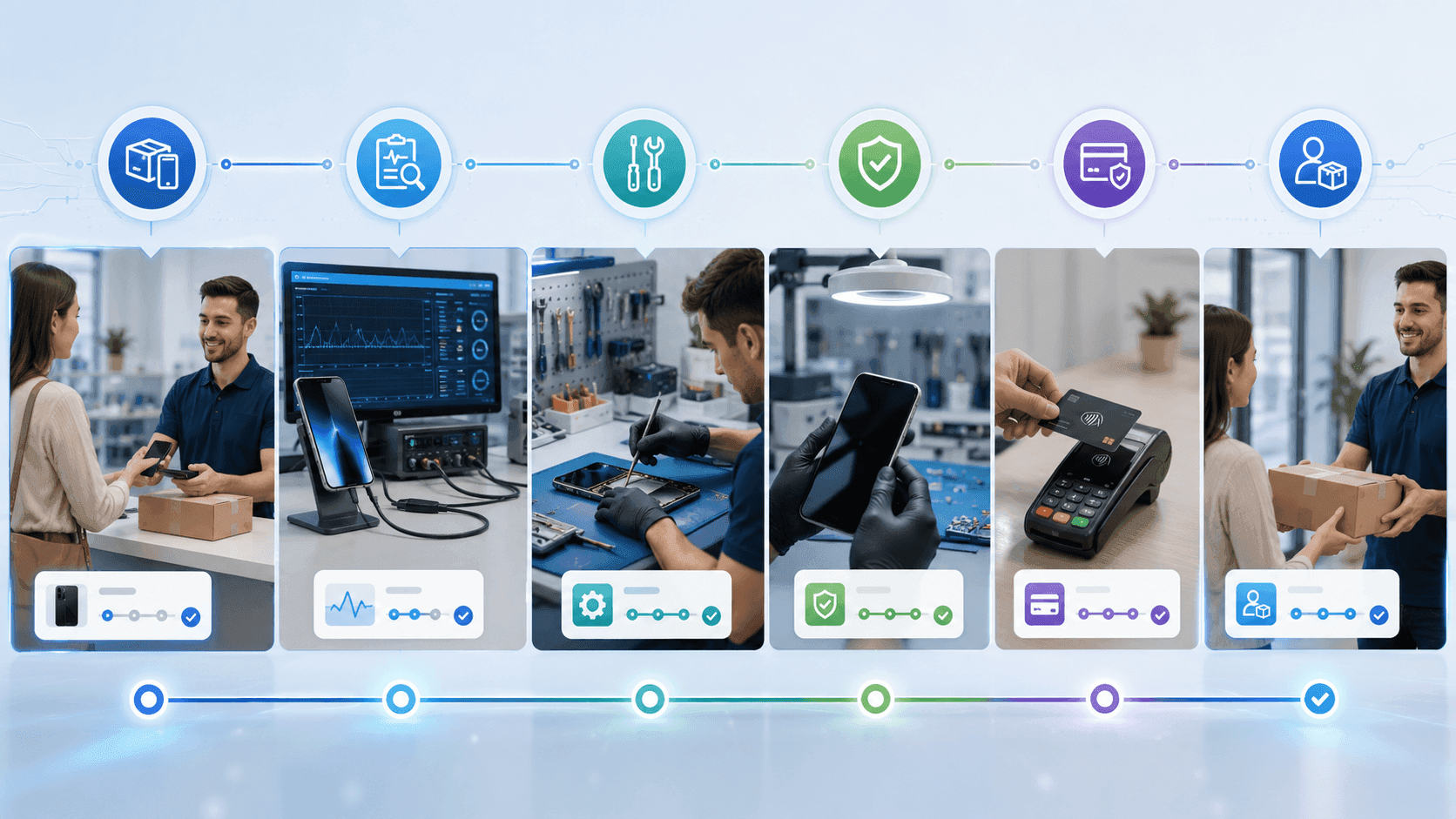
We designed the application around the complete repair lifecycle:
Item Intake → Testing & Diagnosis → Estimate & Approval → Repair → Quality Check → Payment → Delivery
Every repair moves through clearly defined stages, with relevant information captured throughout the process.
This transformed repair management from a collection of manual activities into a structured digital workflow where responsibilities and job status could be monitored from one system.
Digital Customer and Item Intake
The process begins when a customer submits an electrical or solar-related item for repair.
The intake coordinator records the customer and equipment information and creates a repair job within the platform.
From that point forward, the item becomes digitally traceable.
The Intake Coordinator dashboard provides visibility into total items received, items received today, pending work and completed deliveries while also showing whether jobs are under testing, under repair or ready for delivery.
This gives front-office staff a clearer operational picture without depending on paper registers or verbal updates.
Diagnosis and Repair Costing
After intake, the item moves to the testing team.
Testers review assigned equipment, diagnose faults and record the components or work required for repair.
The diagnosis becomes the basis for the repair estimate.
Administrators can then communicate the identified fault and proposed repair cost to the customer. Once the customer approves the work and makes the required advance payment, the job can proceed to repair.
Connecting diagnosis, costing and payment status within the same workflow creates clearer accountability before technicians begin work.
Technician Assignment and Repair Tracking
Approved repairs are assigned to technicians.
Each technician receives a role-specific dashboard showing assigned jobs, new work and repairs currently in progress.
Technicians can update repair status, complete assigned work and record remarks about the service performed.
Instead of managers repeatedly checking with individual employees for progress updates, repair activity becomes visible through the platform.
This also establishes clearer ownership: every job can be associated with a responsible person and a defined repair stage.
Quality Control Before Delivery
Completing a repair does not automatically mean that an item is ready for the customer.
Once technician work is finished, the item returns to the tester for validation.
The tester verifies the repaired equipment and confirms that it is functioning correctly before the workflow moves toward delivery.
This dedicated repair → quality check → ready for delivery process creates an important operational control between technical work and customer handover.
For electrical, solar controller and VFD repair operations, this separation helps establish a more structured service process.
Billing, Payments and Delivery
Payment tracking is integrated into the repair lifecycle.
The system records advance and final payments, allowing administration staff to monitor what has been paid and what remains outstanding before delivery.
Once testing is complete, the customer can be informed that the item is ready. Final payment is processed and the repaired equipment is delivered or collected.
This provides a clearer connection between operational status and commercial status instead of maintaining repair and payment information separately.
Role-Based Repair Management
The system was designed around four operational roles:
Intake Coordinator manages customers, incoming items and delivery.
Tester handles diagnosis and repair validation.
Technician executes assigned repairs and records work updates.
Administrator manages the overall workflow, employees, tasks, customers, payments and operational dashboard.
Role-based access keeps each employee focused on the information and actions relevant to their responsibilities while still feeding one centralized repair-management process.
Management Dashboard and Operational Visibility
The administrator dashboard provides a consolidated view of:
Total Received | Pending | Under Testing | Under Repair | Ready for Delivery | Delivered
Management can see workload distribution and the current condition of repair operations without manually consolidating information from different employees.
This visibility makes it easier to identify pending work, monitor job movement and maintain control as repair volumes grow.
Build a Custom Repair Management System for Growth
Technology Architecture
The repair management system was developed using:
Frontend: Angular
Backend: C# / ASP.NET
Database: SQL
Deployment: Cloud infrastructure on Hostinger
The web-based architecture gives the business a centralized application for managing operational information across different staff roles.
Business Impact
The project moved Seekoji Electric from largely manual repair coordination toward a structured, role-based digital service operation.
The platform provides centralized job tracking, clearer staff responsibilities, better repair-status visibility, organized payment records and a controlled workflow from intake through delivery.
Most importantly, the software was designed around Seekoji Electric’s actual operating process rather than forcing the business into a generic repair application.
That is what makes custom repair management software valuable: technology follows the real service workflow.
Need a Custom Repair Management System?
Murmu Software Infotech develops repair management software, service center systems, technician workflow platforms, job tracking applications, billing systems and custom business automation solutions.
Whether you operate an electronics repair center, solar equipment service business, workshop, machinery repair company or technical service organization, we can design a system around your actual workflow.
Talk to our software team to explore how your repair operations can become more structured, trackable and scalable.
Frequently Asked Questions
What is repair management software?
Repair management software is a centralized system for tracking customer items from intake and diagnosis through quotation, technician assignment, repair, quality checks, billing, payment and final delivery.
How does repair job tracking software work?
Repair job tracking software creates a digital job record for each item and updates its status as it moves through intake, testing, approval, repair, quality validation, payment and delivery.
What was built for Seekoji Electric?
Murmu Software Infotech developed a custom web-based Repair Management System for Seekoji Electric with role-based panels for Intake Coordinators, Testers, Technicians and Administrators, plus repair tracking, task assignment, payment management and dashboards.
Can repair management software assign jobs to technicians?
Yes. Repair jobs can be assigned to individual technicians, who can view their workload, update repair status, record remarks and mark work as completed.
Can repair software track diagnosis and repair estimates?
Yes. Testers can record identified faults and required components, while administrators can manage repair estimates, customer approval and advance payment before repair work begins.
Can repair management software include quality control?
Yes. A repair workflow can route completed technician jobs back to testers for quality verification before an item is marked ready for customer delivery.
Can service center software manage advance and final payments?
Yes. Repair management software can record advance payments, outstanding balances and final payments, connecting commercial status with the repair lifecycle.
What repair statuses can management track?
The Seekoji Electric system tracks stages including received, pending, under testing, under repair, ready for delivery and delivered, giving management a centralized operational view.
What technology was used for the Seekoji repair management system?
The Seekoji Electric Repair Management System uses Angular for the frontend, C# and ASP.NET for the backend, SQL for data storage and cloud infrastructure for deployment.
Can Murmu Software Infotech build custom repair management software?
Yes. Murmu Software Infotech develops custom repair management systems, technician workflow applications, service center software, billing solutions, job tracking platforms and business workflow automation systems.