Marketplace Platform MVP Development for Buying & Selling
In This Article
- Build, Launch and Validate Faster
- Why Marketplace MVP Development Matters
- Core Features of a Buying & Selling Marketplace MVP
- GAXA Marketplace Case Study: Local Buying & Selling Platform
- Marketplace MVP vs Full Marketplace Platform
- AI and Discovery for Marketplace MVPs
- Why Choose Murmu Software Infotech?
- Build Your Marketplace MVP
Build, Launch and Validate Faster
A buying and selling marketplace can become a powerful digital business when it connects the right buyers with the right sellers at the right time. Whether you are planning a local marketplace in Ranchi, a Jharkhand-based classified platform, a niche product marketplace, a service marketplace, or a multi-vendor commerce platform, the first smart step is not building a full-scale product. The first step is building a focused Marketplace Platform MVP.
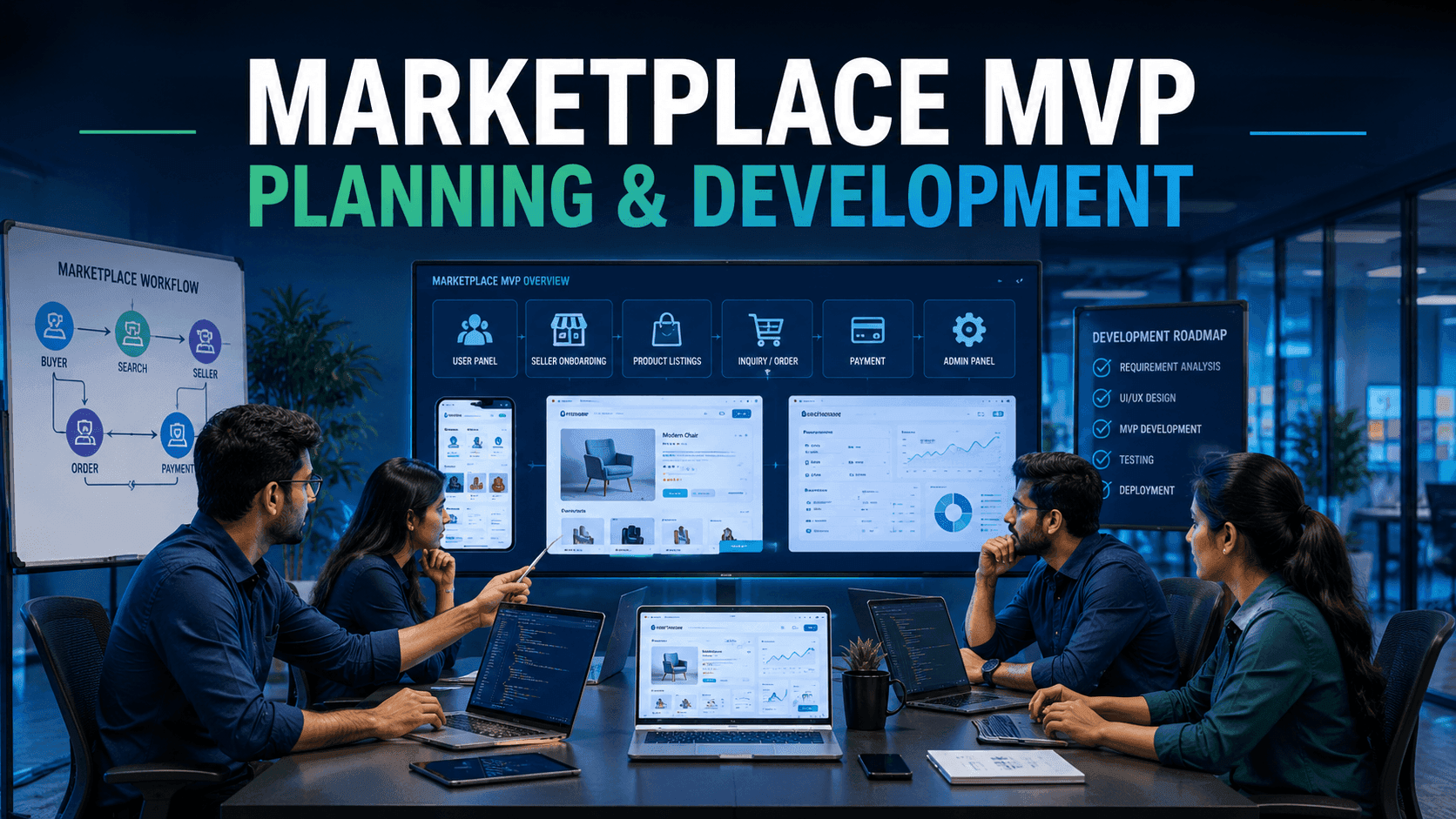
Marketplace platform MVP development helps founders, business owners, startups, and agencies validate their marketplace idea with essential features before investing heavily in a full product. Instead of spending months building complex modules, a marketplace MVP focuses on the core buying and selling journey: user registration, seller onboarding, product or service listings, search, inquiry or checkout, admin control, and basic reporting.
At Murmu Software Infotech, we follow an ROI-driven MVP approach where every feature must support business validation, user adoption, and future scalability. You can explore our approach here: ROI-Driven MVP Software Development.

Build Your Marketplace Faster
Turn your buying and selling idea into a scalable marketplace MVP with smart search, seller onboarding, listings, and growth-ready technology.
Why Marketplace MVP Development Matters
A marketplace is more complex than a normal business website because it serves two sides: buyers and sellers. Sellers want visibility, easy listing management, leads, orders, and payments. Buyers want trust, simple search, clear product details, secure transactions, and fast communication.
If either side fails, the marketplace fails.
This is why MVP development is important. It helps you test whether sellers are ready to list, whether buyers are ready to engage, and whether the platform can generate real transactions or leads. For local businesses in Ranchi and Jharkhand, this can be especially powerful because many offline buying and selling opportunities still need better digital platforms.
Launch Your Marketplace Platform with Scalable MVP
Core Features of a Buying & Selling Marketplace MVP
A strong marketplace MVP should include only the features required to validate the business model. The buyer side should have registration, category browsing, search, product or service detail pages, inquiry or order flow, and basic profile management. The seller side should have seller registration, listing creation, listing management, lead or order tracking, and basic dashboard access. The admin panel should manage users, sellers, listings, categories, inquiries, transactions, reports, and moderation.
You can later add advanced features like AI recommendations, chat, wallet, commission payout, logistics, subscriptions, loyalty, advanced analytics, and mobile apps after the MVP proves demand.
For mobile-first marketplace ideas, you can also review our mobile app development portfolio.
GAXA Marketplace Case Study: Local Buying & Selling Platform
A practical example of marketplace MVP thinking is our GAXA local marketplace platform for buying and selling. It was designed to support users who want to list, discover, and connect around products and services in a more structured digital experience.
Read the detailed case study here: GAXA Local Marketplace Platform for Buying and Selling. You can also watch the product walkthrough on YouTube: GAXA Marketplace Video Demo.
This type of platform is highly relevant for local commerce, classified listings, product resale, service discovery, vendor onboarding, and community-driven buying and selling.
Marketplace MVP vs Full Marketplace Platform
A full marketplace may need multi-vendor commissions, payment split, logistics, dispute handling, seller verification, subscription models, and mobile applications. But building all these features from day one can increase cost, delay launch, and create unnecessary complexity.
A marketplace MVP keeps the product lean. It helps you launch faster, collect feedback, measure buyer-seller activity, and then decide what to build next. If your existing product is stuck, unstable, or not converting, our Software and MVP Rescue Mission can help you fix, rebuild, or reposition it.
Validate Your Marketplace Idea Before Building The Full Platform
AI and Discovery for Marketplace MVPs
Modern marketplace platforms can become smarter with AI. AI can help with product discovery, recommendation, lead qualification, smart search, seller assistance, and automated support. Before development starts, we recommend a clear product discovery phase. Read more here: AI MVP App and Software Product Discovery.
You can also read our guide on how to launch an ROI-driven MVP application in 30 days or less and our India-focused article on MVP application development services in India.
Why Choose Murmu Software Infotech?
Murmu Software Infotech is a software development company in Ranchi, Jharkhand, building marketplace MVPs, custom software, mobile apps, websites, and scalable digital platforms for startups and businesses. Our team can support marketplace strategy, UI/UX, web development, admin panels, APIs, mobile apps, AI integrations, and long-term scaling.
Explore our MVP development portfolio, custom software development services, website design and development portfolio, and website development plans.
Build Your Marketplace MVP
If you want to build a buying and selling marketplace platform in Ranchi, Jharkhand, India, or for a global market, start with an MVP that validates real demand.
Book a free marketplace MVP strategy discussion with Murmu Software Infotech and let us help you build, launch, and scale your marketplace faster.
Frequently Asked Questions
What is marketplace platform MVP development?
Marketplace platform MVP development is the process of building the smallest functional version of a buying and selling platform needed to validate real demand. A marketplace MVP typically focuses on buyer registration, seller onboarding, listings, search, inquiry or checkout, administration and basic marketplace activity.
What features should a buying and selling marketplace MVP include?
A focused marketplace MVP should include user registration, seller onboarding, listing creation and management, categories, search, listing detail pages, buyer inquiry or checkout flow, basic profile management, an admin dashboard, moderation and basic reporting.
Why should startups build a marketplace MVP first?
A marketplace MVP helps startups validate the most important assumptions before investing heavily in a full platform. It can test whether sellers will join, whether buyers will engage, which categories perform best, whether users complete inquiries or transactions and which business model creates demand.
How long does it take to build a marketplace MVP?
A focused marketplace MVP can often be launched within a few weeks when the scope is clear. Development time increases when the product requires advanced payments, chat, logistics, mobile apps, multi-vendor commissions, subscriptions, seller verification or AI capabilities.
How much does marketplace MVP development cost?
Marketplace MVP development cost depends on the product scope, buyer and seller workflows, number of user roles, payment requirements, integrations, mobile apps, AI features and administration complexity. A focused discovery and MVP scope assessment is the best way to estimate the cost accurately.
What is the difference between a marketplace MVP and a full marketplace platform?
A marketplace MVP focuses on validating the core buyer-seller journey with essential features. A full marketplace platform may later include advanced commissions, split payments, logistics, subscriptions, chat, seller verification, wallets, loyalty programs, analytics and native mobile applications.
How does a buyer and seller marketplace platform work?
Sellers register, create profiles and publish products or services. Buyers browse categories, search listings, view details and submit an inquiry or complete a transaction. The marketplace administrator manages users, sellers, categories, listings, moderation, transactions and reports.
Can AI be added to a marketplace platform?
Yes. AI can improve marketplace product discovery through smart search, recommendations, lead qualification, automated support, seller assistance, content generation and personalization. AI should be added when it improves a measurable buyer, seller or marketplace outcome.
What should be built after launching a marketplace MVP?
After launch, marketplace teams should study buyer activity, seller participation, listing quality, inquiries, transactions and conversion. Future development can include AI recommendations, chat, wallets, commission payouts, logistics, subscriptions, loyalty, advanced analytics and mobile applications.
Can a marketplace MVP support local and global buying and selling?
Yes. Marketplace MVPs can be designed for local commerce, classified listings, niche products, services, product resale, vendor networks and global multi-vendor platforms. The feature scope should match the target users, geographic market and business model.