India E-Commerce Rules 2026: 9 Changes Online Businesses Must Make Before 2027
In This Article
- 1. Discounts Must Show Genuine Prior Prices
- 2. Search Results Cannot Mislead Customers
- 3. Sponsored Listings Must Be Clearly Identified
- 4. Annual Dark-Pattern Audits Become Important
- 5. Customers Get Greater Product Information
- 6. Express Consent Is Required for Consumer Information
- 7. Unrelated Bundled Fees Face Restrictions
- 8. Imported Products Need Greater Disclosure
- 9. Consumer Grievance Handling Will Become More Structured
- What E-Commerce Businesses Should Do Before January 2027
- Compliance Can Also Improve Customer Experience
India has introduced significant changes to its e-commerce regulatory framework. The Consumer Protection (E-Commerce) (Amendment) Rules, 2026 strengthen transparency around pricing, search results, sponsored products, consumer consent, complaints, dark patterns and product information.
The amendments were announced on September 10, 2026 and are scheduled to come into force from January 1, 2027.
Need an E-Commerce Platform Ready for What’s Next?
For marketplaces, D2C brands, retailers, quick-commerce platforms and businesses operating custom online stores, this is more than a legal update. It may require changes across ecommerce websites, mobile apps, product catalogues, checkout experiences, promotion engines, search systems and grievance-management workflows.
Here are the major changes businesses should understand and prepare for.
1. Discounts Must Show Genuine Prior Prices
One of the most important changes concerns discount pricing.
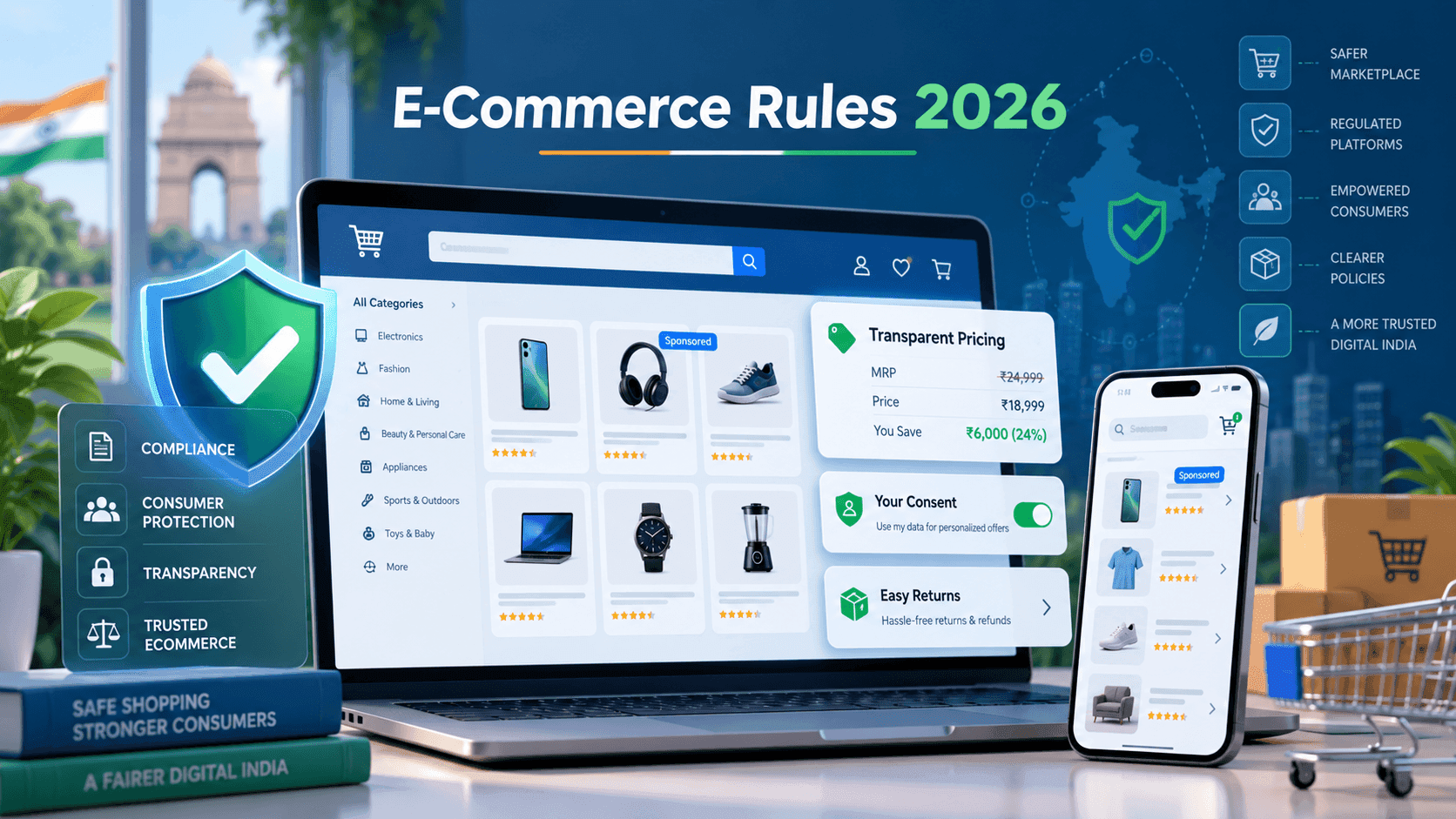
Whenever an ecommerce platform announces a price reduction, it must display both the reduced price and the prior price. The prior price is defined as the lowest price at which the product or service was offered during the 30 days preceding the discount announcement.
This can make artificial discounting such as temporarily increasing a price before showing a large percentage reduction much harder.
For ecommerce technology teams, promotional engines may therefore need reliable historical pricing records rather than simply storing the current selling price and MRP.
2. Search Results Cannot Mislead Customers
Product search is becoming a consumer-protection issue.
E-commerce businesses must not manipulate search results in ways that mislead users or negatively affect the relevance of results to their search query.
That means search algorithms, merchandising rules and AI-powered recommendation systems should balance commercial priorities with genuine relevance.
Retailers developing or modernizing a retail and e-commerce commerce platform should therefore consider transparency and compliance directly within search, product ranking and merchandising architecture.
3. Sponsored Listings Must Be Clearly Identified
Paid product placement cannot look indistinguishable from organic search results.
Sponsored listings must carry clear and prominent disclosures so customers can understand when visibility has been influenced by advertising or commercial arrangements.
This affects marketplace advertising modules, seller promotion systems and search-result interfaces.
Businesses should clearly separate labels such as sponsored or promoted products from organically ranked products.
4. Annual Dark-Pattern Audits Become Important
Manipulative interface practices are receiving greater regulatory attention.
E-commerce entities must comply with the Guidelines for Prevention and Regulation of Dark Patterns, 2023, conduct a yearly self-audit, and prominently display a certificate of compliance.
Dark patterns can include interface techniques that pressure, confuse or manipulate users into actions they may not otherwise choose.
Businesses should review areas such as:
- checkout flows,
- subscription cancellation,
- consent controls,
- add-on services,
- urgency messages,
- promotional pop-ups,
- preselected options, and
- hidden or unexpected charges.
UX design is therefore becoming part of ecommerce compliance not merely conversion optimization.

Build Ecommerce That Converts and Scales
Launch high-performance Shopify, WooCommerce, Custom Ecom Website/App or headless commerce platforms integrated with payments, inventory, CRM and analytics to drive sustainable growth.
5. Customers Get Greater Product Information
Marketplace ecommerce platforms must provide important information that allows buyers to make informed decisions.
Depending on the product or service, this includes information such as best-before or use-before dates, return and refund policies, warranties, delivery details and payment terms.
Product-information architecture will consequently become increasingly important.
Businesses relying on disconnected spreadsheets, manual product entry or incomplete catalogues may need more structured product-data management.
A modern ecommerce web and app development architecture can centralize product information and consistently distribute it across websites, PWAs and mobile applications.
6. Express Consent Is Required for Consumer Information
Consumer data cannot simply be used for specified purposes by default.
Marketplace ecommerce entities must obtain express and affirmative consent before using consumer information for covered purposes.
From a software perspective, businesses should review consent-management workflows across registration, checkout, personalization, marketing automation and customer accounts.
Consent should be intentional, traceable and easy to understand rather than buried inside confusing interfaces or automatically selected options.
7. Unrelated Bundled Fees Face Restrictions
The amendments also restrict marketplace ecommerce entities from collecting bundled fees for services unrelated to the ecommerce platform, with specified exceptions for loyalty or membership programms.
For technology teams, this makes checkout transparency particularly important.
Fees should be clearly categorized, calculated and presented so shoppers understand exactly what they are paying for before completing an order.
8. Imported Products Need Greater Disclosure
For imported goods, ecommerce platforms must disclose importer information and country of origin.
Marketplace operators therefore need product and seller databases capable of storing these fields and displaying them consistently on relevant product pages.
Businesses handling large catalogues should avoid treating compliance information as static page content. Structured product attributes make updates, validation and multi-channel distribution significantly easier.
9. Consumer Grievance Handling Will Become More Structured
Every ecommerce entity will be required to participate in the convergence process of the National Consumer Helpline.
Businesses must also provide complainants with a copy of the complaint as recorded by their grievance officer.
The scale of consumer grievances shows why this is significant. During 2025, the National Consumer Helpline received more than 17.7 lakh grievances, with approximately 5.11 lakh or 29% - related to ecommerce.
For larger platforms, grievance workflows may increasingly need to connect customer support, CRM, order management, refunds and internal escalation systems instead of operating through isolated email processes.
What E-Commerce Businesses Should Do Before January 2027
The new rules should be viewed as a technology-readiness exercise as much as a compliance exercise.
Ecommerce businesses should audit pricing history, search and ranking logic, sponsored-product placement, consent mechanisms, checkout fees, product information, refund policies, complaint handling and dark-pattern risks before the rules take effect.
Build a Transparent, Scalable E-Commerce Experience That Converts
Omnichannel retailers should also make sure ecommerce, inventory and physical retail systems maintain consistent product, price and order information. Integrated retail ecommerce POS and inventory software can help create a unified foundation where online and offline commerce operations depend on the same trusted business data.
Compliance Can Also Improve Customer Experience
The Consumer Protection (E-Commerce) (Amendment) Rules, 2026 are not simply about adding compliance notices.
They point toward a broader shift in digital commerce: transparent pricing, genuine search relevance, informed consent, clear promotions and accountable customer experiences.
Businesses that treat these requirements purely as last-minute compliance work may have to patch multiple systems before January 2027.
Those that incorporate transparency into their ecommerce architecture can use the same investment to improve trust, conversion quality, operational control and long-term customer relationships.
For businesses planning to build, upgrade or redesign an ecommerce platform, the goal should therefore be broader than compliance: create a commerce experience where product discovery, pricing, checkout, customer data and post-purchase support are transparent by design.
Sources & References:
- Press Information Bureau, Government of India - Official announcement of the amended E-Commerce Rules
https://www.pib.gov.in/PressReleaseDetail.aspx?PRID=2308759®=3&lang=1 - News On AIR - Summary of how the amended rules strengthen consumer protection and transparency
https://newsonair.gov.in/centre-amends-e-commerce-rules-to-protect-consumers-and-enhance-transparency/ - DD News - Coverage of the major regulatory changes and their impact on e-commerce platforms
https://ddnews.gov.in/en/government-tightens-e-commerce-rules-to-boost-consumer-protection-and-transparency/ - News18 - Consumer-focused explanation of the key changes online shoppers and e-commerce businesses should know
https://www.news18.com/india/centre-amends-e-commerce-rules-7-changes-online-shoppers-need-to-know-10321725.html
Frequently Asked Questions
What are the new E-Commerce Rules 2026 in India?
India amended the Consumer Protection (E-Commerce) Rules to strengthen transparency and consumer protection across online marketplaces. The changes cover areas including pricing, sponsored listings, search results, consent, product disclosures, dark patterns and grievance handling.
When will the Consumer Protection E-Commerce Amendment Rules 2026 come into effect?
The Consumer Protection (E-Commerce) (Amendment) Rules, 2026 are scheduled to come into effect from January 1, 2027, giving e-commerce businesses time to review and update affected systems and customer journeys.
What changes do e-commerce businesses need to make before 2027?
Businesses should review pricing history, discount displays, sponsored product labels, search-ranking logic, consent mechanisms, checkout fees, product disclosures, grievance workflows and user interfaces for potential dark patterns.
How do the new e-commerce rules affect discount pricing?
The amended framework strengthens pricing transparency. When announcing certain price reductions, platforms need to provide consumers with meaningful reference pricing information so discounts are not presented in a misleading way.
Do sponsored products need to be identified on e-commerce websites?
Yes. Sponsored or commercially promoted listings should be clearly identified so consumers can distinguish paid placements from normal or organically ranked product results.
What do the new rules say about e-commerce search results?
E-commerce platforms should not manipulate product search results in ways that mislead consumers or undermine the relevance of results. Search and merchandising systems should therefore be reviewed for transparency and fairness.
What are dark patterns in e-commerce?
Dark patterns are deceptive user-interface or user-experience techniques designed to influence consumers into decisions they may not otherwise make, such as hidden charges, forced actions, misleading urgency or preselected choices.
Do e-commerce platforms need consumer consent for personal information?
E-commerce businesses should obtain clear, express and affirmative consent where required rather than relying on deceptive interfaces, preselected options or unclear consent mechanisms.
How can an e-commerce website prepare for the 2027 compliance requirements?
Businesses can begin with a compliance and technology audit covering product data, pricing engines, promotion systems, search, checkout, consent management, customer support, grievance handling and mobile and web user experiences.
Will the new e-commerce rules affect website and app development?
Yes. Compliance may require changes to product databases, historical pricing, search algorithms, sponsored listing labels, checkout flows, consent tracking, grievance systems and customer-facing interfaces across e-commerce websites and mobile applications.