How to Optimize Shopify Store Speed with Next.js (2026 Headless Commerce Blueprint)

Problem: Your Shopify Store Is Fast⊠But Not Fast Enough to Win
Many enterprise brands rely on Shopify for scalability and ease of use. But in 2026, thatâs no longer enough.
Despite strong infrastructure, most Shopify stores still face:
- Slower frontend performance due to theme limitations
- Poor Core Web Vitals impacting rankings
- High bounce rates on mobile
- Increasing cart abandonment
For CXOs and digital leaders, this leads to:
- Lost revenue
- Lower ROI on paid campaigns
- Reduced organic visibility
- Competitive disadvantage
The truth: Even a âgoodâ Shopify store can lose millions due to performance gaps.
Why It Matters: Speed = Revenue + Rankings
Google now ranks based on:
- Core Web Vitals
- Page experience
- Mobile performance
A delay of 1 second can:
- Drop conversions by up to 20%
- Increase bounce rates significantly
In competitive eCommerce markets:
1. Faster stores win traffic
2. Faster stores win customers
3. Faster stores win revenue
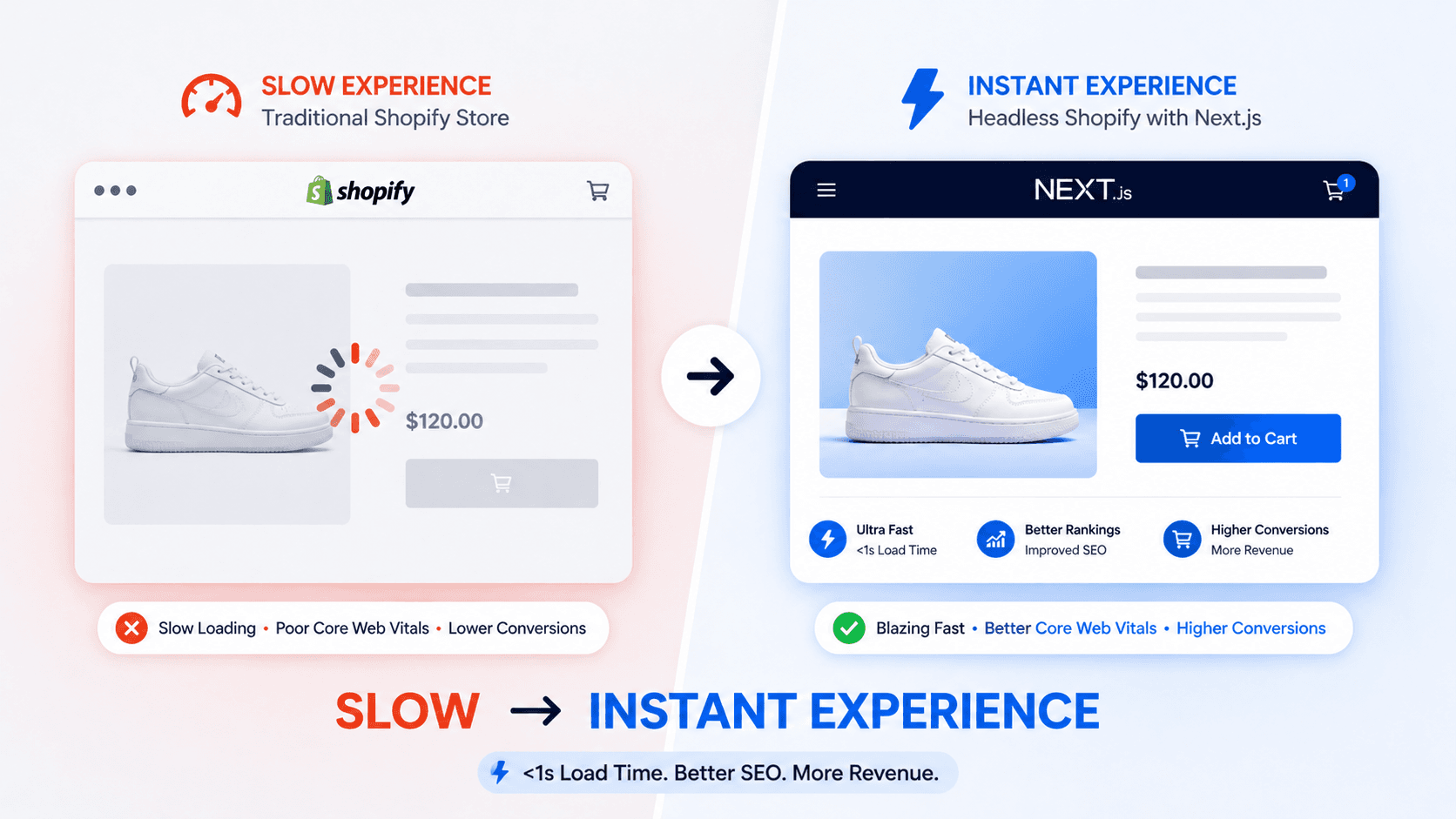
Solution: Headless Shopify + Next.js (2026 Blueprint)
Boost SEO, Speed & Conversions with a Proven Headless Strategy
Forward-thinking companies are adopting:
- Shopify as backend (commerce engine)
- Next.js as frontend (performance layer)
This architectureâShopify Next.js optimization 2026âdecouples backend from frontend, enabling:
- Ultra-fast page loads
- Flexible UI/UX
- Advanced SEO optimization
- Global scalability
Core Shopify + Next.js Optimization Strategies
1. Headless Shopify Performance Optimization
Instead of relying on Shopify themes:
- Use Storefront API
- Deliver content via APIs
- Build custom frontend using Next.js
Result: Faster rendering + enhanced flexibility
2. Next.js Turbo Speed Optimization
Next.js enables:
- Static Site Generation (SSG)
- Incremental Static Regeneration (ISR)
- Server-side rendering (SSR)
This hybrid model ensures:
- Sub-1 second load times
- Faster Time to First Byte
- Seamless scalability
3. Shopify Storefront API Optimization
Optimize API performance by:
- Reducing unnecessary calls
- Using GraphQL efficiently
- Implementing caching layers
Key Insight:
Your frontend speed depends heavily on API efficiency.
4. CDN & Edge Delivery Strategy
Serve content globally via CDN:
- Reduce latency
- Improve load times worldwide
Combine with edge rendering to:
- Deliver personalized experiences instantly
5. Image Optimization (Critical for eCommerce)
Images are the biggest performance bottleneck.
Optimize using:
- Next.js Image component
- Lazy loading
- Modern formats (WebP/AVIF)
Outcome: Faster load + better user experience
6. Improve Shopify Core Web Vitals
Focus on:
- LCP â Faster product page load
- CLS â Stable layouts
- INP â Smooth interactions
Result:
- Better Google rankings
- Higher engagement
7. Next.js Shopify SEO Optimization
A strong SEO strategy includes:
- Server-side rendering for crawlability
- Dynamic meta tags
- Structured data (schema)
- Fast indexing
This improves:
- Organic visibility
- Click-through rates
- Ranking performance
8. Conversion Rate Optimization (CRO)
Speed directly impacts conversions.
Improve:
- Checkout flow
- Mobile UX
- Page load speed
Outcome:
- Reduced cart abandonment
- Increased revenue
Comparison: Traditional Shopify vs Headless Shopify + Next.js
| Factor | Traditional Shopify | Headless + Next.js |
|---|---|---|
| Speed | Moderate | Ultra-fast |
| SEO | Good | Excellent |
| UX Flexibility | Limited | High |
| Scalability | Moderate | Enterprise-grade |
| Conversion Rate | Moderate | High |
Why Choose an Expert Partner
Headless architecture is powerfulâbut complex.
Most businesses struggle with:
- API inefficiencies
- Poor caching strategies
- SEO misalignment
- Performance bottlenecks
An expert partner ensures:
- Scalable architecture
- Performance optimization
- SEO alignment
- Seamless implementation
Explore our services:
- https://murmusoftwareinfotech.com/nextjs-development-services
- https://murmusoftwareinfotech.com/contact
Final Insight
In 2026, speed is not a featureâitâs a growth strategy.
Brands adopting Shopify Next.js optimization 2026 are:
- Ranking higher
- Converting better
- Scaling faster