Hospital Management Software Development
In This Article
- Features, Process, Cost and AI Integration
- What Is Hospital Management Software Development?
- Why Build Custom Hospital Management Software?
- Essential Hospital Management Software Modules
- Patient Registration and EMR
- Appointment and OPD Management
- IPD, Bed and Ward Management
- Laboratory and Diagnostic Integration
- Pharmacy, Inventory and Procurement
- Billing, Insurance and Financial Reporting
- HMS Integration and Interoperability
- Security Requirements for Hospital Software
- AI in Hospital Management Software
- Hospital Management Software Development Process
- What Affects HMS Development Cost?
- Build a Connected Digital Hospital Platform
Features, Process, Cost and AI Integration
Hospitals do not need another disconnected application. They need a digital platform that connects the entire patient journey with clinical, administrative and financial operations.
Hospital management software development involves designing and building a central system for patient registration, appointments, electronic medical records, OPD and IPD workflows, bed management, laboratory operations, pharmacy, billing, inventory, staff management and reporting.
A successful Hospital Management System, or HMS, should help doctors access relevant information, enable staff to complete routine work efficiently and provide management with reliable operational visibility. Modern HMS platforms are increasingly developed as connected ecosystems rather than single-purpose applications.
What Is Hospital Management Software Development?
Hospital management software development is the process of planning, designing, developing, integrating and maintaining software that supports a hospital’s clinical and operational workflows.
Depending on the organization, the platform may serve:
- Patients and caregivers
- Doctors and nurses
- Reception and OPD teams
- Laboratory and radiology departments
- Pharmacy and inventory teams
- Billing and insurance personnel
- Hospital administrators
- Management and decision-makers
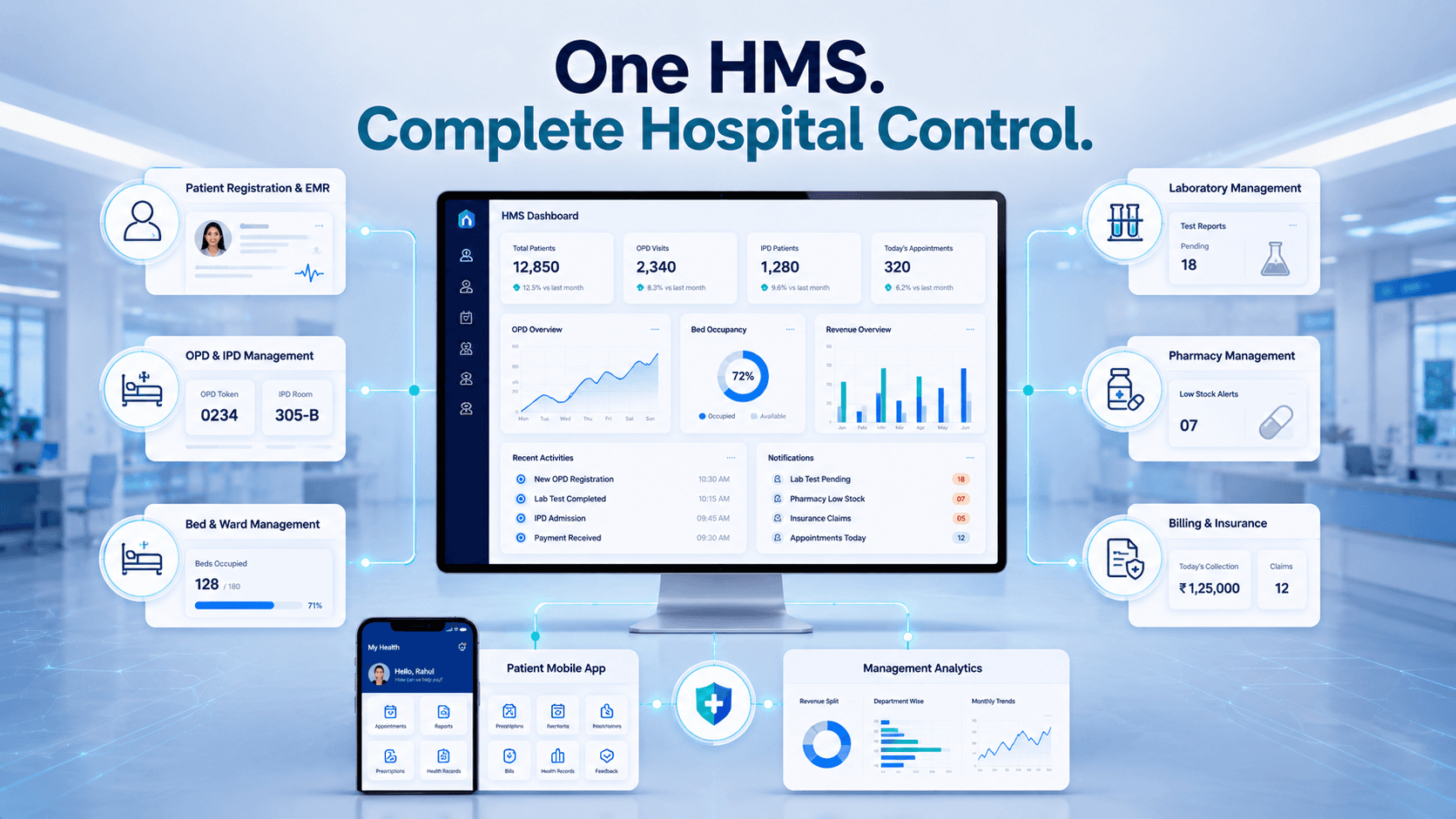
A modern HMS generally combines patient management, EMR, scheduling, billing, laboratory, pharmacy, inventory, ward management and analytics within one coordinated platform.
Why Build Custom Hospital Management Software?
Ready-made hospital software may work for facilities with standard workflows and limited customization needs. However, hospitals with specialized departments, multiple branches, unusual billing rules or existing healthcare systems may find fixed software restrictive.
Custom hospital management software allows the platform to be designed around:
- The hospital’s current patient journey
- Department-specific workflows
- Doctor and staff responsibilities
- Existing billing and accounting processes
- Laboratory and pharmacy systems
- Local reporting requirements
- Mobile and patient-facing services
- Future integrations and expansion
The build-versus-buy decision depends on budget, timeline, operational complexity and long-term ownership. Off-the-shelf software can be deployed faster, while custom development provides greater control over workflows, integrations and future enhancements.
Transform Hospital Operations with Custom, Connected Management Software
Essential Hospital Management Software Modules
Patient Registration and EMR
The registration module establishes a central patient profile containing demographics, contact information, medical history, visit records and identifiers.
Doctors and authorized staff can access relevant clinical information through an Electronic Medical Record, including:
- Previous consultations
- Diagnoses and allergies
- Vital signs
- Prescriptions
- Laboratory results
- Treatment history
- Discharge information
Patient-focused, doctor-focused and administrative experiences should be designed separately because each group has different responsibilities and information requirements.
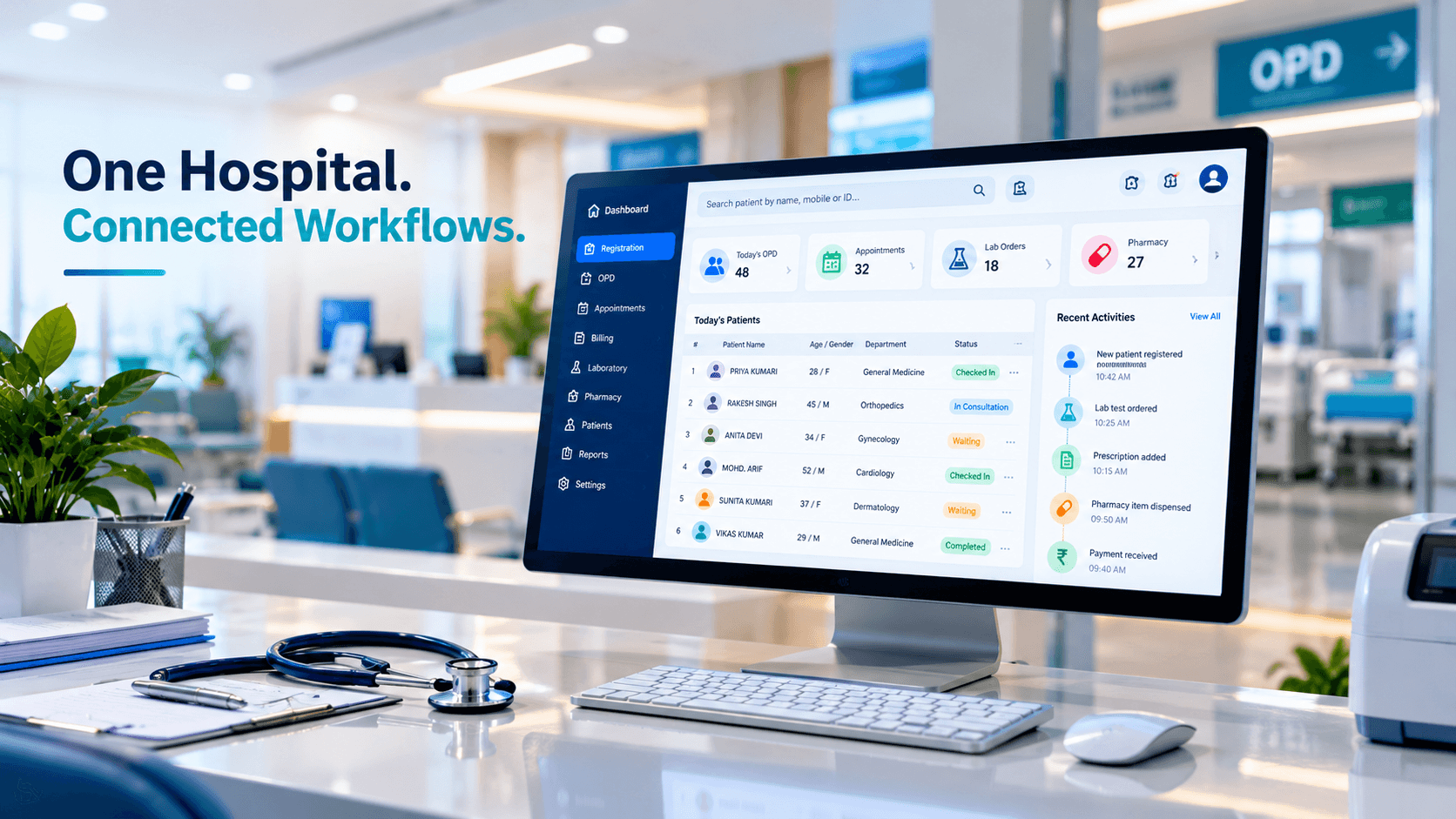
Our Hospital Management System case study demonstrates how registration, appointments, consultations, billing, staff access and management functions can operate through a central platform.
Appointment and OPD Management
Appointment management should connect doctor availability, online bookings, walk-ins, cancellations, reminders and follow-up visits.
For busy outpatient departments, the HMS can integrate with an OPD token and queue management system. This allows hospitals to manage digital tokens, doctor-wise queues, waiting-room displays, missed calls and patient notifications.
A connected OPD workflow may follow:
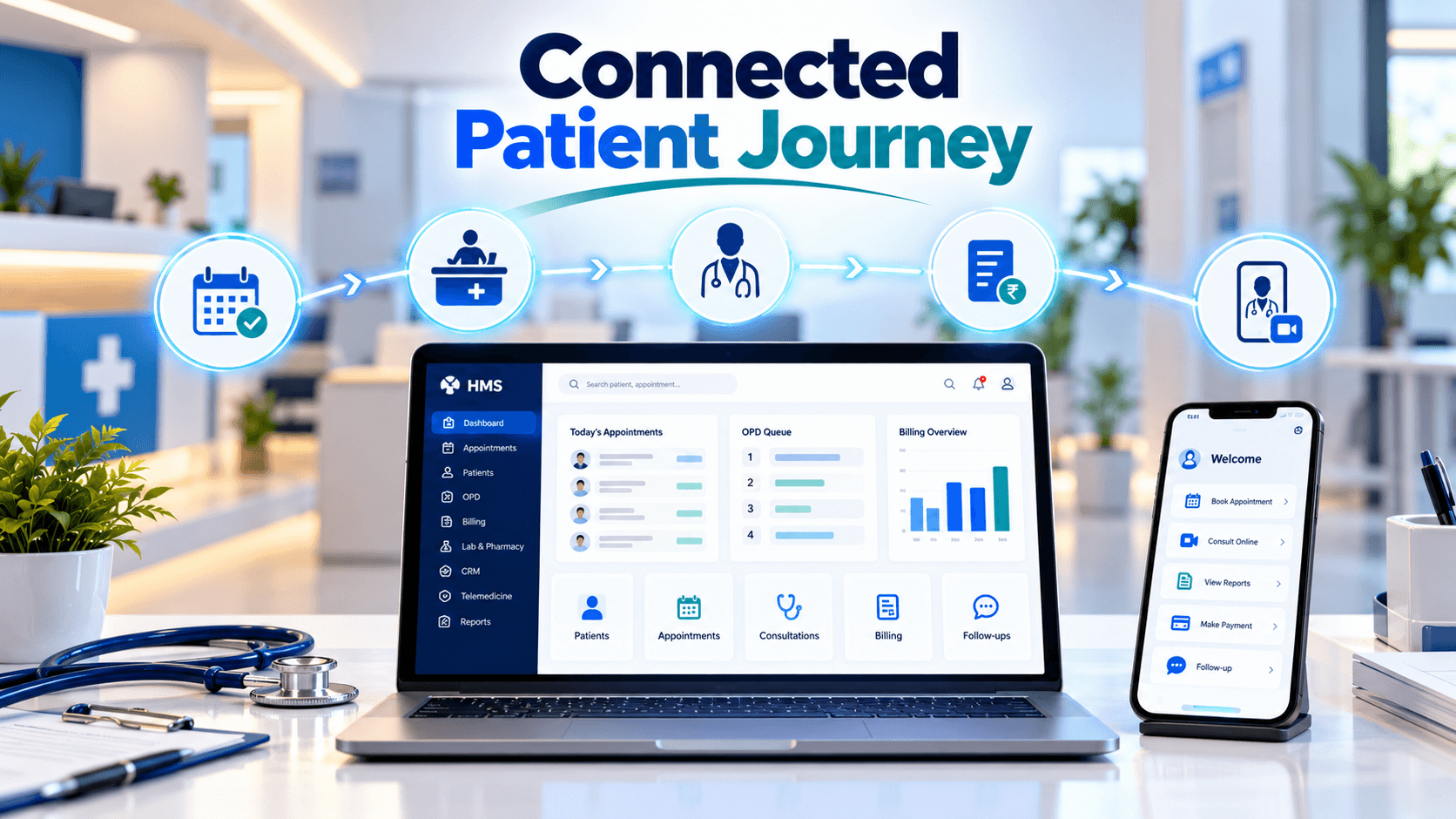
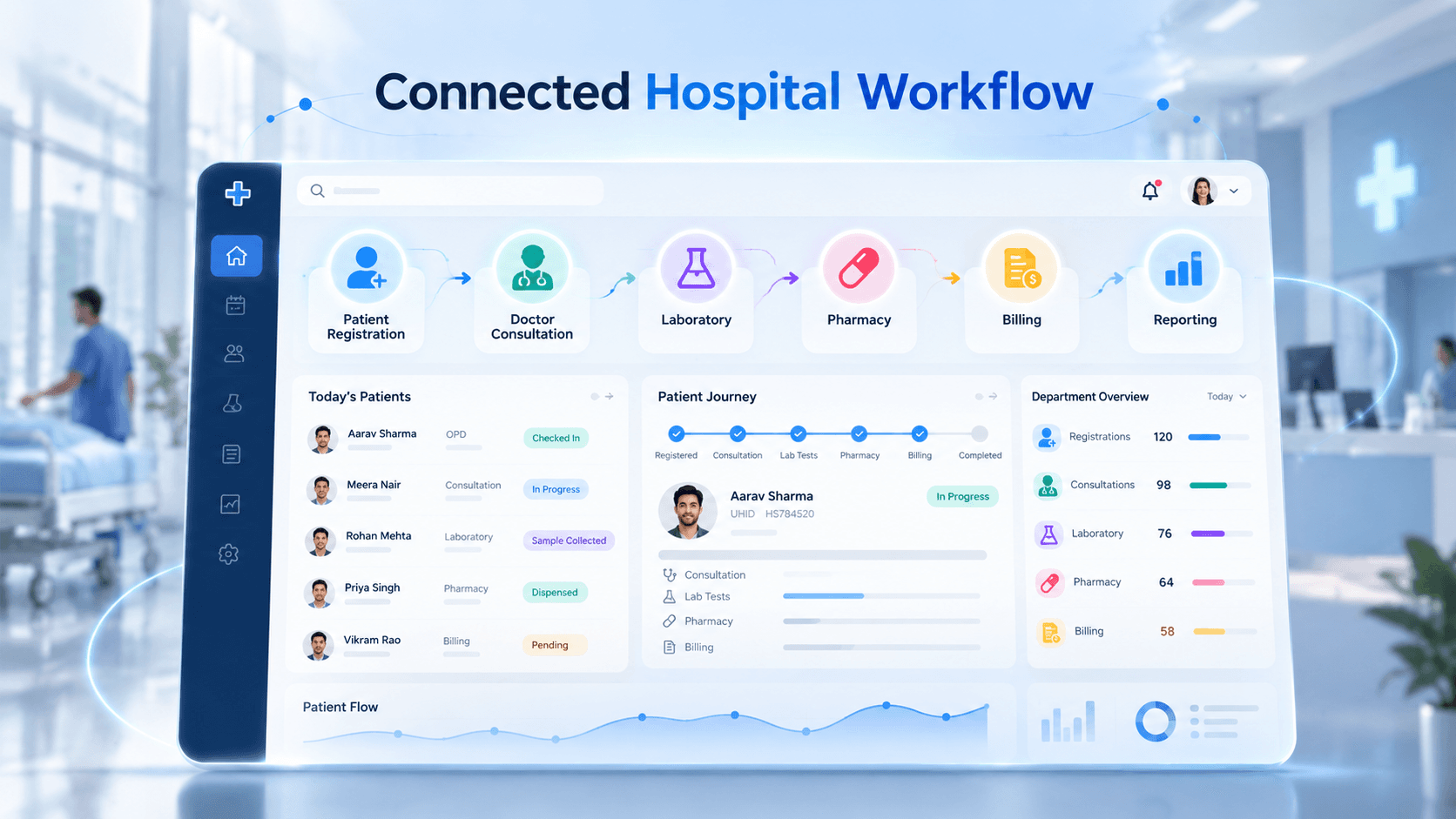
Appointment or Walk-In → Registration → Check-In → Digital Token → Consultation → Lab or Pharmacy → Billing → Follow-Up
IPD, Bed and Ward Management
The IPD module helps hospitals manage admissions, bed allocation, ward transfers, nursing activities, treatment orders and discharge workflows.
Management teams can view:
- Available and occupied beds
- Department and ward capacity
- Patient admission status
- Transfer history
- Expected discharges
- Nursing and service requirements
Bed, ward and resource management are repeatedly identified as foundational HMS capabilities because they connect clinical care with hospital capacity planning.
Laboratory and Diagnostic Integration
Doctors should be able to request laboratory tests from the patient record. Laboratory teams can receive the order, collect and track samples, process results and return approved reports to the HMS.
A connected Lab Management System Software can support:
- Test and package booking
- Barcode-based sample tracking
- Technician work queues
- Result validation
- Pathologist approval
- Laboratory billing
- Online report delivery
Laboratory, radiology and pharmacy integrations reduce repeated manual entry and help departments work with the same patient and order information.
Pharmacy, Inventory and Procurement
A pharmacy module can connect prescriptions with dispensing, medicine stock, batch details, expiry dates and patient billing.
Inventory management may cover medicines, surgical items, consumables, medical equipment and departmental stock. The system can provide reorder alerts, usage history, purchase information and supplier records.
Billing, Insurance and Financial Reporting
Hospital billing can be complex because one patient may receive consultations, room services, procedures, medicines, diagnostic tests and other chargeable services.
An integrated billing module can manage:
- Service and package pricing
- Interim and final bills
- Payments and refunds
- Discounts and approvals
- Insurance information
- Outstanding balances
- Department-wise revenue
- Financial reports
Centralised billing helps connect clinical services with their associated charges and gives management clearer financial visibility.
HMS Integration and Interoperability
A hospital platform should be designed to exchange information with other authorized systems rather than becoming another isolated database.
Possible integrations include:
- LIMS and laboratory analyzers
- Radiology Information Systems and PACS
- Pharmacy software
- Insurance and payment services
- Accounting platforms
- Telemedicine systems
- Patient mobile applications
- Healthcare CRM
- Government digital-health services
HL7 FHIR is a healthcare information-exchange standard that represents clinical and administrative information as structured resources. The exact standard and implementation version should be selected according to the connected systems and project requirements.
For Indian hospitals, the architecture may also support applicable ABHA and ABDM integration workflows. Explore our ABDM-ready healthcare software case study. Official ABDM guidance requires software providers to integrate and validate applicable APIs before describing a specific solution as officially certified.
Security Requirements for Hospital Software
Hospital software manages sensitive personal, medical and financial information. Security must therefore be incorporated during architecture and development—not added only before deployment.
Important controls include:
- Role-based access
- Least-privilege permissions
- Encryption in transit and at rest
- Secure API authentication
- Audit trails
- User activity logs
- Backup and disaster recovery
- Session and device controls
- Vulnerability testing
- Production monitoring
Compliance requirements depend on the country, data flows, hosting model and intended use. A software vendor should not make blanket compliance claims without reviewing the complete implementation.
AI in Hospital Management Software
AI can enhance selected hospital workflows after reliable data and permissions are established.
Practical applications include:
- Patient-history summarization
- Consultation documentation drafts
- Appointment assistance
- Patient enquiry chatbots
- Bed-demand forecasting
- Inventory forecasting
- Billing anomaly detection
- Operational dashboards
- Workflow alerts
Our AI Assistant for Doctors in HMS case study demonstrates how AI can assist consultation documentation and patient-history review.
AI output should remain reviewable, with doctors and authorized hospital professionals responsible for clinical decisions and final documentation. Competitor development guides similarly position AI around automation, forecasting, workflow assistance and patient support.
Build a Scalable HMS Around Your Hospital Workflows
Hospital Management Software Development Process
A reliable HMS development process should include:
- Workflow discovery: Study patient, doctor, staff and department journeys.
- Requirements and MVP planning: Prioritize the most valuable modules.
- Architecture design: Define data models, integrations, security and deployment.
- UI/UX design: Build role-specific interfaces for clinical and administrative users.
- Development and integration: Implement modules, APIs and third-party connections.
- Testing: Validate workflows, performance, security and usability.
- Phased deployment: Roll out to selected departments before hospital-wide adoption.
- Training and support: Train users and monitor real operating conditions.
- Continuous enhancement: Improve the platform based on usage and changing requirements.
Competitor research consistently emphasizes discovery, clinician involvement, architecture planning, user testing, phased implementation and ongoing support as essential to successful adoption.
What Affects HMS Development Cost?
Hospital management software development cost depends on:
- Number and complexity of modules
- Web and mobile applications
- Number of hospitals or branches
- User roles and permissions
- Laboratory, pharmacy and device integrations
- Billing and insurance requirements
- Data migration
- Cloud or on-premise deployment
- Security and testing
- Training and post-launch support
A focused HMS MVP costs less and launches faster than a multi-location enterprise platform. Competitor estimates vary widely because scope, technology, integrations and customization materially affect the final budget and timeline.
Build a Connected Digital Hospital Platform
Murmu Software Infotech develops custom HMS platforms for hospitals, clinics, diagnostic centers and healthcare organizations.
Our Digital Healthcare Management System can connect HMS, OPD, laboratory operations, telemedicine, patient engagement, mobile applications and responsible AI-assisted workflows.
Watch the Digital Healthcare Management System demonstration to explore how hospital operations, virtual care and AI capabilities can work together.
Planning to develop or modernize hospital management software? Request a workflow assessment and personalized HMS demonstration.
Frequently Asked Questions
What is hospital management software development?
Hospital management software development is the process of designing, building, integrating and supporting a digital platform that manages clinical, administrative, operational and financial hospital workflows.
What modules should a Hospital Management System include?
A complete HMS can include patient registration, appointments, EMR, OPD, IPD, bed and ward management, billing, insurance, pharmacy, laboratory, inventory, staff permissions and management dashboards.
What is the difference between custom and ready-made hospital software?
Ready-made software provides predefined modules and may be implemented faster. Custom HMS software is designed around the hospital's workflows, user roles, billing rules, integrations, reports and long-term expansion plans.
How does hospital management software improve operations?
Hospital software centralises patient and operational information, reduces repeated data entry, connects departments, standardises workflows and gives authorised teams real-time visibility into hospital activities.
Can HMS software manage OPD and IPD workflows?
Yes. OPD modules can manage appointments, walk-ins, queues, consultations and follow-ups, while IPD modules can manage admissions, beds, wards, nursing activities, treatment orders, transfers and discharge.
Can hospital software integrate with a laboratory system?
Yes. HMS software can send laboratory orders, receive approved results and connect sample, billing and patient-record workflows through supported APIs, middleware or custom integrations.
Can hospital management software integrate with pharmacy systems?
Yes. Pharmacy integration can connect digital prescriptions, medicine dispensing, billing, stock levels, batches, expiry dates, purchase records and inventory alerts.
Can an existing Hospital Management System be modernised?
Yes. An existing HMS can be assessed and modernised through interface redesign, module replacement, API development, cloud migration, database improvement, mobile applications and third-party integrations.
Can hospitals provide patient mobile applications?
Yes. A patient application can support registration, appointments, reports, prescriptions, billing, telemedicine, notifications and follow-up access when connected securely with the HMS.
Can an HMS support ABDM and ABHA workflows?
Hospital software can be designed to support applicable ABHA verification, structured health records and consent-based ABDM workflows. Official integration claims should only be made after completing the applicable validation process.
How can AI be used in hospital management software?
AI can assist with patient-history summaries, consultation documentation drafts, appointment support, patient enquiries, operational forecasting, inventory planning and workflow alerts.
Can AI make clinical decisions inside an HMS?
AI can support healthcare professionals with information and workflow assistance, but clinical decisions and final documentation should remain under the control of qualified and authorised professionals.
What security features should hospital software include?
Important controls include role-based permissions, secure authentication, encryption, API protection, audit trails, activity logging, backups, disaster recovery, vulnerability testing and production monitoring.
How much does hospital management software development cost?
The cost depends on the number of modules, hospitals, departments, users, mobile applications, integrations, data migration, deployment model, security requirements, testing and ongoing support.
How long does custom HMS development take?
The timeline depends on scope, workflows, integrations, migration and testing. A focused HMS MVP can be delivered sooner than a complete multi-specialty or multi-location hospital platform.
What should an HMS MVP include?
An HMS MVP should prioritise essential workflows such as patient registration, appointments, OPD, doctor consultations, billing, user permissions and core reports before adding advanced enterprise modules.
How should a hospital choose an HMS development company?
Evaluate healthcare workflow experience, relevant case studies, integration capabilities, security practices, customisation, user experience, project ownership, staff training, maintenance and long-term technical support.