Development / CMS
Headless CMS Sitecore vs Traditional CMS: Which is Better for Enterprises?
PPrem Murmu5 Min Read
Enterprise digital experience expectations have changed dramatically over the last few years.
Modern organizations are expected to deliver:
Traditional CMS platforms were not designed for these modern enterprise demands.
As a result, many organizations are now evaluating whether a headless CMS Sitecore architecture is better than traditional CMS implementations.
This is one of the most important strategic technology decisions enterprises will make in 2026.
Choosing the wrong architecture can lead to:
This guide explains the differences between traditional CMS and headless CMS architecture, how Sitecore CMS fits into modern enterprise ecosystems, and which approach is best for long-term enterprise growth.
Many enterprises still operate on traditional monolithic CMS environments.
While these systems worked well in the past, modern digital experience requirements have evolved significantly.
This creates several major business challenges.
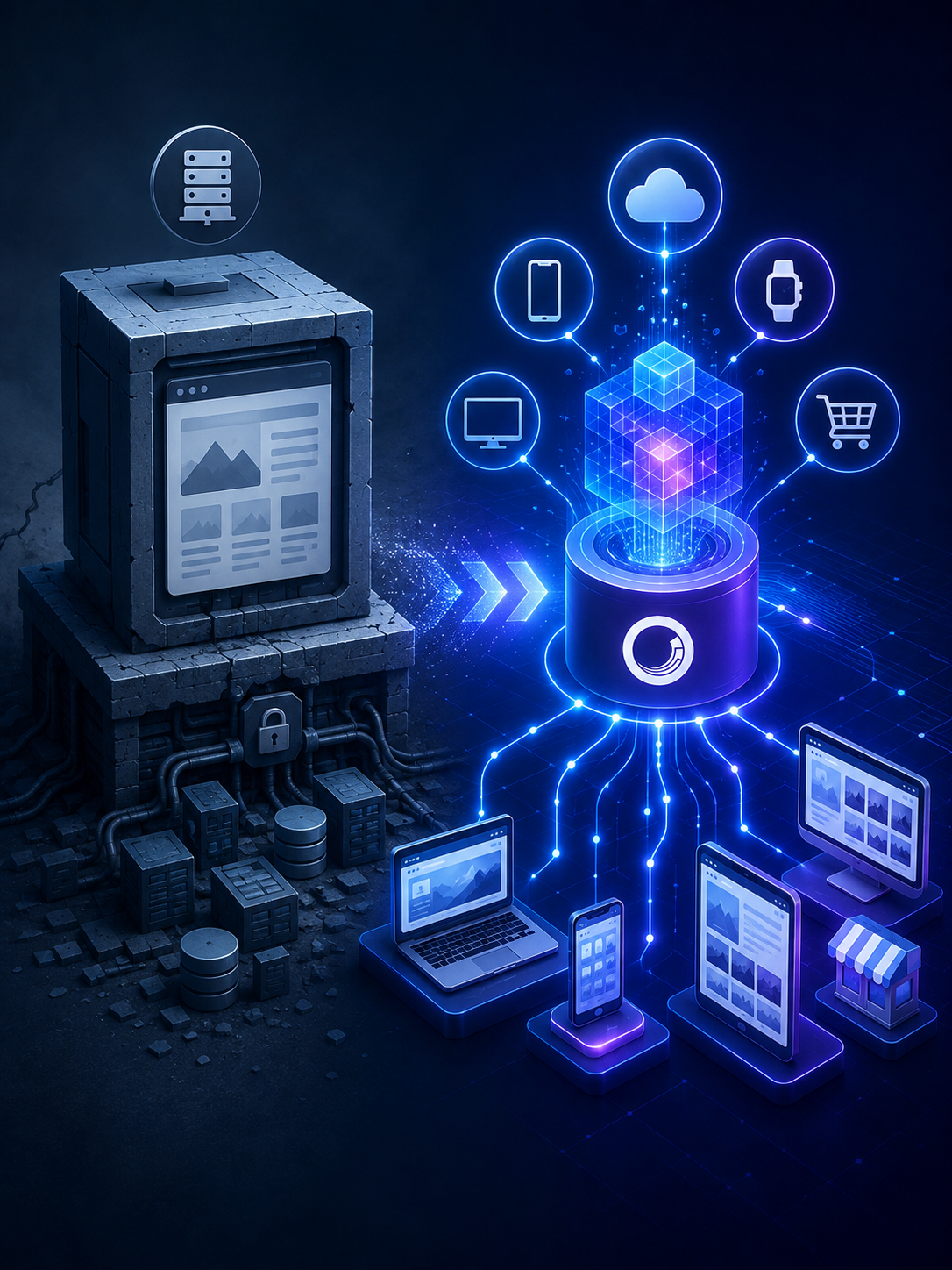
Compare traditional and headless Sitecore architectures to unlock faster performance, omnichannel delivery, scalable infrastructure, flexible frontends, and AI-powered personalization.
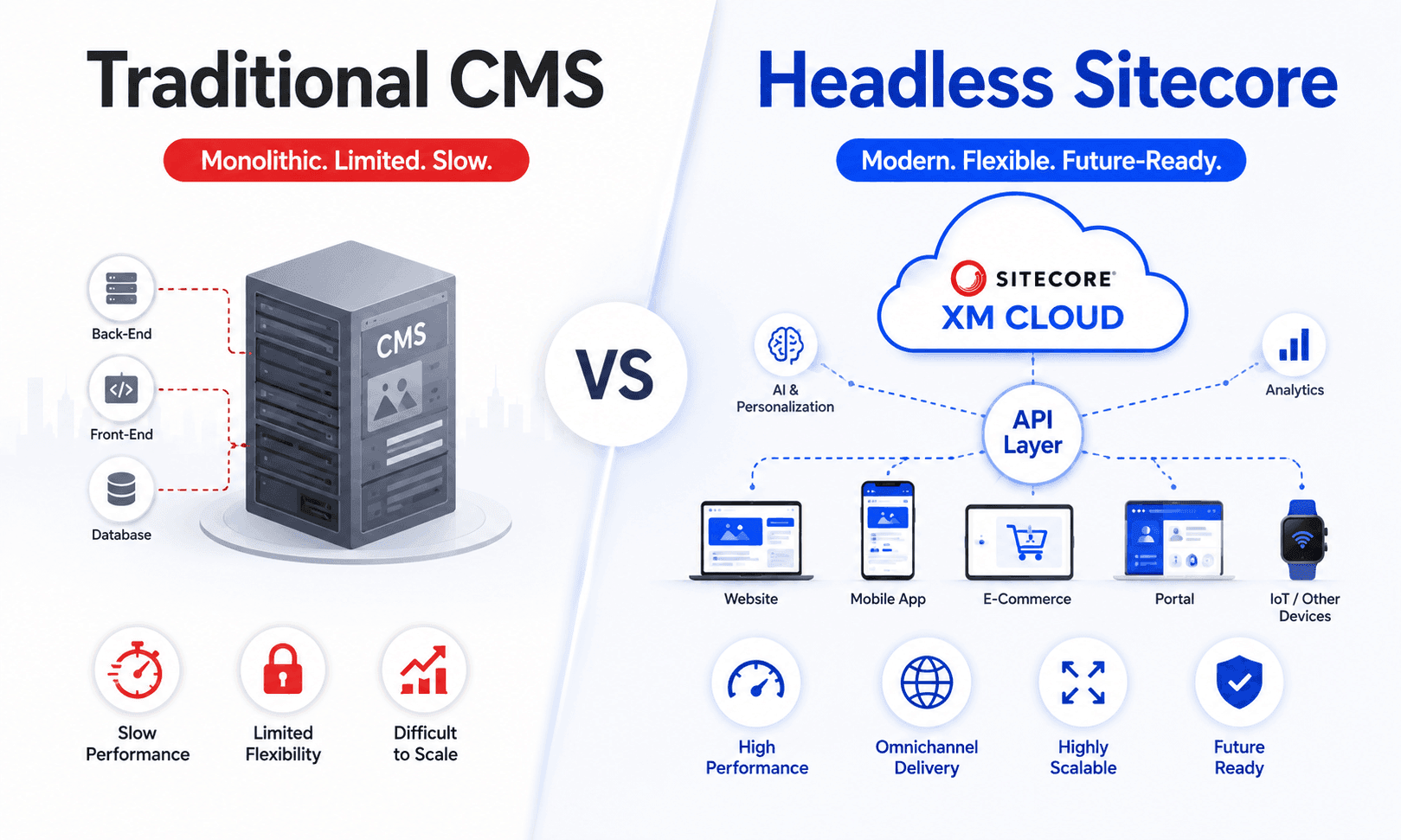
Traditional CMS platforms tightly couple frontend presentation with backend content management.
This often creates:
Modern enterprises need to deliver content across:
Traditional CMS systems struggle to support scalable omnichannel delivery efficiently.
Legacy CMS platforms often require:
This increases long-term operational cost significantly.
Modern digital experiences require flexibility.
Traditional CMS systems often restrict frontend teams from using modern technologies such as:
As enterprise ecosystems grow globally, traditional CMS architecture often becomes difficult to scale efficiently.
Digital experience directly influences customer behavior and business growth.
Organizations with faster, scalable, and personalized experiences gain measurable competitive advantages.
Modern customers expect:
Poor digital experiences directly impact conversions and customer retention.
Businesses today need to launch campaigns, products, and experiences rapidly.
Modern architecture enables:
Cloud-native and headless platforms reduce:
Modern enterprise platforms increasingly use:
This improves customer engagement and long-term loyalty.
A traditional CMS combines:
into a single tightly connected system.
Examples of traditional CMS approaches include older monolithic implementations.
Traditional CMS platforms still offer some advantages for smaller or less complex environments.
Traditional CMS systems are often simpler to deploy for basic websites.
Frontend and backend systems are managed together.
Many organizations are already familiar with traditional CMS operations.
However, enterprise digital transformation requirements increasingly expose major limitations.
Scaling globally becomes difficult.
Content reuse across multiple touchpoints is restricted.
Frontend flexibility and optimization are limited.
Modern frontend technologies are harder to integrate.
A headless CMS Sitecore architecture separates content management from frontend presentation.
Content is delivered through APIs while frontend experiences are built independently using modern technologies.
This creates significantly greater flexibility and scalability.
Yes.
Modern Sitecore implementations support full headless CMS architecture through:
Sitecore has evolved into a modern composable digital experience platform.
Content can be delivered seamlessly across:
Modern frontend frameworks improve:
Headless architecture aligns naturally with modern cloud platforms like XM Cloud.
Modern Sitecore ecosystems support:
Organizations can use modern technologies such as:
to build scalable digital experiences.
| Capability | Traditional CMS | Headless CMS Sitecore |
|---|---|---|
| Frontend Flexibility | Limited | Extensive |
| Performance | Moderate | High-speed |
| Omnichannel Delivery | Weak | Strong |
| AI Integration | Minimal | Advanced |
| Scalability |
Modern organizations increasingly prioritize:
Traditional CMS systems often cannot support these requirements effectively.
Headless architecture is particularly valuable for enterprises that require:
Multi-region digital ecosystems require flexible architecture.
Organizations delivering content across multiple touchpoints benefit significantly from headless CMS.
Modern customer engagement increasingly depends on intelligent personalization.
Fast websites improve SEO, engagement, and conversions.
Headless architecture supports long-term digital transformation strategies.
Headless CMS implementation requires specialized expertise.
The right implementation partner helps enterprises:
Modern Sitecore implementations increasingly rely on XM Cloud.
Strong expertise in:
is essential.
Large-scale ecosystems require scalable integrations.
Modern digital experience requires intelligent customer engagement strategies.
At Murmu Software Infotech, we help enterprises build scalable digital ecosystems using modern Sitecore headless architecture.
Our expertise includes:
The future of enterprise digital experience is becoming increasingly:
Traditional CMS platforms continue to struggle with modern scalability and performance requirements.
A modern headless CMS Sitecore architecture enables enterprises to:
Organizations that modernize early will gain a major competitive advantage in the evolving digital experience economy.
Planning a Sitecore modernization or XM Cloud migration initiative?
✔ Architecture assessment
✔ Headless CMS roadmap
✔ XM Cloud migration planning
✔ Performance optimization insights
✔ AI personalization recommendations
👉 Connect with our Sitecore experts and build a scalable enterprise digital experience platform for the future.
A traditional CMS tightly connects content management with frontend presentation, while Sitecore headless CMS separates content from the presentation layer and delivers content through APIs. This gives enterprises greater frontend flexibility, omnichannel delivery, scalability, and integration options.
Yes. Modern Sitecore implementations support headless CMS architecture through technologies such as Sitecore JSS, Next.js, APIs, GraphQL, and Experience Edge. Sitecore XM Cloud is built around a cloud-hosted headless approach.
For enterprises that need omnichannel delivery, scalable architecture, modern frontend frameworks, cloud deployment, personalization, and complex integrations, a Sitecore headless approach can provide significant advantages over a tightly coupled traditional CMS. The best choice still depends on business requirements, technical capabilities, budget, and governance needs.
| Moderate |
| Enterprise-grade |
| Cloud-Native Support | Limited | Strong |
| Personalization | Basic | Advanced |
| Future Readiness | Lower | High |
Key benefits include frontend flexibility, omnichannel content delivery, integration with modern frameworks such as Next.js, cloud scalability, reusable content, API-driven architecture, and support for personalized digital experiences.
Enterprises are adopting headless architecture to support faster digital experiences, multiple customer touchpoints, modern frontend development, scalable cloud infrastructure, content reuse, and more flexible integrations. Headless architecture can also support future channels without rebuilding the underlying content system.
A headless Sitecore implementation can support high-performance frontend architectures by allowing teams to use modern frameworks such as Next.js and optimize rendering, caching, delivery, and frontend performance independently from content management.
Yes. Sitecore provides headless development capabilities for Next.js through its JavaScript SDK and related Sitecore headless technologies. Next.js supports rendering approaches such as server-side rendering and static generation, depending on the implementation.
Sitecore XM Cloud is a cloud-hosted headless web CMS and part of Sitecore's modern composable digital experience platform. It includes Sitecore's headless capabilities, Pages editor, Headless SXA, Headless Services, Next.js SDK, and Experience Edge.
A traditional CMS may be appropriate when an organization has a simple website, limited development resources, primarily web-only content needs, a strong preference for built-in templates and editing tools, or a need for a simpler initial implementation.
A typical migration involves assessing the existing CMS, defining the target architecture, modeling reusable content, selecting the Sitecore implementation approach, building the frontend with technologies such as Next.js, integrating APIs and third-party systems, migrating content, testing performance and SEO, and executing a phased production rollout.