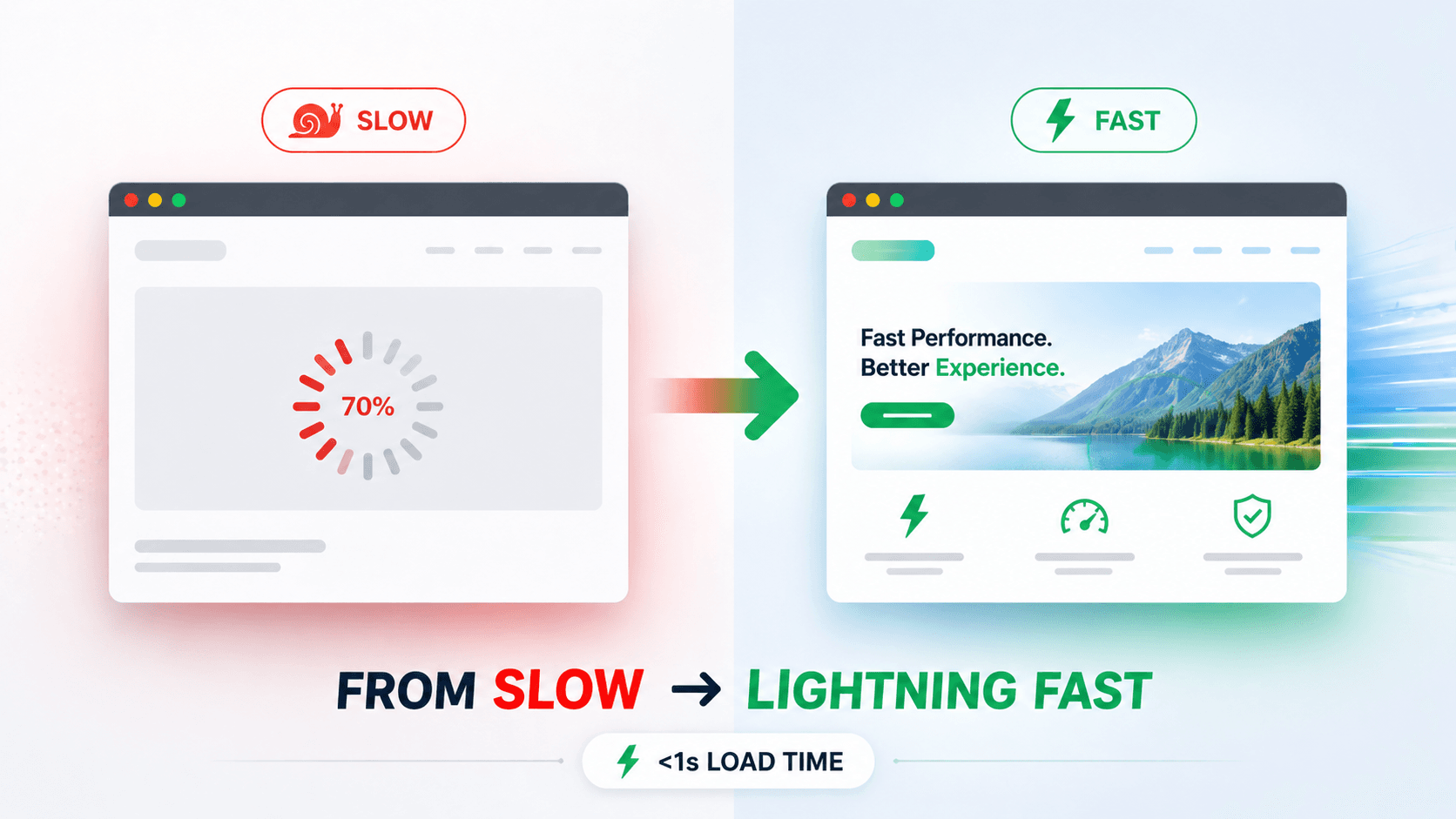
From Slow to Lightning Fast: WordPress Headless + Next.js SEO Optimization Strategy for 2026
In This Article
- Problem: Slow Websites Are Silently Killing Your Growth
- Why It Matters: Performance Directly Impacts Revenue & Rankings
- Solution: WordPress Headless + Next.js Architecture
- Core Strategy to Achieve Lightning Speed
- 1. Headless WordPress Performance Optimization
- 2. Next.js Turbo Speed Website Optimization
- 3. Improve Core Web Vitals (Critical for Ranking)
- 4. WordPress API Caching Best Practices
- 5. Advanced SEO Optimization Strategy
- 6. Edge Caching & Global Delivery
- Comparison: Traditional WordPress vs Headless WordPress + Next.js
- Why Choose an Expert Partner
- Final Insight
Problem: Slow Websites Are Silently Killing Your Growth
In today’s digital economy, your website is not just a marketing asset—it’s a revenue engine.
Yet many enterprise organizations still rely on traditional WordPress setups that suffer from:
- Slow page load times (3–5 seconds)
- Poor Lighthouse and Core Web Vitals scores
- Plugin-heavy architecture causing instability
- Declining SEO performance despite increased spend
For leadership teams—CEOs, CTOs, Managing Directors—this creates a serious business problem:
- Lost conversions
- Reduced ROI on digital investments
- Higher customer acquisition costs
- Lower search visibility
The harsh reality:
If your website is slow, your competitors are already winning your customers.
Why It Matters: Performance Directly Impacts Revenue & Rankings
Google’s ranking algorithm in 2026 prioritizes:
- Core Web Vitals
- Page Experience
- Mobile-first performance
A delay of even 1 second can reduce conversions by up to 20%.
Slow websites lead to:
- Higher bounce rates
- Lower engagement
- Poor brand perception
- Increased dependency on paid ads
This is not just a technical issue—it’s a growth bottleneck.
Boost Rankings, Speed & Conversions—All in One Strategy
Solution: WordPress Headless + Next.js Architecture
To solve this, forward-thinking enterprises are adopting:
- WordPress as a headless CMS
- Next.js as a high-performance frontend
This decoupled architecture allows you to:
- Deliver content via APIs
- Render ultra-fast frontends
- Scale globally with ease
- Improve SEO performance dramatically
Core Strategy to Achieve Lightning Speed
1. Headless WordPress Performance Optimization
Instead of rendering pages inside WordPress:
- Use REST API or GraphQL
- Remove heavy themes and plugin dependencies
- Focus WordPress purely on content management
Outcome: Reduced server load + faster response time
2. Next.js Turbo Speed Website Optimization
Next.js enables:
- Static Site Generation (SSG)
- Server-Side Rendering (SSR)
- Incremental Static Regeneration (ISR)
This hybrid approach ensures:
- Sub-1 second load times
- Faster Time to First Byte (TTFB)
- Seamless scalability
3. Improve Core Web Vitals (Critical for Ranking)
Focus on:
- LCP (Load speed)
- CLS (Visual stability)
- INP (User interaction responsiveness)
With Next.js:
- Automatic image optimization
- Code splitting
- Lazy loading
Result:
Higher Lighthouse scores + better rankings
4. WordPress API Caching Best Practices
Your backend must be optimized:
- Implement Redis or object caching
- Cache API responses
- Reduce database queries
Key insight:
Frontend speed depends on backend efficiency
5. Advanced SEO Optimization Strategy
A strong Next.js SEO optimization guide includes:
- Server-side rendering for crawlability
- Dynamic meta tags
- Structured data implementation
- XML sitemap automation
This ensures:
- Faster indexing
- Higher visibility
- Improved click-through rates
6. Edge Caching & Global Delivery
Deploy your frontend using edge networks:
- Serve content closer to users
- Reduce latency worldwide
This results in:
- Consistent global performance
- Better user experience
- Stronger SEO signals
Comparison: Traditional WordPress vs Headless WordPress + Next.js
| Factor | Traditional WordPress | Headless + Next.js |
|---|---|---|
| Speed | Moderate | Ultra-fast |
| SEO Performance | Good | Excellent |
| Scalability | Limited | Enterprise-grade |
| Security | Moderate | Strong |
| Flexibility | Low | High |
Why Choose an Expert Partner
While the architecture is powerful, execution defines success.
Most organizations struggle with:
- Incorrect API structure
- Poor caching strategies
- SEO misalignment
- Deployment inefficiencies
An expert partner ensures:
- Optimized architecture design
- Seamless integration
- Performance tuning
- Long-term scalability
Explore our services:
- https://murmusoftwareinfotech.com/nextjs-development-services
- https://murmusoftwareinfotech.com/contact
Final Insight
In 2026, speed is not optional—it’s a competitive advantage.
Organizations adopting WordPress Next.js optimization 2026 strategies are:
- Ranking higher
- Converting better
- Scaling faster
Frequently Asked Questions
What is From Slow to Lightning Fast: WordPress Headless + Next.js SEO Optimization Strategy for 2026?
Optimize WordPress with Next.js for faster load times, better SEO, and improved Core Web Vitals using modern headless CMS strategies in 2026.