AI / AI Tools
From AI-Generated MVP to Scalable Product: Custom Development, Optimization & Full Code Ownership
PPrem Murmu2 Min Read
In 2026, building an MVP is faster than ever.
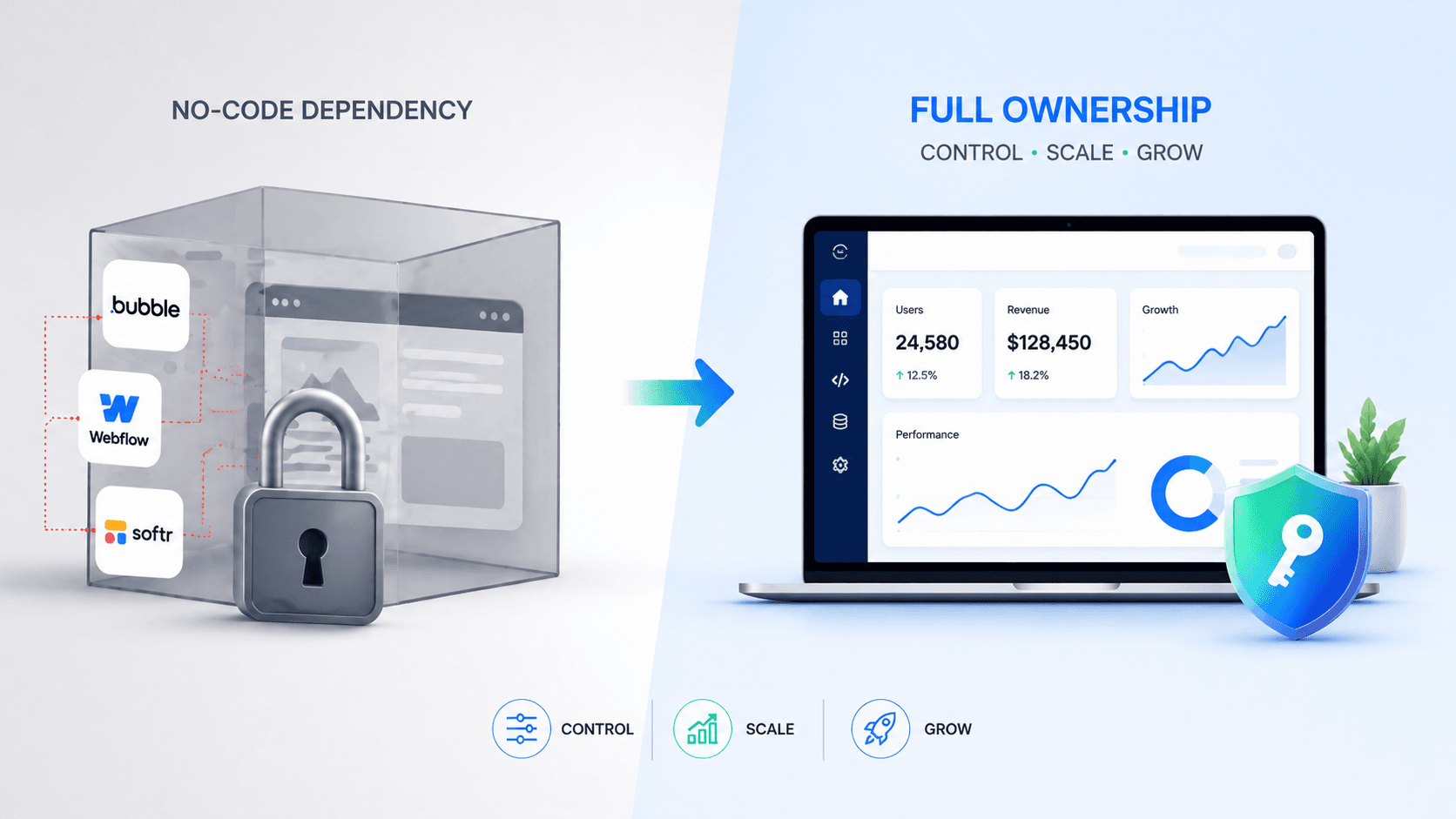
With tools like Webflow, Bubble, and Replit, startups can launch prototypes in days.
But here’s what most leadership teams discover after launch:
What seemed like a fast launch becomes a long-term limitation.
For CXOs and founders, this creates a strategic risk:
The truth:
AI-generated MVPs are great for speed—but not for scale.

Transform your AI-generated MVP into a scalable, high-performance product with custom architecture, optimized workflows, and complete source code ownership.
When your product is built on no-code or AI tools:
This directly impacts:
In contrast, custom-built applications provide:
Bottom line:
If you don’t own your product, you don’t control your growth.
Forward-thinking companies are now shifting from:
👉 AI-generated MVP → Custom-built scalable platforms
This approach ensures:
We begin by analyzing:
This identifies:
👉 Why your current MVP cannot scale
Instead of patching limitations, we:
This allows:
👉 Long-term product evolution
AI-built MVPs often lack:
We:
Focus areas:
Outcome:
👉 Faster, reliable user experience
We help businesses:
We ensure:
Before launch:
Result:
👉 Enterprise-ready product
| Factor | AI / No-Code MVP | Custom Product |
|---|---|---|
| Ownership | Limited | Full |
| Scalability | Restricted | Unlimited |
| Performance | Moderate | High |
| Customization | Limited | Flexible |
| Cost Over Time |
Transitioning from MVP to scalable product is not just technical—it’s strategic.
Most businesses fail because:
An expert partner ensures:
👉 Explore our services:
AI tools help you start fast.
But custom development helps you scale, compete, and lead.
The real advantage in 2026 is not building fast—
It’s building something you fully own and control.
An AI-generated MVP is an early software product or prototype created partly or largely with AI coding tools, AI app builders, no-code platforms, or rapid development tools. It can help validate an idea quickly but may require custom development when performance, security, scalability, integrations, or product control become more important.
Yes. An AI-generated MVP can be audited, retained, refactored, or rebuilt with custom architecture. The right approach depends on code quality, security, data structures, integrations, performance requirements, and the cost of improving the existing product versus rebuilding critical components.
A rebuild should be considered when the product has persistent performance problems, security concerns, limited integrations, difficult customization, platform lock-in, weak architecture, rising subscription costs, or technical limitations that prevent important product growth.
| High (subscriptions) |
| Controlled |
An AI-generated or no-code MVP prioritizes rapid prototyping and validation, while a custom product is designed around specific business requirements, controlled architecture, integrations, performance, security, and long-term scalability. Custom development can also provide greater control over source code and the product roadmap.
An MVP code audit reviews the existing codebase or platform structure, architecture, security, performance bottlenecks, database design, integrations, dependencies, and maintainability. The goal is to determine what can be retained, what should be improved, and whether a partial or full rebuild is the better option.
Yes. A product built with platforms such as Bubble or Webflow can be migrated to custom development. The process may involve rebuilding the frontend and backend, migrating data, replacing platform-specific logic, recreating integrations, and designing infrastructure that supports future product requirements.
With a properly structured development agreement, a business can receive ownership and control of its source code, project assets, documentation, and intellectual property. Ownership terms should be clearly defined before development begins.
MVP performance can be improved through code optimization, database tuning, API optimization, caching, frontend improvements, infrastructure changes, security hardening, monitoring, and removal or replacement of technical bottlenecks identified during an architecture audit.
The decision should be based on a technical audit and business requirements. Patching may be suitable for isolated issues, while rebuilding can be more effective when core architecture, security, maintainability, platform dependency, or scalability problems affect the entire product.
Scale an MVP by validating the core workflow first, auditing the existing foundation, improving or rebuilding critical architecture, completing essential business features, optimizing performance, strengthening security, adding reliable integrations, implementing monitoring, and deploying a production-ready system that can evolve with user demand.