Free AI Strategy Guide for Enterprises & Business Owners: How to Scale, Automate & Lead with AI
In This Article
- Introduction
- Why AI Strategy Matters More Than AI Tools
- Step 1: Define Business Objectives
- Step 2: Identify High-Impact AI Use Cases
- Step 3: Build Data & Infrastructure Readiness
- Step 4: Develop an AI Implementation Roadmap
- Step 5: Measure ROI and Business Impact
- Common Mistakes to Avoid
- The Future of AI in Business
- How Murmu Software Infotech Helps
- Final Thoughts
Introduction
Artificial Intelligence is no longer an experimental technology—it has become a core driver of business strategy and competitive advantage.
Enterprises and growing businesses are leveraging AI to:
- Automate operations
- Enhance customer experiences
- Improve strategic decision-making
- Unlock new revenue opportunities
Yet, many organizations struggle with one key question:
Where do we start with AI?
This Free AI Strategy Guide for Enterprises & Business Owners provides a practical roadmap to help decision-makers implement AI successfully—without unnecessary complexity.
Why AI Strategy Matters More Than AI Tools
Many businesses fail with AI because they jump directly into tools without a clear strategy.
Leading organizations approach AI differently. They focus on:
- Business objectives
- Measurable outcomes
- Scalable implementation
AI is not just about technology—it is about transforming how your business operates and competes.
Companies that adopt AI strategically gain:
- Faster decision-making
- Higher operational efficiency
- Better customer engagement
Step 1: Define Business Objectives
Before implementing AI, leadership teams must clearly define:
- What are the growth targets?
- Where are inefficiencies costing time or money?
- Which processes can be automated?
AI initiatives must align with business goals, not just innovation trends.
For example:
- Reduce customer support costs
- Increase sales conversion rates
- Automate repetitive operational tasks
Step 2: Identify High-Impact AI Use Cases
The most successful AI strategies start with focused, high-impact use cases.
AI Chatbots
- Automate customer support
- Capture and qualify leads
AI Automation
- Streamline internal workflows
- Reduce manual tasks
AI Analytics
- Generate actionable insights
- Improve forecasting
Generative AI
- Automate content creation
- Enhance productivity
Businesses can explore these solutions through our
👉 AI Solutions Development Services
Step 3: Build Data & Infrastructure Readiness
AI success depends heavily on:
- Data availability
- System integration
- Scalable infrastructure
Organizations must evaluate:
- CRM and ERP systems
- API readiness
- Data quality
Without strong data foundations, AI initiatives often fail.
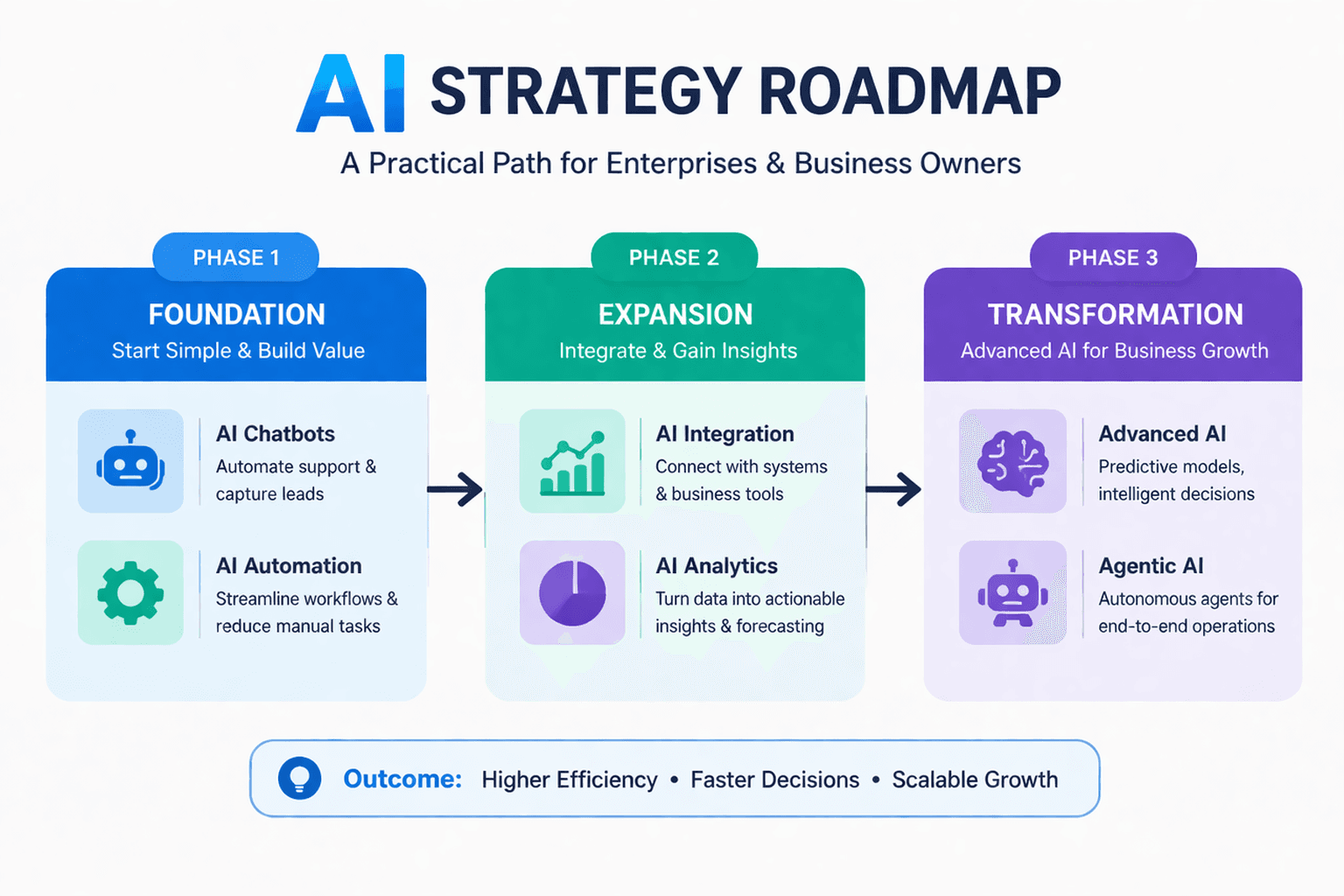
Step 4: Develop an AI Implementation Roadmap
A structured roadmap ensures successful AI adoption:
Phase 1: Foundation
- Deploy AI chatbots
- Implement basic automation
Phase 2: Expansion
- Integrate AI into business systems
- Enable analytics and reporting
Phase 3: Transformation
- Implement advanced AI applications
- Deploy agentic AI systems
A phased approach reduces risk and ensures measurable progress.
Step 5: Measure ROI and Business Impact
AI investments must deliver tangible results.
Key metrics include:
- Cost reduction
- Time savings
- Revenue growth
- Customer satisfaction
Organizations that track ROI effectively can scale AI faster and with confidence.
Common Mistakes to Avoid
Many businesses fail due to:
- Lack of clear strategy
- Poor data quality
- Overcomplicating solutions
- Ignoring ROI measurement
Avoiding these pitfalls is critical for success.
The Future of AI in Business
AI is rapidly evolving into:
- Autonomous decision systems
- Agentic AI workflows
- Intelligent business operations
Forward-thinking organizations are not just adopting AI—they are building AI-driven businesses.
How Murmu Software Infotech Helps
At Murmu Software Infotech, we help enterprises and business owners:
- Build custom AI chatbots
- Develop AI-powered applications
- Implement generative AI solutions
- Integrate AI with CRM, APIs, and MCP
Explore our solutions here:
👉 AI Solutions Development Services
Final Thoughts
AI is no longer optional—it is essential for growth and competitiveness.
Businesses that act today will:
- Lead their industry
- Scale faster
- Operate more efficiently
Frequently Asked Questions
What is Free AI Strategy Guide for Enterprises & Business Owners: How to Scale, Automate & Lead with AI?
Discover a complete AI strategy guide for enterprises and business owners. Learn how to implement AI chatbots, generative AI, and automation to scale your business, reduce costs, and increase revenue.