ABDM Hospital Software
In This Article
- Build Connected, Consent-Based Digital Healthcare
- What Is ABDM Hospital Software?
- Understanding ABDM M1, M2 and M3 Integration
- M1: ABHA Creation, Capture and Verification
- M2: Health Information Provider Integration
- M3: Health Information User Integration
- Core Features of ABDM-Ready Hospital Software
- ABHA-Based Patient Registration
- Scan and Share for Faster OPD Registration
- Consent-Based Health Record Sharing
- Structured Digital Health Records
- HFR and HPR Alignment
- ABDM Software Should Still Be a Complete HMS
- Security and Interoperability Requirements
- Digital Health Incentive Scheme
- Implementation Roadmap for Hospitals
- Build a Connected ABDM-Ready Hospital
Build Connected, Consent-Based Digital Healthcare
India’s healthcare ecosystem is moving toward interoperable, patient-controlled digital health records through the Ayushman Bharat Digital Mission, or ABDM.
For hospitals, clinics and diagnostic centers, adopting ABDM hospital software is not only about creating an ABHA number. It requires a Hospital Management Information System capable of identifying patients, creating structured digital records, linking those records with ABHA and exchanging authorized health information through consent-based workflows.
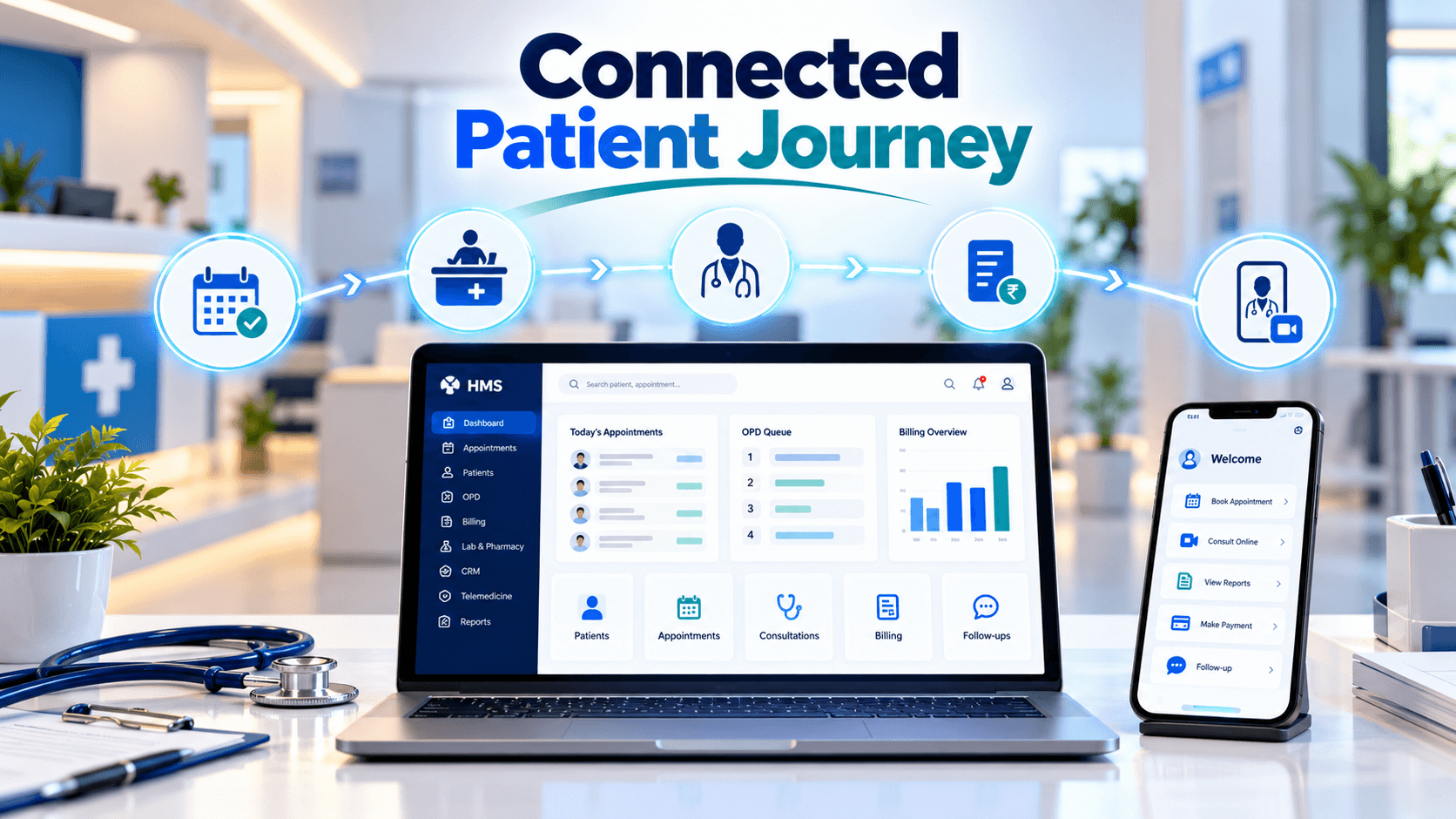
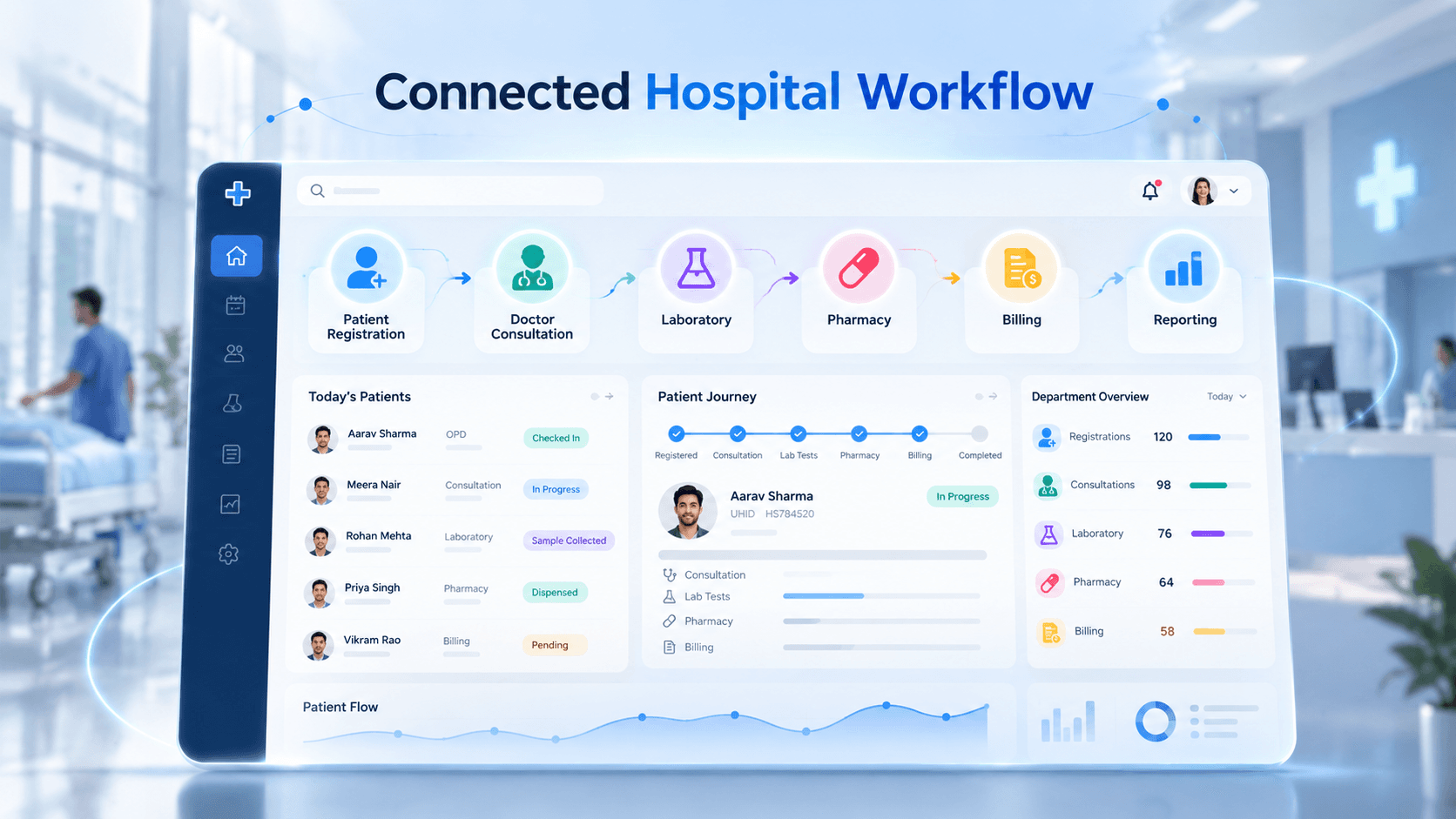
A properly planned ABDM-ready Hospital Management System can connect patient registration, OPD, IPD, consultations, laboratory reports, prescriptions, billing and patient applications while preparing the organization to participate in India’s wider digital health ecosystem.
What Is ABDM Hospital Software?
ABDM hospital software is an HMIS, EMR, EHR or healthcare platform designed to integrate with the services and standards of the Ayushman Bharat Digital Mission.
ABDM’s main building blocks include:
- ABHA: A unique health account used to identify individuals within the digital health ecosystem.
- Healthcare Professionals Registry: A registry of verified healthcare professionals.
- Health Facility Registry: A registry covering hospitals, clinics, diagnostic laboratories, pharmacies and other health facilities.
- Personal Health Records applications: Patient-controlled applications for accessing and managing health records.
- Unified Health Interface: An interface intended to support digital interaction between health-service applications and providers.
An ABDM-enabled HMIS helps healthcare facilities create ABHA-linked health records and participate in interoperable, paper-light healthcare workflows.
Make Your Hospital ABDM-Ready with Secure Connected Digital Workflows
Understanding ABDM M1, M2 and M3 Integration
Hospitals evaluating ABDM software should understand the three principal HMIS integration milestones.
M1: ABHA Creation, Capture and Verification
Milestone 1 allows the software to create, capture or verify a patient’s ABHA during registration.
This can support:
- ABHA creation and verification
- Patient demographic matching
- Faster digital registration
- Linking the hospital’s patient ID with ABHA
- QR-based registration workflows
M2: Health Information Provider Integration
During M2, the hospital becomes a Health Information Provider, or HIP.
The system creates care contexts, links eligible records to the patient’s ABHA address and supports consent-based sharing through a Personal Health Records application.
Applicable records may include prescriptions, diagnostic reports, OP consultation notes, discharge summaries, immunization records, invoices and other supported health-information types.
M3: Health Information User Integration
During M3, authorized healthcare workers can request and view a patient’s linked health information as a Health Information User, or HIU.
Access must occur through a valid patient-consent workflow. The hospital should not be able to retrieve records merely because it knows the patient’s ABHA number.
Core Features of ABDM-Ready Hospital Software
ABHA-Based Patient Registration
The registration module should support ABHA creation or verification, patient matching and linking with the hospital’s internal patient record.
It should also prevent accidental duplicate patient profiles and clearly record whether identity verification and record linking were completed.
Scan and Share for Faster OPD Registration
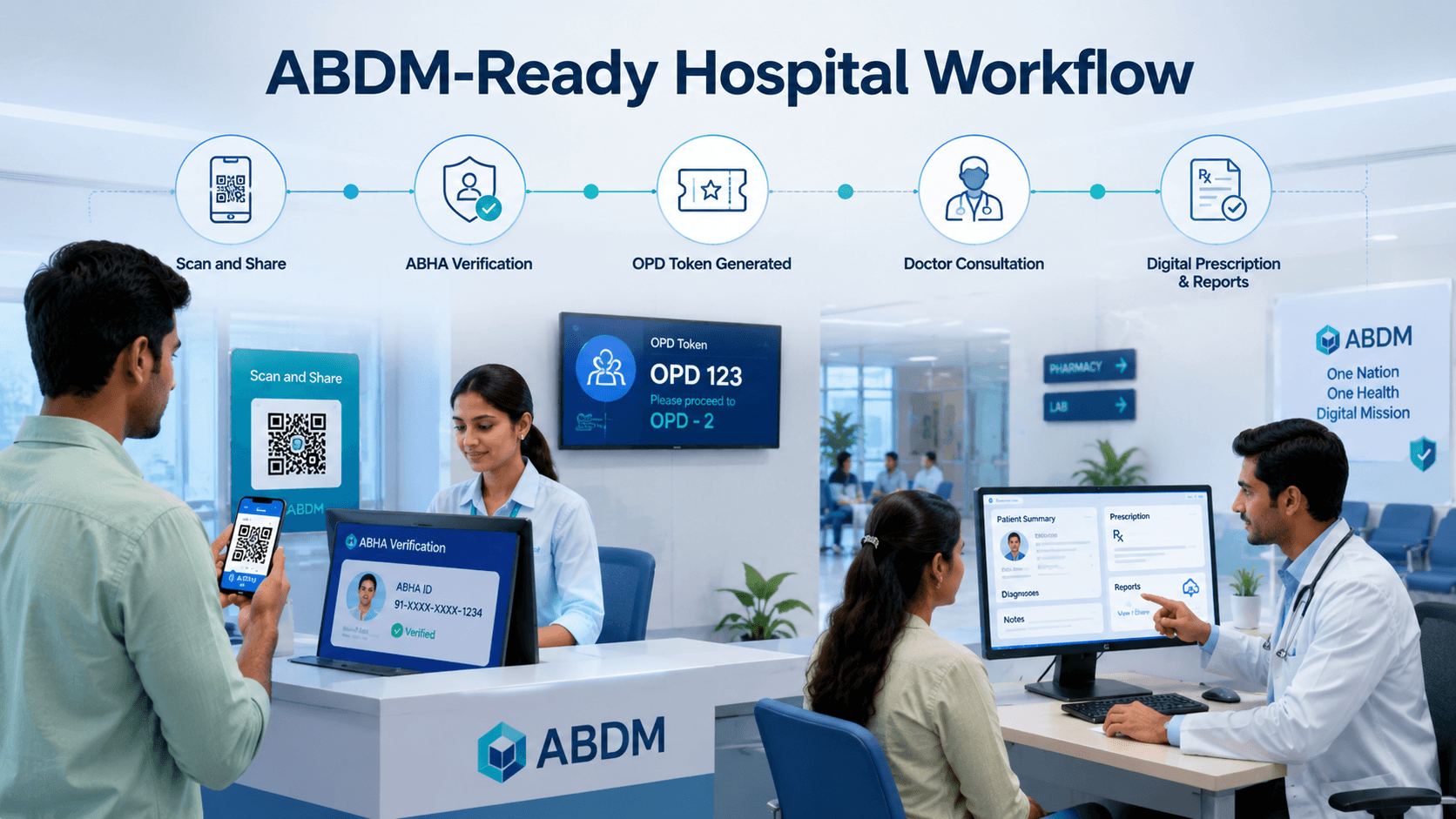
ABDM’s Scan and Share workflow allows patients to scan a facility QR code through a supported application and share demographic information for express registration.
When connected with OPD software, the workflow can reduce repeated form filling and generate an appointment or queue token more efficiently. The official ABHA application also supports QR scanning at ABDM-enabled facilities for express registration.
A practical implementation can connect:
QR Scan → Patient Details Shared → Registration Verified → OPD Token Generated → Doctor Queue Updated
Our OPD Token and Queue Management case study demonstrates how registration, tokens, doctor queues, display screens and consultation status can be managed through one connected workflow.
Consent-Based Health Record Sharing
Patient consent is central to ABDM data exchange.
The software should maintain a clear workflow for:
- Consent requests
- Purpose of access
- Requested record categories
- Permitted duration
- Consent approval or denial
- Consent expiry or revocation
- Audit history
This creates a patient-controlled model in which health information is shared only through authorized workflows.
Structured Digital Health Records
ABDM integration works best when the hospital already produces structured digital records.
The HMIS should support:
- OP consultation records
- Prescriptions
- Diagnostic reports
- Discharge summaries
- Immunization records
- Invoices
- Patient history
- Follow-up information
A hospital cannot achieve meaningful interoperability when important records remain only in handwritten files or unstructured attachments.
HFR and HPR Alignment
Hospitals should complete Health Facility Registry enrolment, while eligible professionals should enrol through the relevant healthcare professional registry.
The official HFR process requires facility details to be submitted and reviewed for verification. The registry supports discoverability and participation in ABDM’s digital-health ecosystem.
ABDM Software Should Still Be a Complete HMS
ABDM integration alone does not manage a hospital.
The underlying platform should still provide operational modules such as:
- Patient registration and EMR
- Appointment scheduling
- OPD and IPD management
- Doctor dashboards
- Bed and ward management
- Billing and insurance
- Pharmacy and inventory
- Laboratory workflows
- Staff permissions
- Reports and analytics
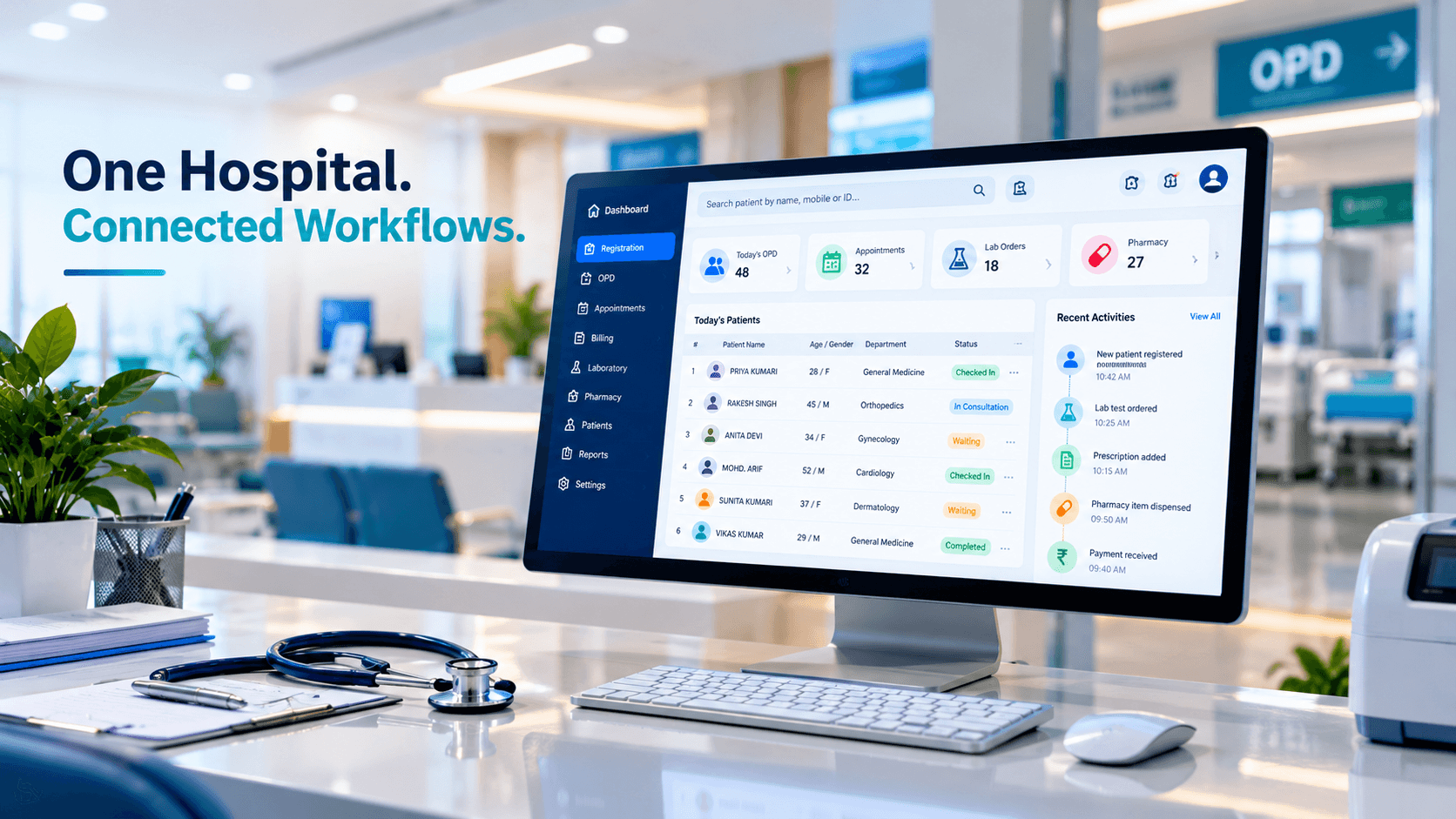
Our Hospital Management System case study explains how these clinical and administrative workflows can operate through a centralized hospital platform.
Diagnostic centers can also connect ABDM-ready patient identity and record-sharing workflows with a Laboratory Management System covering test booking, sample tracking, report approval, billing and online report access.
Security and Interoperability Requirements
An ABDM-ready healthcare platform should be designed around:
- Role-based access control
- Encryption in transit and at rest
- Secure API authentication
- Patient consent
- Audit logs
- Record traceability
- Data-retention controls
- Backup and recovery
- Staff accountability
- FHIR-compatible health-information structures where required
FHIR is used within ABDM health-information exchange workflows to support interoperable digital records between participating systems.
Connect ABHA, Consent and Hospital Operations in One Platform
Digital Health Incentive Scheme
The Digital Health Incentive Scheme supports eligible healthcare facilities and Digital Solution Companies that generate qualifying ABDM-linked digital health transactions.
As of the April–September 2026 scheme period, the minimum eligibility threshold remains 100 transactions, with updated conditions intended to promote KYC-linked records, consent-based sharing, private-sector participation and v3 API adoption. Scheme terms can change, so hospitals should verify the latest official guidelines before estimating incentives.
Implementation Roadmap for Hospitals
A realistic ABDM hospital software implementation should be phased:
- Assess the hospital’s existing HMS and digital-record readiness.
- Complete relevant facility and professional registry processes.
- Digitize required consultation, prescription, billing and diagnostic records.
- Implement ABHA creation, capture and verification workflows.
- Add Scan and Share registration where applicable.
- Implement HIP and consent-based record-linking workflows.
- Add HIU record-access workflows based on the approved scope.
- Complete sandbox testing and required validation.
- Train registration, clinical, laboratory and administrative teams.
- Monitor production workflows, consent failures and record-linking quality.
Murmu Software Infotech’s ABDM-ready healthcare software case study covers ABHA integration planning, digital patient identity, consent-based record sharing, healthcare APIs and secure digital-record architecture.
Build a Connected ABDM-Ready Hospital
The strongest solution combines ABDM integration with the complete hospital journey:
ABHA Registration → OPD/IPD → Consultation → Prescription → Laboratory → Billing → Digital Record Linking → Consent-Based Exchange
Murmu Software Infotech develops connected healthcare platforms covering HMS, OPD, LIMS, healthcare CRM, telemedicine, patient applications and responsible AI-assisted workflows.
Explore our complete Digital Healthcare Management System or watch the HMS, Telemedicine and AI-Powered Hospital Software demonstration.
Planning ABDM integration or modernizing your existing hospital software? Request an ABDM-readiness assessment and personalized platform demo.
Frequently Asked Questions
What is ABDM hospital software?
ABDM hospital software is an HMIS, EMR, EHR, LIMS or clinic platform designed to support ABHA identification, structured digital health records and consent-based health-information exchange through applicable ABDM workflows.
What is the difference between ABDM-ready and ABDM-certified software?
ABDM-ready describes software designed or being prepared for ABDM integration. ABDM-certified or officially integrated should only be used when the specific solution has completed the applicable validation process and has verifiable official evidence.
What is ABDM M1 integration?
M1 enables hospital software to create, capture or verify a patient's ABHA and connect it with the healthcare facility's internal patient-registration workflow.
What is ABDM M2 integration?
M2 enables an enrolled healthcare facility to operate as a Health Information Provider, create care contexts and link supported digital health records with the patient's ABHA address.
What is ABDM M3 integration?
M3 enables an authorised Health Information User to request and receive health information through a valid patient-consent workflow. Knowing an ABHA number alone does not provide unrestricted access.
What is ABDM Scan and Share?
Scan and Share is a QR-based registration workflow through which a patient can share demographic details with a participating facility, helping reduce repeated form filling and speed up OPD registration.
Can ABDM integrate with an existing HMS?
Yes. ABDM APIs and workflows can be integrated with an existing HMS, EMR, EHR, LIMS or clinic platform when its architecture, data model and integration interfaces support the required changes.
Which records can be included in ABDM workflows?
Depending on the supported implementation, records may include consultation notes, prescriptions, diagnostic reports, discharge summaries, immunisation records, invoices and other structured health-information documents.
Can a diagnostic laboratory use ABDM-ready software?
Yes. A laboratory platform can connect patient identity, test orders, diagnostic reports and consent-based record-sharing workflows with ABDM where the applicable LIMS integration requirements are implemented.
What security controls should ABDM software include?
ABDM-ready software should support secure authentication, role-based permissions, encryption, consent management, audit logs, API security, record traceability, backup and controlled data retention.
How long does ABDM integration take?
The timeline depends on the existing software architecture, digital-record readiness, required milestones, API version, testing, organisational approvals and staff-training requirements.
How much does ABDM hospital software cost?
Cost depends on whether a new HMIS is being built or an existing platform is being integrated, the required ABDM milestones, hospital modules, data migration, security controls, testing and ongoing support.
What is the Digital Health Incentive Scheme?
DHIS is an ABDM programme that provides incentives for eligible digital-health transactions generated by qualifying healthcare facilities and digital-solution companies, subject to the current official eligibility and API requirements.
How should a hospital prepare for ABDM integration?
A hospital should assess its existing HMS, digitise core clinical records, complete relevant registry processes, define M1–M3 requirements, implement and test APIs, train staff and monitor production workflows.