What is MCP Server? Architecture, Integration & Business Value in the Era of AI-Native Enterprises
In This Article
- Understanding MCP Server: A Strategic Perspective
- Why MCP Matters for Modern Enterprises
- 1. Standardized Connectivity
- 2. Portable Intelligence
- 3. Faster Innovation Cycles
- How MCP Works: Architecture & Core Components
- 1. MCP Host
- 2. MCP Client
- 3. MCP Server
- 4. Transport Layer
- A Simple Way to Understand MCP
- Integration with Web & Application Development
- AI-Enhanced Web Platforms
- Mobile App Intelligence
- Headless & API-First Systems
- Business Value: Why CXOs Should Pay Attention
- 1. Faster Time-to-Market
- 2. Lower Operational Costs
- 3. Data-Driven Decision Making
- 4. Scalability
- 5. AI as a Business Assistant
- MCP vs Traditional AI Integration
- Emerging Trends Around MCP
- AI-Native Applications
- Composable AI Architecture
- Enterprise Automation
- Unified Data Access
- Why Forward-Thinking Organizations Are Adopting MCP
- Executive Insight
Artificial Intelligence is rapidly evolving from standalone tools into deeply integrated enterprise systems. However, one major limitation has consistently slowed adoption—fragmented integrations between AI models and business systems.
This is where the concept of an MCP Server becomes transformative.
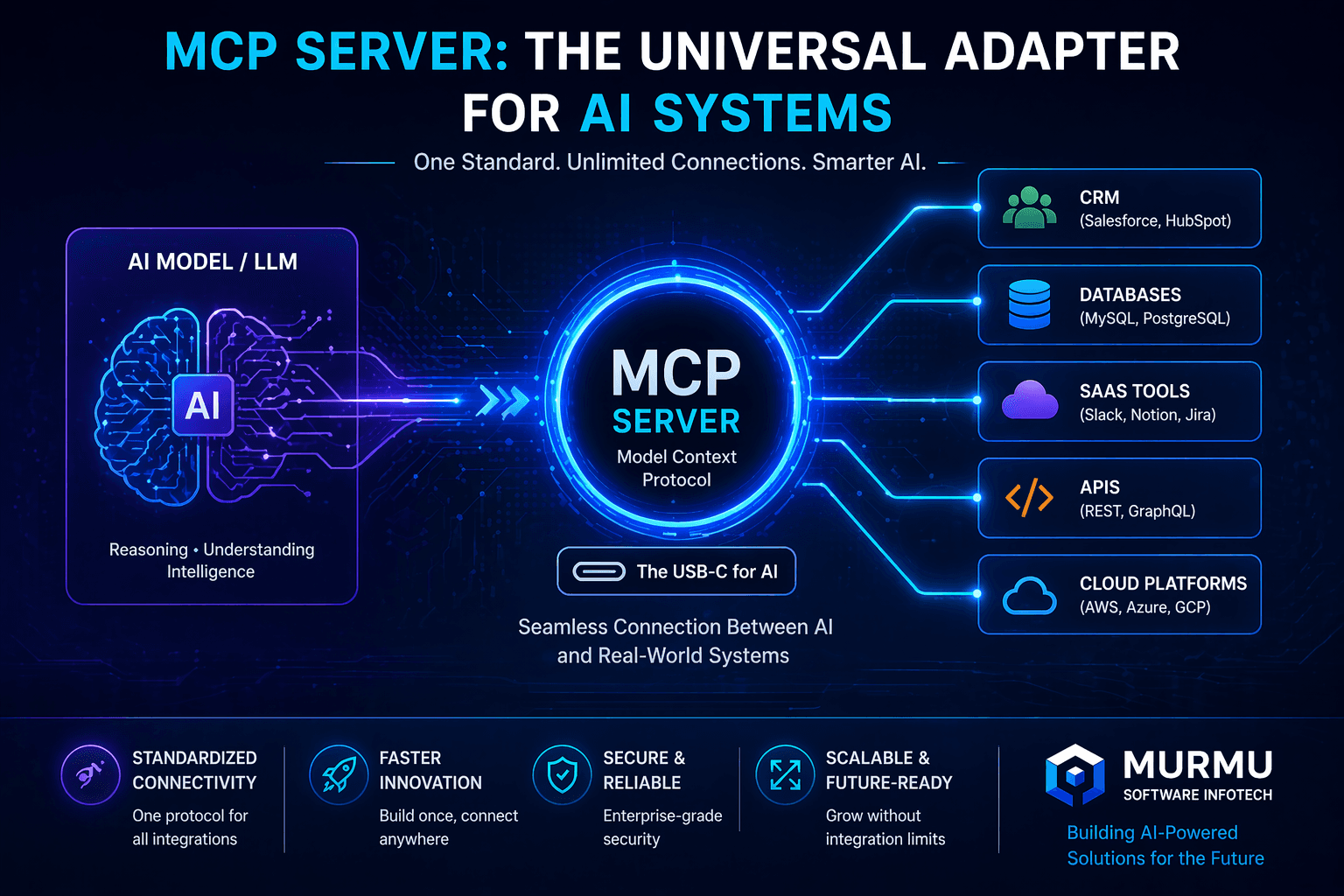
The Model Context Protocol (MCP) introduces a standardized approach to connect AI systems with enterprise data, tools, and workflows—effectively acting as a universal adapter layer for AI ecosystems.
Understanding MCP Server: A Strategic Perspective
At its core, an MCP Server is part of a broader architecture designed to:
- Enable seamless communication between AI models and external systems
- Replace brittle, hardcoded integrations with standardized protocols
- Allow AI systems to interact dynamically with real-world data
For leadership teams, this means AI that is not just intelligent—but operationally useful.
Why MCP Matters for Modern Enterprises
Traditional AI deployments often suffer from:
- Limited access to real-time business data
- Complex API integrations
- High maintenance costs
- Lack of scalability
MCP solves these challenges by introducing:
1. Standardized Connectivity
AI systems can connect to multiple tools without custom integration.
2. Portable Intelligence
Applications become reusable across environments.
3. Faster Innovation Cycles
Reduced dependency on custom development accelerates deployment.
How MCP Works: Architecture & Core Components
Build AI That Actually Works in Your Business
MCP operates through a client-server architecture, ensuring separation between AI reasoning and execution.
1. MCP Host
The environment where the AI model runs (e.g., enterprise AI platform).
2. MCP Client
Acts as the interface between the AI and external systems.
3. MCP Server
Handles execution by connecting to tools, APIs, and data sources.
4. Transport Layer
Manages communication between systems securely and efficiently.
A Simple Way to Understand MCP
Think of MCP as USB-C for AI systems:
- Instead of building a new connector for every device
- You use a universal standard
Similarly, MCP allows AI to plug into:
- CRM systems
- Databases
- SaaS tools
- Internal enterprise platforms
Without rewriting integrations every time.
Integration with Web & Application Development
MCP is redefining how AI integrates with modern applications:
AI-Enhanced Web Platforms
Web applications can now interact with AI that understands real-time data.
Mobile App Intelligence
Apps become smarter with contextual AI capabilities.
Headless & API-First Systems
MCP aligns perfectly with modern architecture trends.
👉 Link: https://yourdomain.com/ai-development-services
Business Value: Why CXOs Should Pay Attention
MCP is not just a technical innovation—it is a business transformation layer.
1. Faster Time-to-Market
Standardized integrations reduce development cycles.
2. Lower Operational Costs
Eliminates repetitive integration work.
3. Data-Driven Decision Making
AI gains access to real-time enterprise data.
4. Scalability
Systems can grow without re-engineering integrations.
5. AI as a Business Assistant
Transforms AI into a context-aware decision engine.
MCP vs Traditional AI Integration
| Traditional AI | MCP-Based AI |
|---|---|
| Hardcoded APIs | Standardized protocol |
| Limited scalability | Highly scalable |
| High maintenance | Low maintenance |
| Static intelligence | Dynamic, context-aware AI |
Emerging Trends Around MCP
AI-Native Applications
Applications built with AI at the core, not as an add-on.
Composable AI Architecture
Modular systems that integrate seamlessly.
Enterprise Automation
AI-driven workflows across departments.
Unified Data Access
Breaking silos between systems.
Why Forward-Thinking Organizations Are Adopting MCP
Organizations adopting MCP gain:
- Competitive advantage
- Faster innovation
- Improved operational efficiency
- Better customer experiences
Executive Insight
The real value of AI lies not in its intelligence—but in its ability to act within your business ecosystem.
MCP makes this possible.
Ready to build AI systems that truly integrate with your business?
Partner with Murmu Software Infotech to build AI-native platforms powered by MCP architecture.
Frequently Asked Questions
What is What is MCP Server? Architecture, Integration & Business Value in the Era of AI-Native Enterprises?
Learn what MCP Server is, how Model Context Protocol works, its architecture, integration, and business value for scalable AI-driven enterprises.