Sitecore AI Design Studio: Why It Matters for Business
In This Article
- Introduction
- What Is Design Studio in Sitecore AI?
- Why Design Studio Matters for Businesses
- 1. Faster Time to Market
- Business Impact
- 2. Improved Personalization
- Business Impact
- 3. Reduced Operational Complexity
- Business Impact
- 4. Data-Driven Decision Making
- Business Impact
- Best Practices for Businesses
- Create Strong Governance
- Focus on Customer Journeys
- Train Teams Properly
- Best Practices for Technical Developers
- Use Headless Architecture
- Prioritize Performance
- Implement Strong Security
- Monitor AI Outputs
- Real-World Use Cases
- E-Commerce
- Financial Services
- Healthcare
- Manufacturing and B2B
- Challenges Organizations Should Consider
- AI Governance
- Data Quality
- Organizational Readiness
- Future of Design Studio in Sitecore AI
- Conclusion
Introduction
Artificial intelligence is changing how digital experiences are designed, built, and optimized. Organizations are moving beyond static websites and generic customer journeys toward adaptive, personalized, and AI-driven experiences. Within the Sitecore ecosystem, Design Studio in Sitecore AI represents a major step toward simplifying experience creation while improving collaboration between business teams and technical developers.
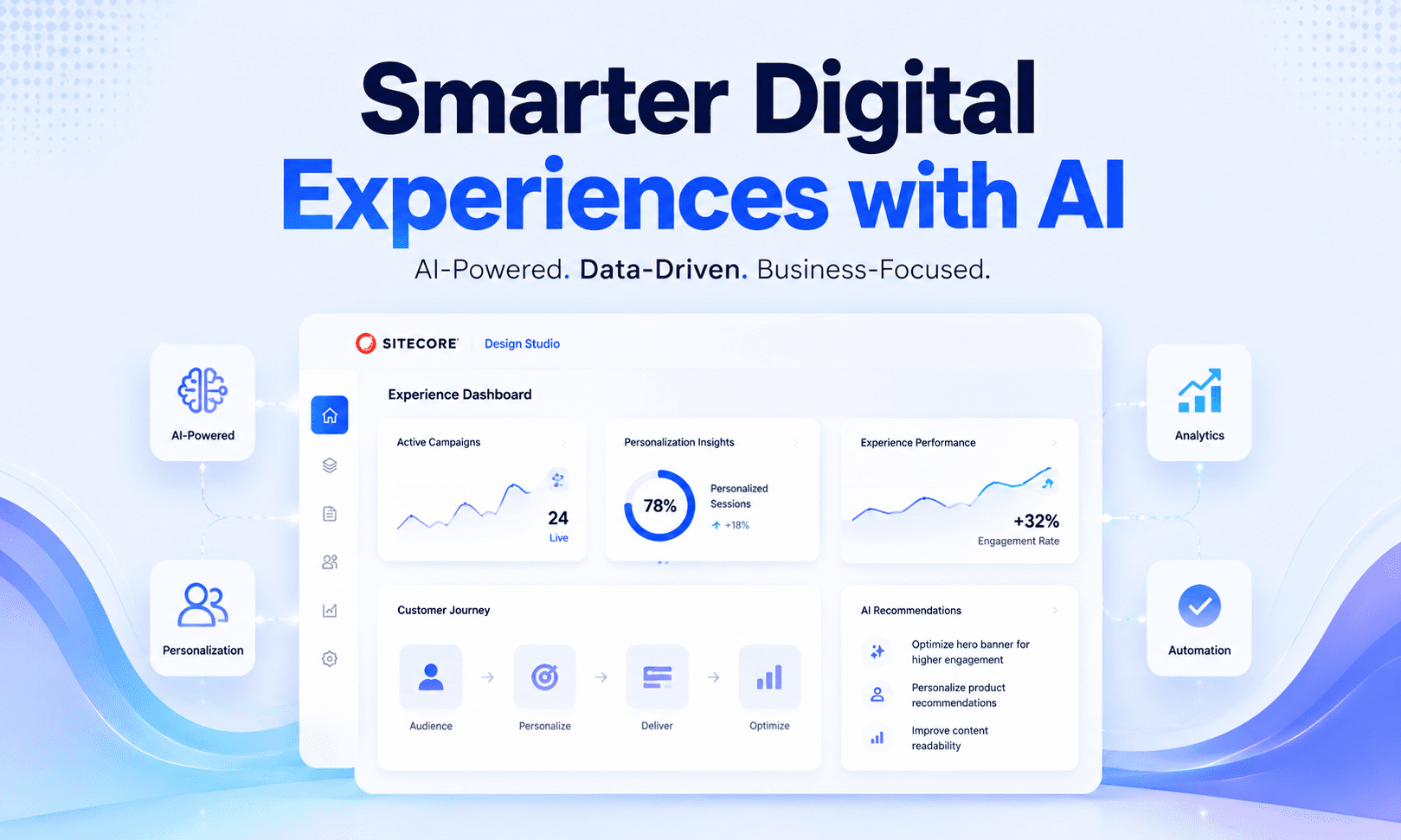
Design Studio combines AI-assisted design workflows, personalization capabilities, content intelligence, and experience orchestration into a unified environment. Instead of relying only on manual development and traditional content management processes, teams can use AI-powered tools to accelerate delivery, improve consistency, and optimize customer engagement.
For businesses, this means faster go-to-market execution, improved personalization, lower operational overhead, and better customer outcomes. For technical developers, it introduces a more efficient framework for managing components, experiences, workflows, and integrations.
This article explains what Design Studio in Sitecore AI is, why it matters, and how both business users and developers can use it effectively.

Transform Experiences With Sitecore AI
Accelerate digital experiences with AI-powered design, personalization, smarter workflows, faster campaigns, and data-driven decisions that drive business growth.
What Is Design Studio in Sitecore AI?
Design Studio in Sitecore AI is an AI-assisted digital experience design environment that helps organizations create, manage, and optimize customer experiences.
It enables:
- AI-assisted content and experience generation
- Visual experience design
- Reusable component management
- Intelligent personalization
- Automated recommendations
- Faster collaboration between marketing and development teams
- Omnichannel experience orchestration
- Design consistency across platforms
Rather than separating design, content, and development into isolated workflows, Design Studio creates a collaborative layer where business users and developers can work together.
The platform supports modern composable architecture principles, making it easier to integrate with:
- Sitecore XM Cloud
- Sitecore Personalize
- Sitecore CDP
- Sitecore Content Hub
- Sitecore Search
- Third-party APIs and services
Why Design Studio Matters for Businesses
Power Your Business with AI-Driven Experiences
1. Faster Time to Market
Traditional digital experience projects often require:
- Long development cycles
- Repeated content approvals
- Manual testing
- Multiple stakeholder dependencies
Design Studio reduces these delays through AI-assisted workflows.
Business teams can:
- Generate layouts quickly
- Create content variations automatically
- Reuse templates and components
- Launch campaigns faster
- Test experiences without major redevelopment
This significantly improves agility.
Business Impact
- Faster campaign launches
- Reduced dependency on engineering teams
- Improved operational efficiency
- Better responsiveness to market changes
2. Improved Personalization
Modern customers expect personalized experiences.
Design Studio enables AI-driven personalization by using:
- Customer behavior
- Session data
- Engagement patterns
- Demographics
- Purchase history
- Intent signals
AI can recommend:
- Dynamic layouts
- Personalized banners
- Product recommendations
- Tailored content blocks
- Optimized customer journeys
Business Impact
- Higher conversion rates
- Better engagement
- Increased customer retention
- Improved digital experience quality
3. Reduced Operational Complexity
Many organizations struggle with fragmented systems and disconnected workflows.
Design Studio centralizes experience management.
Teams can manage:
- Components
- Templates
- Layouts
- Content blocks
- AI recommendations
- Brand consistency
from one unified workspace.
Business Impact
- Lower maintenance overhead
- Simplified governance
- Better collaboration
- Reduced content duplication
4. Data-Driven Decision Making
AI-driven insights help organizations understand what works and what does not.
Design Studio can support:
- A/B testing
- Journey optimization
- Experience analytics
- Performance monitoring
- Conversion tracking
This helps marketing and product teams continuously optimize digital experiences.
Business Impact
- Smarter campaigns
- Better ROI
- Continuous optimization
- Improved customer understanding
Best Practices for Businesses
Create Strong Governance
Define:
- Content ownership
- Approval workflows
- Personalization policies
- AI usage standards
- Publishing guidelines
Governance prevents inconsistent experiences.
Focus on Customer Journeys
Do not use AI only for automation.
Use it to improve:
- Customer intent mapping
- Journey orchestration
- Contextual engagement
- Real-time adaptation
Customer-centric design delivers better outcomes.
Train Teams Properly
Business users should understand:
- AI recommendations
- Personalization concepts
- Experience analytics
- Workflow management
Developer enablement is equally important.
Best Practices for Technical Developers
Use Headless Architecture
Modern Sitecore implementations benefit from headless and composable approaches.
Recommended technologies include:
- Next.js
- React
- GraphQL
- Sitecore JSS
- Edge delivery models
This improves scalability and flexibility.
Prioritize Performance
AI-driven experiences should still remain performant.
Developers should optimize:
- API calls
- Rendering strategies
- Lazy loading
- Caching
- Asset delivery
Performance directly affects user experience.
Implement Strong Security
Because personalization relies on customer data, developers should enforce:
- Authentication standards
- Data encryption
- Secure APIs
- Access controls
- Compliance policies
Security must remain a top priority.
Monitor AI Outputs
AI-generated recommendations should be reviewed regularly.
Developers and business teams should validate:
- Brand alignment
- Accuracy
- Ethical usage
- Accessibility compliance
- Personalization quality
AI should augment human decision-making, not replace governance.
Real-World Use Cases
E-Commerce
Retail organizations can use Design Studio for:
- Dynamic product recommendations
- Personalized landing pages
- Smart search experiences
- Cart recovery journeys
- Campaign optimization
Financial Services
Banks and financial institutions can:
- Personalize onboarding journeys
- Recommend financial products
- Improve customer engagement
- Streamline support experiences
Healthcare
Healthcare providers can:
- Deliver contextual patient education
- Improve portal experiences
- Personalize communication
- Simplify navigation
Manufacturing and B2B
B2B organizations can:
- Personalize account experiences
- Improve lead nurturing
- Deliver targeted resources
- Optimize partner portals
Challenges Organizations Should Consider
AI Governance
Organizations need clear policies around:
- AI transparency
- Data usage
- Ethical personalization
- Content approval
Data Quality
AI effectiveness depends heavily on clean and reliable data.
Poor data quality can result in:
- Irrelevant recommendations
- Weak personalization
- Inaccurate insights
Organizational Readiness
Successful adoption requires:
- Cross-team collaboration
- Process modernization
- Technical enablement
- Executive support
Technology alone is not enough.
Future of Design Studio in Sitecore AI
The future of digital experience management is increasingly AI-driven.
We can expect:
- More autonomous personalization
- Predictive customer journeys
- Conversational experience management
- AI-assisted design systems
- Intelligent optimization engines
- Real-time adaptive interfaces
Sitecore AI Design Studio represents an important transition toward intelligent digital experience ecosystems.
Organizations that adopt these capabilities early can gain competitive advantages in:
- Customer engagement
- Operational efficiency
- Experience quality
- Digital innovation
Conclusion
Design Studio in Sitecore AI is more than a visual editing tool. It is a collaborative experience platform that combines AI, personalization, content intelligence, and composable architecture principles.
For businesses, it provides:
- Faster digital delivery
- Improved personalization
- Better operational efficiency
- Smarter decision-making
For technical developers, it offers:
- Reusable architecture
- Improved collaboration
- AI-assisted workflows
- Better scalability
- Omnichannel flexibility
As digital experiences become more dynamic and customer expectations continue to rise, organizations need platforms that support agility, intelligence, and collaboration.
Design Studio in Sitecore AI helps bridge the gap between business innovation and technical execution, making it an increasingly important capability for modern digital enterprises.
Frequently Asked Questions
What is Sitecore AI Design Studio?
Sitecore AI Design Studio is a centralized workspace in SitecoreAI that helps teams visualize, test and experiment with components and forms, explore design configurations and generate component variants using AI.
Why does Sitecore AI Design Studio matter for businesses?
It can help businesses accelerate digital experience development, improve collaboration, support reusable components, reduce repetitive design work and maintain greater consistency across digital properties.
How does AI help in Sitecore Design Studio?
AI can help generate new component variants, allowing teams to explore alternative design, layout and content configurations without manually duplicating every component.
Can Sitecore AI Design Studio improve time to market?
Yes. By centralizing component discovery, experimentation and AI-assisted variant creation, teams can reduce repetitive setup work and move faster from design exploration to implementation.
Can marketing and development teams collaborate in Sitecore AI Design Studio?
Yes. Design Studio supports designers, developers and content authors by providing a shared environment for visualizing, testing and exploring reusable experience components.
Does Sitecore AI Design Studio support reusable components?
Yes. Teams can visualize, discover and manage components and variants centrally, helping organizations reuse approved design building blocks across digital experiences.
Can businesses test components without affecting live pages?
Yes. The Design Studio provides a safe environment for experimenting with content, layouts, styling and configurations without inserting components into live pages.
Does Sitecore AI Design Studio support responsive design testing?
Yes. Teams can simulate how components appear across different devices and experiment with responsive design configurations.
How does Sitecore AI Design Studio support brand consistency?
Reusable components, design systems and centralized testing can help teams maintain more consistent design patterns across sites. SitecoreAI also provides brand governance capabilities for AI-assisted workflows.
Who should use Sitecore AI Design Studio?
Sitecore AI Design Studio is relevant for enterprise marketing teams, designers, developers, content authors, digital experience teams, product teams and organizations building scalable digital experiences.