MVP Development Agency in USA: How Modern Businesses Are Launching Smarter, Faster, and Leaner
In This Article
- The New Reality of Product Innovation
- Why MVP Development Has Become a Boardroom Strategy
- 1. Risk Mitigation
- 2. Accelerated Go-to-Market
- 3. Real Market Validation
- 4. Optimized ROI
- Why the USA Remains a Key Market for MVP Development
- The Global Delivery Advantage: USA Strategy + Offshore Execution
- Murmu Software Infotech: Delivering MVPs for the USA Market
- Core MVP Services Designed for Business Leaders
- 1. Rapid MVP Prototyping
- 2. Product Validation Framework
- 3. AI-Enabled MVP Solutions
- 4. Cross-Platform Development
- 5. Continuous Iteration & Scaling
- The MVP Execution Model That Works
- Phase 1: Business Discovery
- Phase 2: Lean Development
- Phase 3: Market Testing
- Phase 4: Data-Driven Scaling
- Key Trends Shaping MVP Development in the USA
- 1. AI-First MVPs
- 2. Lean Product Engineering
- 3. API-Driven Architectures
- 4. Continuous Delivery Models
- What Separates a Great MVP Agency from the Rest
- Executive Insight
The speed at which markets evolve today has fundamentally changed how products are built.
Enterprises and startups alike are facing the same challenge:
How do you validate ideas quickly without overinvesting?
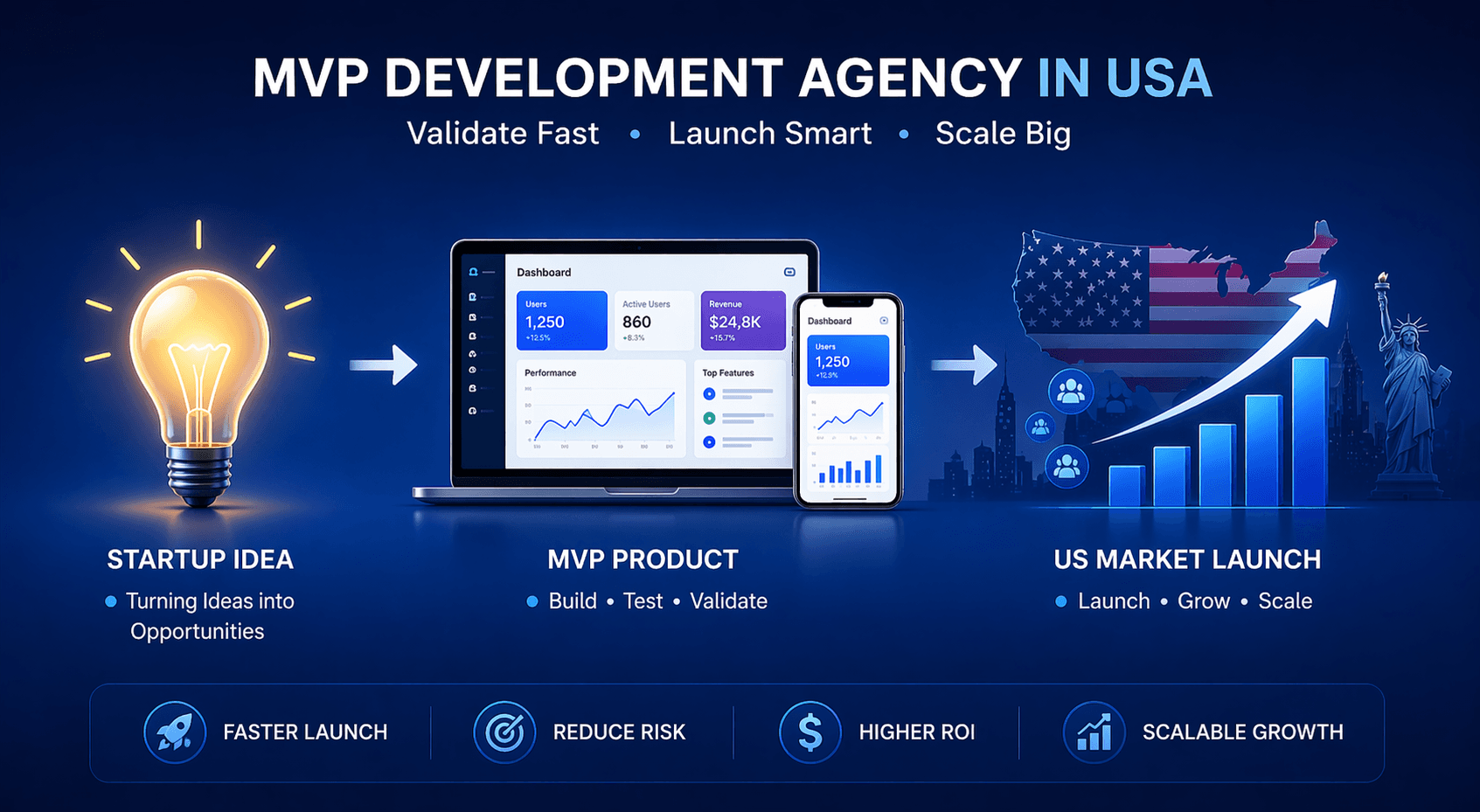
This is where choosing the right MVP development agency in USA becomes a strategic decision—not just a technical one.
Organizations are no longer asking “How do we build this product?”
They are asking:
“How do we prove this product will succeed—before we scale it?”
The New Reality of Product Innovation
The traditional product lifecycle is broken.
- Long development cycles
- High capital investment
- Delayed user feedback
- High failure rates
In contrast, MVP-driven companies operate differently:
✔ Launch early
✔ Learn fast
✔ Iterate continuously

Launch Your MVP Smarter
Turn your product idea into a lean, scalable MVP built faster, validated earlier, and ready for real market growth.
Why MVP Development Has Become a Boardroom Strategy
MVP is no longer just a startup concept—it is now a strategic business framework adopted by enterprises, innovation labs, and venture-backed companies.
For CXOs, the value is clear:
1. Risk Mitigation
Avoid large investments in unvalidated ideas.
2. Accelerated Go-to-Market
Launch in weeks, not quarters.
3. Real Market Validation
Make decisions based on actual user behavior.
4. Optimized ROI
Invest only where value is proven.
Why the USA Remains a Key Market for MVP Development
Launch Your MVP Faster With Lean, Validation-Driven Development
The United States continues to lead in:
- Startup innovation
- Venture capital ecosystems
- Technology adoption
As a result, demand for MVP development agency in USA services is growing rapidly.
However, modern delivery models are evolving.
The Global Delivery Advantage: USA Strategy + Offshore Execution
Today’s most successful companies combine:
This hybrid model delivers:
- Faster turnaround
- Cost optimization
- Access to global talent
Murmu Software Infotech: Delivering MVPs for the USA Market
Murmu Software Infotech specializes in delivering high-impact MVP solutions for businesses targeting the USA market.
With a focus on fast prototyping, lean execution, and product validation, the company helps organizations move from idea to market-ready product efficiently.
Core MVP Services Designed for Business Leaders
1. Rapid MVP Prototyping
Quickly transform ideas into working products.
👉 https://yourdomain.com/mvp-development-services
2. Product Validation Framework
Test assumptions with real users before scaling.
3. AI-Enabled MVP Solutions
Integrate intelligence into your product from day one.
4. Cross-Platform Development
Build solutions for web, mobile, and cloud ecosystems.
5. Continuous Iteration & Scaling
Refine your product based on real-time insights.
The MVP Execution Model That Works
Phase 1: Business Discovery
Align product vision with market demand.
Phase 2: Lean Development
Build only the core features that matter.
Phase 3: Market Testing
Launch and collect real user feedback.
Phase 4: Data-Driven Scaling
Expand based on validated success metrics.
Key Trends Shaping MVP Development in the USA
1. AI-First MVPs
Products are now built with intelligence from the start.
2. Lean Product Engineering
Focus on efficiency and speed.
3. API-Driven Architectures
Enable faster integrations and scalability.
4. Continuous Delivery Models
Products evolve continuously post-launch.
What Separates a Great MVP Agency from the Rest
For CXOs evaluating a MVP development agency in USA, the key differentiators are:
- Business-first approach
- Speed of execution
- Scalability readiness
- Ability to validate ideas
- Strong communication and alignment
Executive Insight
The biggest competitive advantage today is not innovation alone—
it is validated innovation delivered faster than the market.
If you're planning to launch a product for the USA market:
Partner with Murmu Software Infotech to build, validate, and scale your MVP with speed and confidence.
Frequently Asked Questions
What is an MVP development agency in the USA?
An MVP development agency helps startups, enterprises, and product teams design, build, validate, and launch a Minimum Viable Product for the USA market. The goal is to test a product idea with essential features, gather real user feedback, reduce development risk, and make better decisions before investing in a full-scale product.
Why should businesses build an MVP before developing a full product?
Building an MVP allows businesses to validate market demand before committing major time and budget to a full product. It helps teams test assumptions, understand user behavior, collect feedback, identify the most valuable features, and improve product-market fit.
How long does it take to develop an MVP?
MVP development time depends on product complexity, features, integrations, platforms, and validation requirements. A focused MVP can often be designed and developed in weeks, while more complex SaaS, AI, web, or mobile products may require a longer delivery timeline.
How much does MVP development cost in the USA?
MVP development costs vary based on scope, technical complexity, product type, integrations, design requirements, and development model. A lean MVP approach focuses on building only the essential features needed to validate the business idea and reduce unnecessary early-stage investment.
What should be included in a Minimum Viable Product?
A Minimum Viable Product should include the core user problem, the essential product workflow, the most important features, basic user experience, analytics, and enough functionality to collect meaningful feedback from real users. Non-essential features can be added after validation.
Can an MVP be built for web and mobile platforms?
Yes. An MVP can be developed as a web application, mobile application, SaaS platform, cross-platform product, or cloud-based solution. The right platform should be selected based on target users, business goals, speed to market, and validation requirements.
What is AI-powered MVP development?
AI-powered MVP development involves building artificial intelligence capabilities into a product from the beginning. Depending on the use case, this can include AI assistants, automation, intelligent search, recommendations, analytics, generative AI, machine learning workflows, or AI-driven business processes.
How do you validate an MVP idea before scaling?
An MVP can be validated by launching to real users, tracking product usage, collecting qualitative feedback, measuring engagement and conversion, testing assumptions, and identifying whether users receive enough value to continue using or paying for the product.
What is the advantage of a USA strategy and global development team?
A hybrid delivery model can combine market-focused product strategy with access to global engineering talent. This approach can help businesses improve development speed, access specialized expertise, optimize costs, and maintain a focus on product validation and scalable architecture.
How do I choose the right MVP development agency in the USA?
Choose an MVP development agency based on its product strategy, ability to define a lean scope, speed of execution, technical expertise, communication process, product validation approach, scalability planning, portfolio, and ability to support continuous iteration after launch.