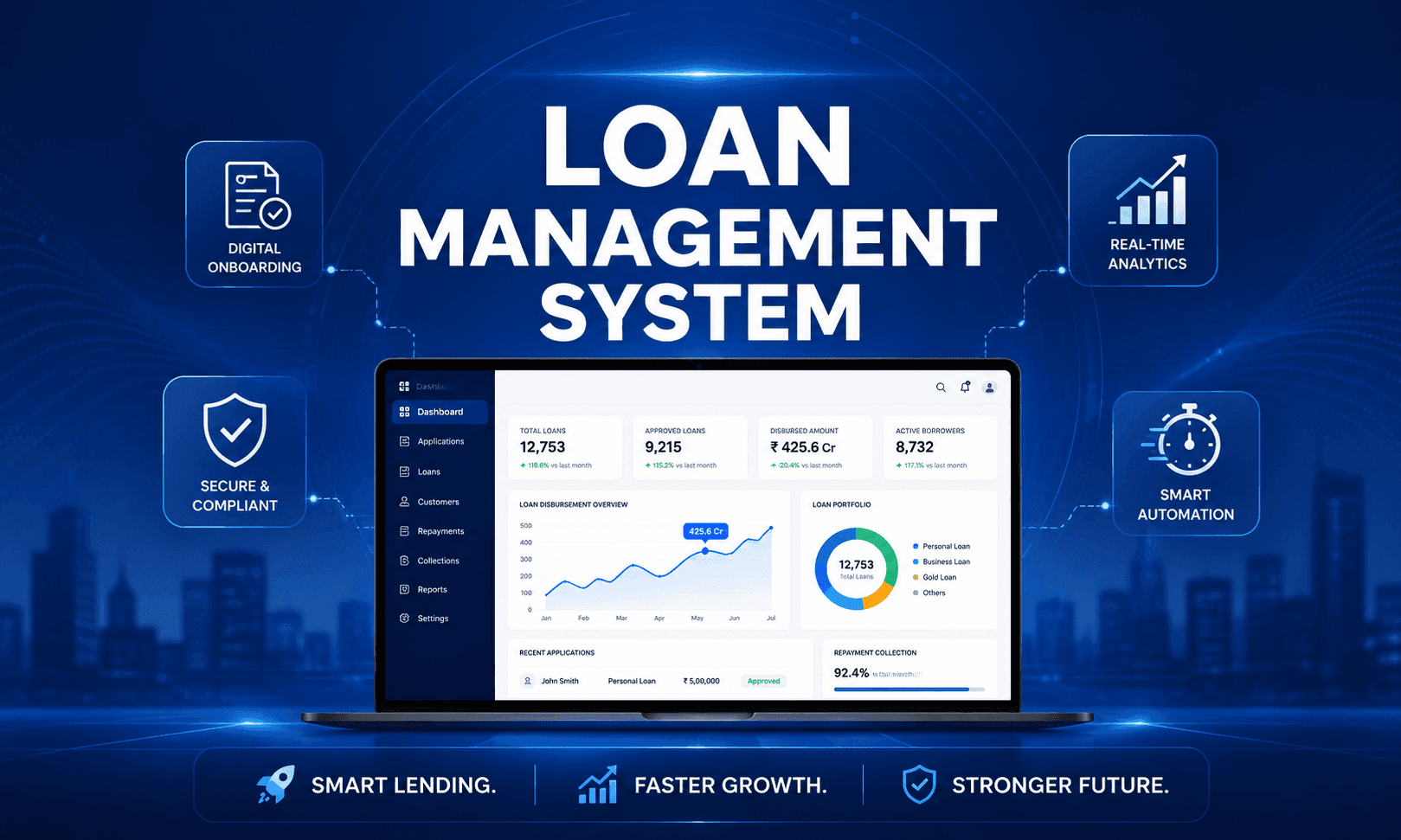
In today’s digital-first lending ecosystem, speed, compliance, customer experience, and operational efficiency are no longer optional — they are business-critical. Whether you are an NBFC, microfinance institution, fintech startup, cooperative bank, or enterprise lender, managing loans manually or through disconnected systems can severely impact growth and profitability.
This is where a modern Loan Management System (LMS) becomes a strategic asset.
A Loan Management System helps finance companies automate the entire lending lifecycle — from loan origination and underwriting to repayment tracking, collections, compliance, and reporting. More importantly, it enables CXOs and business leaders to scale lending operations while minimizing operational risks.
In this article, we’ll explore:
What a Loan Management System is
Key features every finance company should look for
Cost factors involved in LMS implementation
Business benefits for lenders and financial institutions
Why investing in the right LMS can future-proof your lending business
What is a Loan Management System?
A Loan Management System is a centralized digital platform that automates and manages the complete lifecycle of loans. It helps lenders streamline borrower onboarding, credit assessment, EMI tracking, repayment schedules, document management, customer communication, and collections.
Modern LMS platforms are designed to support multiple lending products such as:
For growing finance companies, an LMS is not just operational software — it is the backbone of scalable lending infrastructure.
Why Finance Companies Need a Modern Loan Management System
The lending industry is evolving rapidly. Customers expect faster approvals, digital onboarding, and seamless repayment experiences. At the same time, regulators are increasing compliance expectations while competition from fintech companies continues to rise.
Traditional loan processing methods create several challenges:
Manual paperwork and delayed approvals
Data inconsistencies across departments
Poor visibility into repayments and defaults
Compliance and audit risks
Higher operational costs
Inefficient collections management
Limited scalability
A robust Loan Management System addresses these issues by digitizing workflows and providing real-time operational visibility.
For CXOs, founders, CTOs, and IT leaders, adopting an LMS is now a strategic growth decision rather than merely a technology upgrade.
When evaluating an LMS platform, finance companies should focus on features that improve automation, customer experience, risk management, and operational efficiency.
1. Loan Origination & Application Management
A modern LMS should streamline the entire borrower onboarding process.
Key capabilities include:
Digital loan applications
KYC verification
Document upload and validation
Credit scoring integration
Eligibility assessment
Automated approval workflows
This significantly reduces loan processing time and improves customer experience.
2. Automated EMI & Repayment Tracking
Repayment management is one of the most critical components of lending operations.
An advanced Loan Management System enables:
Automated EMI calculations
Flexible repayment schedules
Interest computation
Late payment tracking
Auto-reminders through SMS/email/WhatsApp
Real-time payment reconciliation
This minimizes manual intervention while improving repayment efficiency.
3. Multi-Product Loan Management
Finance companies often offer multiple loan products with varying business rules.
An enterprise-grade LMS should support:
Multiple loan types
Configurable interest structures
Dynamic repayment models
Custom workflows
Product-specific compliance rules
This flexibility allows lenders to scale quickly without rebuilding systems repeatedly.
4. Collections & Recovery Management
Poor collections management directly impacts profitability and NPA levels.
A strong LMS includes:
Automated collection workflows
Delinquency tracking
Field collection management
Recovery allocation
Settlement management
Collection analytics dashboards
These features help reduce defaults and improve cash flow visibility.
5. Compliance & Regulatory Reporting
Regulatory compliance is increasingly complex for financial institutions.
An LMS should support:
Audit trails
Regulatory reporting
RBI/NBFC compliance requirements
Data security protocols
Role-based access controls
Digital documentation storage
This reduces compliance risk while improving governance.
6. Analytics & Executive Dashboards
Leadership teams need real-time visibility into lending operations.
Modern LMS platforms provide:
Loan portfolio analytics
Risk assessment dashboards
Collection performance reports
Branch-level KPIs
NPA monitoring
Customer behavior insights
For CXOs and business leaders, these insights support faster and smarter decision-making.
7. API Integrations & Ecosystem Connectivity
Today’s lending ecosystem relies heavily on third-party integrations.
An LMS should integrate with:
Credit bureaus
Payment gateways
Banking systems
Accounting software
CRM platforms
E-signature solutions
KYC/AML verification providers
API-first architecture ensures seamless digital lending operations.
Benefits of Loan Management System for Finance Companies
1. Faster Loan Processing
Automation dramatically reduces turnaround time from application to disbursement.
Finance companies can process higher loan volumes with fewer operational bottlenecks, improving both productivity and customer satisfaction.
2. Reduced Operational Costs
Manual loan management requires large operational teams and repetitive processes.
A Loan Management System minimizes:
Manual data entry
Paper-based workflows
Human errors
Administrative overhead
This leads to significant cost savings over time.
3. Improved Customer Experience
Borrowers today expect seamless digital experiences.
An LMS enables:
Faster approvals
Self-service customer portals
Real-time loan status tracking
Automated notifications
Digital repayments
Better customer experiences directly improve retention and brand trust.
4. Better Risk Management
Data-driven lending decisions help reduce defaults and improve portfolio quality.
Advanced LMS platforms offer:
Credit risk analysis
Early delinquency alerts
Fraud detection support
Predictive analytics
This helps lenders make informed risk decisions at scale.
5. Scalability for Growth
As lending operations grow, manual systems become difficult to manage.
A scalable Loan Management System allows finance companies to:
Expand geographically
Launch new loan products
Handle higher transaction volumes
Support multi-branch operations
Without scalable technology infrastructure, growth becomes operationally expensive.
6. Real-Time Business Visibility
Leadership teams require centralized visibility into operations, collections, and portfolio performance.
An LMS provides:
Centralized reporting
Real-time monitoring
Executive dashboards
Branch performance tracking
This enables faster strategic decision-making.
Loan Management System Cost: What Influences Pricing?
One of the most common questions finance companies ask is:
How much does a Loan Management System cost?
The answer depends on several business and technical factors.
1. Customization Requirements
Highly customized LMS platforms cost more than standard SaaS solutions.
Factors include:
Custom workflows
Product configurations
Industry-specific modules
Custom dashboards
Integration complexity
2. Deployment Model
There are typically two deployment approaches:
Cloud-Based LMS
Lower upfront investment
Faster implementation
Subscription-based pricing
Easier scalability
On-Premise LMS
Higher upfront cost
Greater infrastructure control
Preferred by some enterprise institutions
3. Number of Users & Branches
Pricing often scales based on:
User licenses
Branch locations
Loan volumes
Customer records
4. Integration Requirements
Integrating with external systems such as CRMs, accounting platforms, payment gateways, and credit bureaus increases implementation complexity and cost.
5. Security & Compliance Needs
Enterprise-grade security requirements such as:
Encryption
Audit logs
Compliance certifications
Data localization
can also impact overall LMS pricing.
Estimated LMS Pricing for Finance Companies
While pricing varies significantly, here’s a broad industry estimate:
LMS Type
Estimated Cost
Basic SaaS LMS
$5,000 – $20,000 annually
Mid-Sized Custom LMS
$25,000 – $100,000
Enterprise Loan Management System
$100,000+
The actual investment depends on business goals, loan complexity, integrations, and scalability requirements.
For finance companies, the focus should not only be on software cost but also on long-term ROI, operational savings, and scalability.
How to Choose the Right Loan Management System
Before selecting an LMS vendor, decision-makers should evaluate:
Business Alignment
Does the platform support your lending model and future growth plans?
Scalability
Can the system handle increased loan volumes and multi-product expansion?
Integration Readiness
Does it integrate smoothly with your existing ecosystem?
Security & Compliance
Does the platform meet regulatory and cybersecurity requirements?
User Experience
Is the interface intuitive for internal teams and borrowers?
Vendor Expertise
Does the technology partner understand the lending industry deeply?
Future Trends in Loan Management Systems
The future of lending technology is increasingly driven by AI, automation, and analytics.
Emerging LMS trends include:
AI-driven underwriting
Predictive risk analytics
Embedded finance capabilities
Hyper-personalized lending
Mobile-first lending experiences
Automated compliance monitoring
Open banking integrations
Finance companies that modernize early will gain a significant competitive advantage in operational efficiency and customer acquisition.
Final Thoughts
A modern Loan Management System is no longer optional for finance companies aiming to scale efficiently in a competitive lending environment.
From automating loan processing and repayment tracking to improving customer experience and compliance, the right LMS can transform lending operations end-to-end.
For CEOs, CTOs, founders, IT heads, and business leaders, investing in the right lending technology today means building a stronger, faster, and more scalable financial business for tomorrow.
Frequently Asked Questions
What is Loan Management System: Features, Cost & Benefits for Finance Companies?⌄
Discover how a Loan Management System helps finance companies automate lending, reduce operational costs, improve collections, and scale faster. Explore key features, pricing, and business benefits.