Clinic Management Software vs Hospital HMS in India: Features, Cost & Best Choice
In This Article
- 1. Clinic Management Software or Hospital HMS: Which Do You Need?
- 2. What Is Clinic Management Software?
- 3. What Does a Complete Hospital Management System Include?
- 4. Clinic Management Software vs Hospital HMS: Complete Comparison
- 5. Which Software Fits Your Healthcare Facility?
- 6. Clinic Software Cost vs Hospital HMS Price in India
- Recommended Phased Implementation
- 7. Before vs After Connected Healthcare Software
- 8. Cloud, On-Premises or Hybrid HMS?
- 9. ABDM, ABHA and Patient Data Security in India
- 10. How MSI Develops Clinic and Hospital HMS Platforms
- 11. MSI Healthcare Software Engineering Experience
- Conclusion: Choose the Right Healthcare Software Before Investing
Small Clinics with only 5 rooms will not require all modules of a hospital. Growing hospitals cannot be managed using only billing software.
Many Indian clinics and nursing homes have issues with fragmented patient records, manual scheduling, multiple billing systems and data duplication. But buying an expensive HMS without considering your needs can cause unnecessary costs.
It is important to understand the difference between clinic management software and hospital management systems.
No matter if you are running a clinic in Ranchi, nursing home in Patna or multi-speciality hospital in Kolkata, you will want to invest in the right software that will help you manage patients today and grow in the future.
1. Clinic Management Software or Hospital HMS: Which Do You Need?
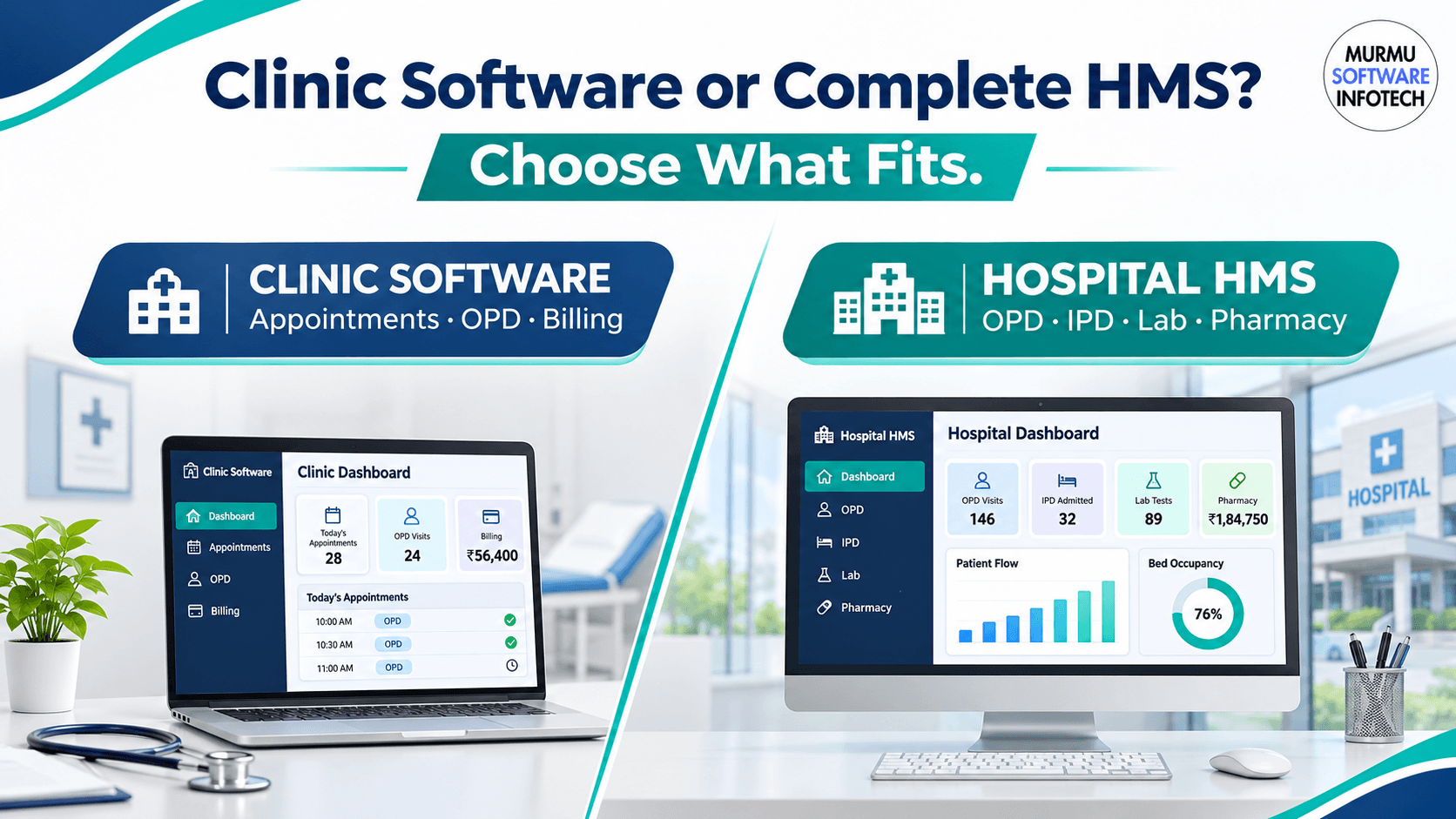
Quick Answer: Clinic management solutions typically include outpatient appointment, consulting, patient record keeping and billing features. Hospital HMS will also include inpatient admission, bed management, ward management, pharmacy, lab and multi-department features.
The deciding factor will be:
How complex the workflows are.
For an outpatient only facility a clinic solution could be adequate. If you have inpatient admissions and multiple departments then you will probably want to go for a more comprehensive HMS solution.
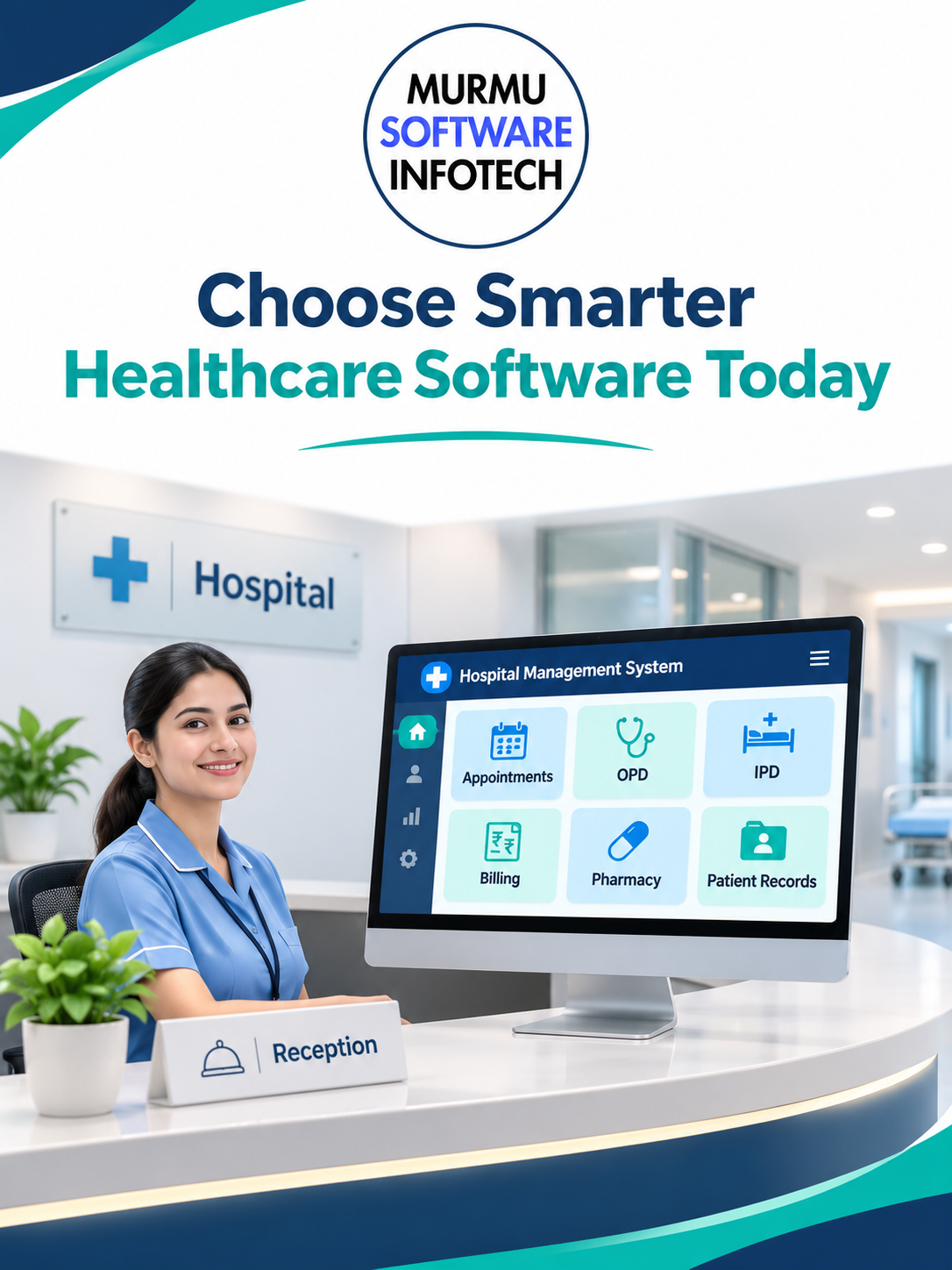
Choose Smarter Healthcare Software Today
Simplify appointments, OPD, IPD, billing, pharmacy and patient records with scalable clinic and hospital management software tailored to your healthcare facility.
2. What Is Clinic Management Software?
Clinic management software digitizes daily operations for small and medium-sized outpatient healthcare facilities.
Typical features include:
- Patient registration and medical records
- Doctor appointments and scheduling
- Consultation notes and prescriptions
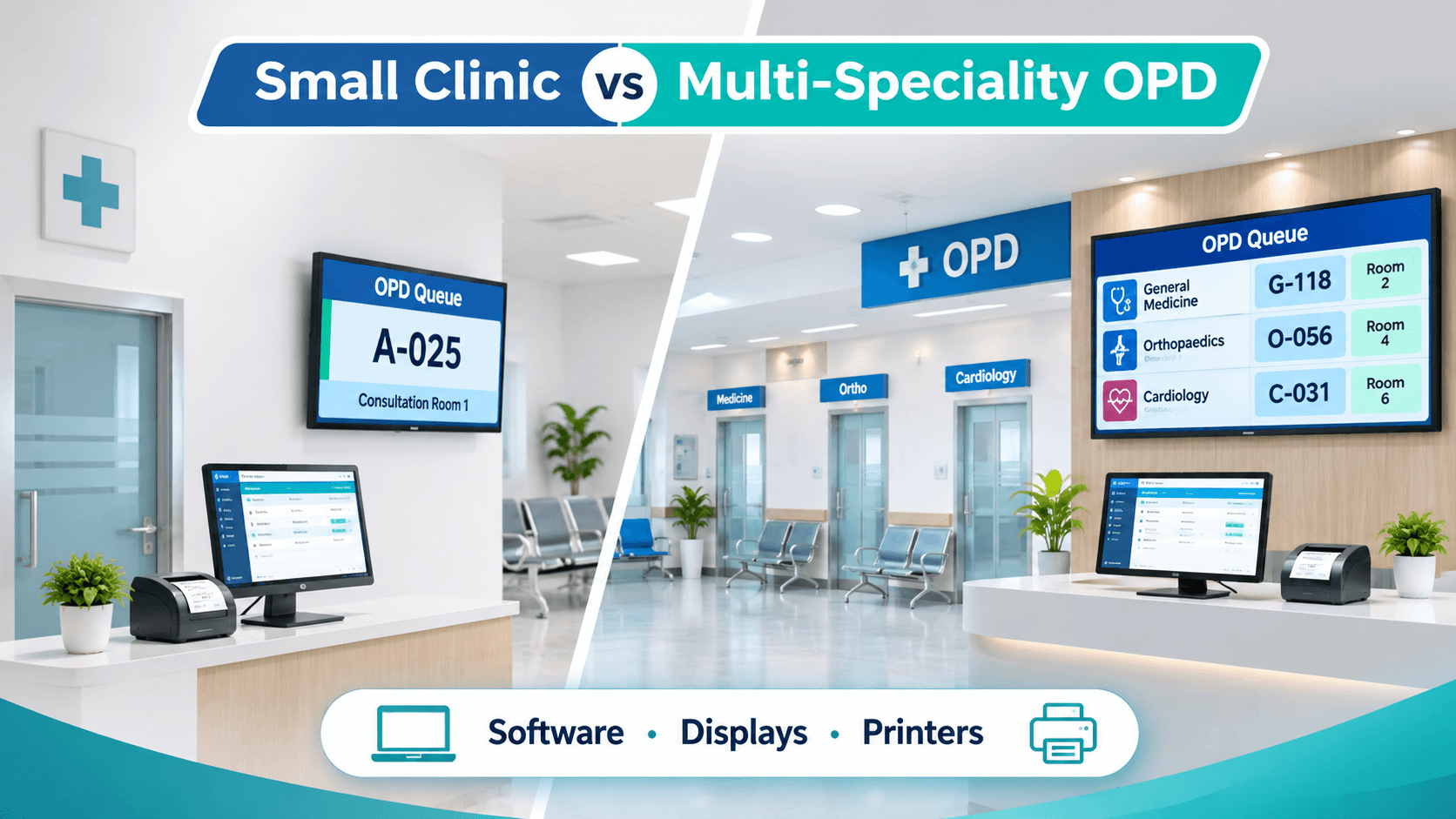
- OPD token and queue management
- Consultation billing and payment tracking
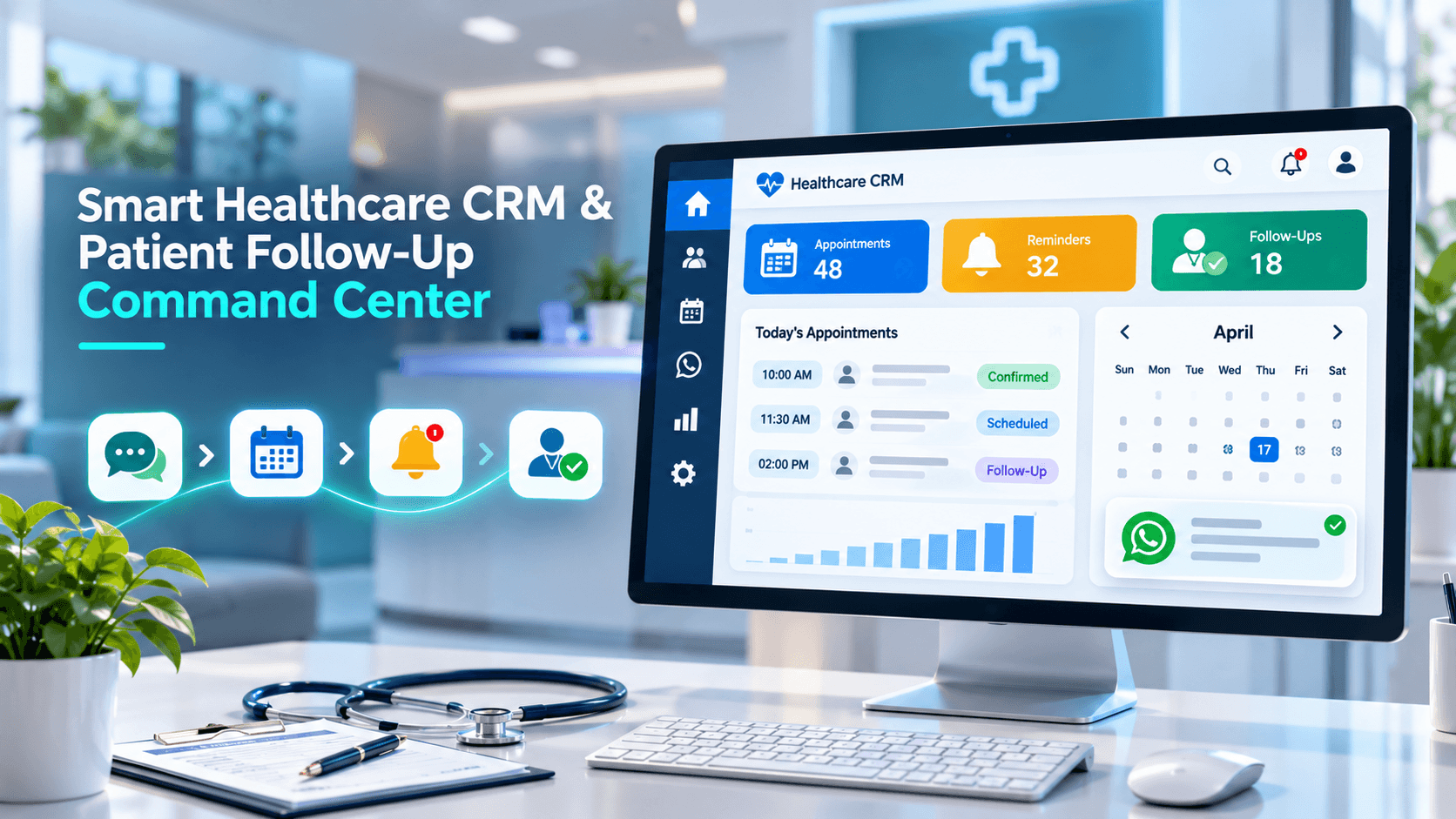
- Follow-up reminders and operational reports
For a single-doctor practice or multi-doctor clinic, these modules can replace disconnected registers and spreadsheets.
A well-scoped solution should remain simple for receptionists and doctors while allowing relevant integrations.
3. What Does a Complete Hospital Management System Include?
A Hospital Management System (HMS) connects clinical, administrative and financial operations across departments.
Depending on the hospital's scope, modules may include OPD and IPD management, admissions and discharges, bed allocation, electronic medical records, laboratory, pharmacy, inventory, billing, insurance workflows and management dashboards.
For example:
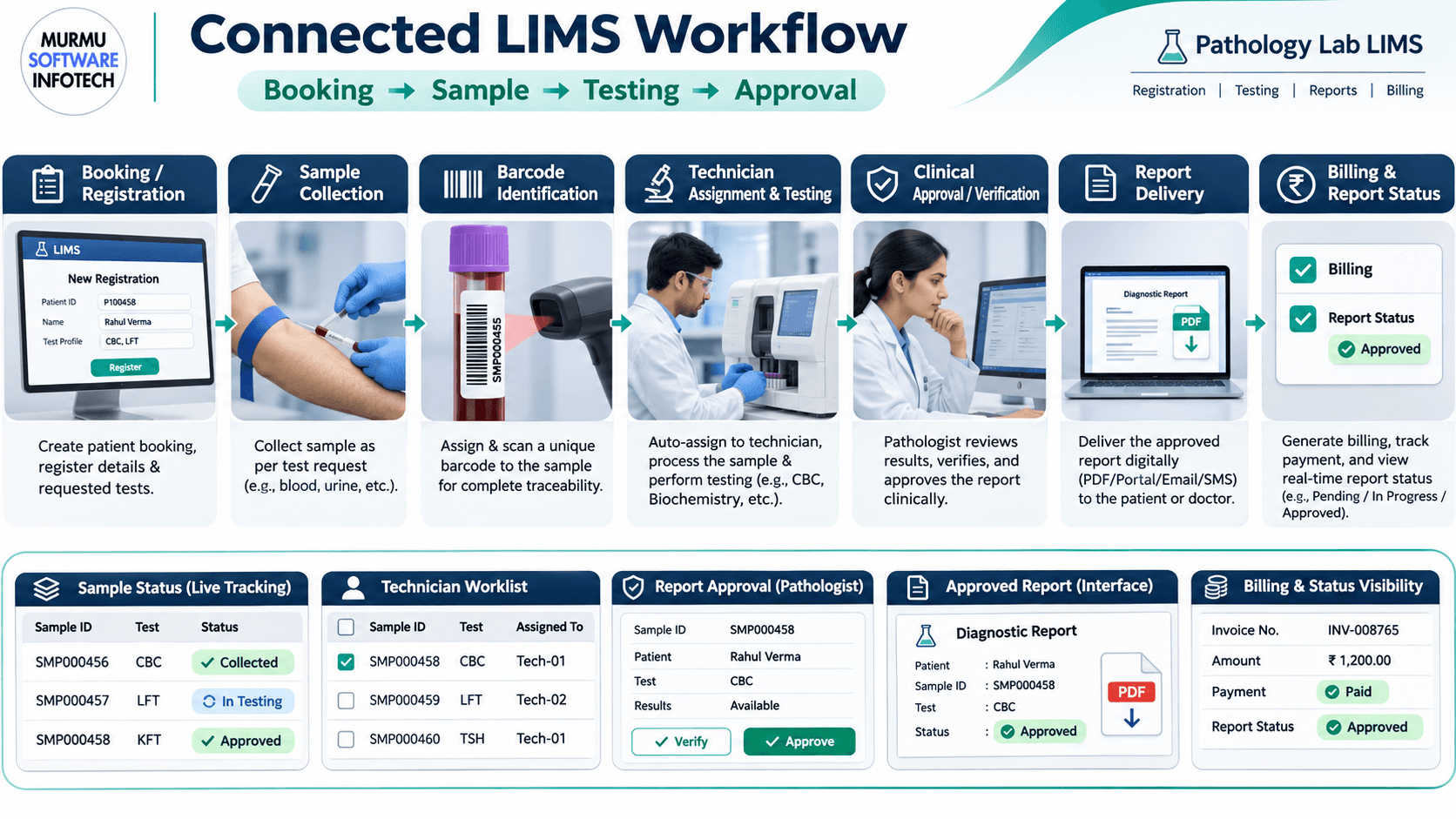
Registration → OPD Consultation → Laboratory → Pharmacy → Billing → Follow-Up
For admitted patients, the journey also includes bed assignment, nursing workflows, inpatient charges and discharge processes.
Explore MSI's Hospital Management Software Development Services for custom and modular HMS solutions.
Transform Your Healthcare Operations With Smart, Scalable Hospital Management Software
4. Clinic Management Software vs Hospital HMS: Complete Comparison
| Feature | Clinic Software | Hospital HMS |
|---|---|---|
| Best fit | Outpatient clinics | Hospitals and inpatient facilities |
| Registration | Core module | Core module |
| Appointments and OPD | Core module | Core department |
| Consultation records | As configured | Shared across departments |
| IPD and bed management | Usually unnecessary | Common requirement |
| Laboratory and pharmacy | Optional modules | Often integrated |
| Billing | Consultation and services | Multi-department billing |
| Staff access | Smaller teams | Multiple departments and roles |
| Implementation | Usually more focused | Potentially more extensive |
Key takeaway: Buy software based on required workflows, integration needs and expected growth not simply the number of features advertised.
5. Which Software Fits Your Healthcare Facility?
Single Doctor Clinic Registration Appointments Patient Consultation Prescriptions Billing
Multi Doctor Clinic Doctor Scheduling Role Based Access Queue Management Reporting
Nursing Home Patient Admissions Bed Allocation Pharmacy Lab Billing Discharge
Multi Speciality Hospital Integration of OPD/IPD Inventory Diagnostic Pharmacy Insurance Department Level Reporting
If your facility is likely to grow in the future then you should consider a solution that allows you to add more modules.
Not sure what modules you need?
Discuss Which HMS Modules You Actually Need
6. Clinic Software Cost vs Hospital HMS Price in India
The clinic software cost in India and hospital HMS price in India depend on implementation scope rather than a universal package price.
| Cost Factor | What to Evaluate |
|---|---|
| Software modules | Appointments, OPD, IPD, pharmacy, laboratory |
| Users and locations | Doctors, staff, departments and branches |
| Deployment | Cloud, on-premises or hybrid |
| Data migration | Existing patient and billing records |
| Integrations | Laboratory, payments, ABHA and other systems |
| Training and support | Go-live assistance, AMC and maintenance |
Murmu Software Infotech currently advertises focused HMS implementations starting from approximately ₹70,000.
This is an indicative starting scope, not a guaranteed price for a complete hospital installation. Hardware, additional modules, integrations and other services must be clarified in a detailed quotation.
Recommended Phased Implementation
Phase 1: Patient registration, appointments, OPD and billing.
Phase 2: Pharmacy, laboratory, inventory and IPD where required.
Phase 3: Patient CRM, mobile applications, analytics and additional integrations.
A phased approach helps healthcare facilities prioritize essential workflows and assess each release before expanding.
7. Before vs After Connected Healthcare Software
| Traditional Workflow | Potential Digital Workflow |
|---|---|
| Separate patient registers | Structured patient records |
| Manual appointment books | Connected doctor scheduling |
| Repeated patient data entry | Reusable registration details |
| Separate laboratory and billing records | Integrated departmental workflows |
| Manual management reports | Configured operational dashboards |
These are potential improvements after successful implementation, not guaranteed financial or clinical outcomes.
8. Cloud, On-Premises or Hybrid HMS?
Deployment architecture affects accessibility, maintenance, data protection and operating costs.
Cloud HMS: Supports remote access and centralized hosting, subject to secure connectivity and access controls.
On-premises HMS: Uses locally managed infrastructure and requires appropriate server maintenance, backups and disaster recovery.
Hybrid HMS: Combines selected local and cloud capabilities where supported by the architecture.
Hospitals should assess connectivity, encryption, role-based access, audit logs, backup recovery and data ownership before selecting deployment.
Smart Clinic & Hospital Software Solutions
Explore scalable clinic management, hospital HMS, patient workflows and digital automation.
402 KB
9. ABDM, ABHA and Patient Data Security in India
Indian healthcare facilities may wish to integrate ABDM and implement ABHA-enabled workflows.
This can allow you to identify patients, link records and securely share health data with their consent.
However, this doesn’t mean your software is ABDM compliant.
You will need to consider whether you are ready to integrate, what technical standards apply, patient consent, security testing and any regulatory requirements.
10. How MSI Develops Clinic and Hospital HMS Platforms
At Murmu Software Infotech (MSI), our approach starts with understanding how patients, doctors and administrative teams actually work.
Our recommended implementation process includes:
Workflow Assessment → Module Selection → System Architecture → Development & Integration → Testing → Training & Rollout
This helps define suitable modules, permissions, APIs, reporting needs and phased implementation milestones.
We support custom healthcare software planning for clinics, nursing homes and hospitals across Ranchi, Jamshedpur, Patna, Bhubaneswar, Kolkata, Raipur and India.
Discover the Right Clinic or Hospital Software Before You Invest
11. MSI Healthcare Software Engineering Experience
Our Hospital Management System Case Study describes patient registration, OPD workflows, appointments, doctor dashboards, billing, permissions and reporting.
Our separate DOC24 Telemedicine Platform Case Study covers doctor booking, virtual consultations and live clinic queues.
These examples demonstrate different healthcare engineering capabilities; they are not presented as one unified hospital deployment.
Conclusion: Choose the Right Healthcare Software Before Investing
The best healthcare software is not necessarily the system with the most modules. It is the system that supports your essential workflows and can grow with your facility.
For clinics, this may mean simple appointments, registration and billing. For hospitals, it may mean connected OPD, IPD, laboratory, pharmacy and administrative operations.
Murmu Software Infotech helps healthcare organizations evaluate requirements, define practical implementation scopes and plan appropriate software architecture.
Opening a clinic or upgrading your hospital software?
Start with the right modules, understand the implementation budget and choose a solution aligned with your patient journey.
Request Clinic / HMS Demo & Estimate
Frequently Asked Questions
What is the difference between clinic management software and a hospital management system?
Clinic management software primarily handles outpatient appointments, registration, consultations, patient records and billing. A Hospital Management System (HMS) supports broader workflows, including OPD, IPD, beds, departments, laboratory, pharmacy, inventory and hospital administration. The right choice depends on clinical operations, patient volume and integration requirements.
How much does clinic management software cost in India?
Clinic management software pricing in India depends on the number of doctors, users, locations, required modules, hosting, customization and ongoing support. A basic outpatient-focused system generally requires less implementation work than a comprehensive hospital HMS. Request a module-wise quotation covering setup and recurring costs.
What is the price of hospital HMS software in India?
Hospital HMS pricing varies according to OPD, IPD, laboratory, pharmacy, billing, integrations, users and deployment complexity. Murmu Software Infotech advertises focused HMS projects starting from approximately ₹70,000. This is an indicative starting scope, not a fixed price for complete multi-department software, hardware or integrations.
Which is better for a small clinic: clinic software or hospital HMS?
Clinic management software is generally more suitable for outpatient-only clinics requiring appointments, consultation records, prescriptions, basic billing and patient follow-ups. A complete HMS becomes relevant when inpatient admissions, bed management, complex departmental billing or broader hospital operations are required.
What software should a nursing home use?
A nursing home should select software based on the services it operates. Outpatient-only facilities may use clinic management software, while nursing homes with admissions, beds, inpatient billing, pharmacy and laboratory workflows often need hospital HMS modules. A requirements assessment helps identify essential features.
Can clinic management software be upgraded to a hospital HMS?
Yes, if the existing software architecture supports modular expansion, suitable APIs and reliable data migration. Modules such as IPD, bed management, pharmacy, laboratory and advanced reporting may be added in phases. Some legacy systems may require significant redevelopment or replacement.
What modules should a multi-speciality hospital HMS include?
A multi-speciality hospital may require patient registration, appointments, OPD, IPD, bed management, electronic medical records, laboratory, pharmacy, inventory, departmental billing, insurance workflows, role-based permissions and operational reporting. Modules should be selected according to the hospital's actual services.
Does hospital management software support ABDM and ABHA integration?
Hospital management software can support ABDM and ABHA-related workflows when the required integrations, patient-consent processes, security controls and validation steps are implemented. ABDM compliance should not be assumed from a general product feature list. Integration feasibility requires technical and regulatory assessment.
Is cloud-based HMS better than on-premises hospital software?
Cloud HMS offers centrally hosted access and managed infrastructure, while on-premises deployment provides locally controlled hosting. Hybrid deployment may combine selected capabilities. The best option depends on internet reliability, infrastructure, security requirements, backups, data ownership and maintenance resources.
How long does clinic software or hospital HMS implementation take?
Implementation timelines depend on modules, customization, integration complexity, migration, testing and staff training. A focused clinic system generally requires less work than a multi-department hospital platform. Murmu Software Infotech recommends phased implementation with workflow assessment, development, testing, training and rollout.